Siemens has a booth at CES 2025. I imagine the attendees, most of them electronic gadget lovers, think Siemens a company on a mission to save the world judging from the exhibits. Indeed, many of Siemens’ exhibits emphasize sustainability. The booth is big by CAD show standards. It has a 2nd floor! However, none of the ground-level displays convey the true Siemens: a global manufacturing conglomerate that makes trains, giant wind turbines, power plants, engineering software, and more.
Perhaps sensing the crowd at CES would have no appetite for their manufacturing prowess; Siemens went forward with what is becoming their secondary initiative: sustainability. Smart. Staffing the booth with young, environmentally conscious employees who took the company’s sustainability-minded customers seriously: even smarter.
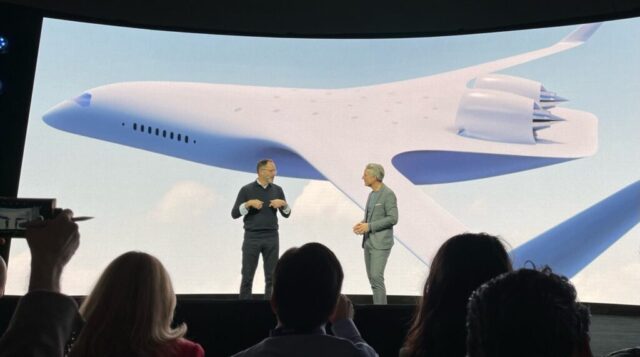
First and most impressive is JetZero, a wide-body blended-wing aircraft meant for commercial flights. It’s not the actual aircraft, mind you, though I would not be surprised if a future CES would roll one onto the parking lot of the Las Vegas Convention Center, the main venue of CES. This year’s show has only smaller aircraft.
JetZero’s goal is to eventually run on green hydrogen. The company’s name is derived from Net Zero and the current design is halfway to Net Zero. The blended wing design accommodates a cabin wider than the widest body flying these days. The cabin has more room and, depending on cabin configurations, should supply more comfort for passengers. The double-deck cabin avoids the tunnel-like interior of aircraft, resembling more the interior of a small ship.
How will JetZero manage to build an aircraft without a tubular fuselage that can withstand the pressure difference at altitude? We don’t know at this point.
JetZero uses NX, Siemens’ enterprise CAD software. They were using Sony’s new headset to walk around virtually inside the aircraft model.
Spinnova creates clothes with 97% less water and with74% reduction of carbon emissions compared to other clothing manufacturers. This is due to a “machine-based,” rather than a “water-based” process. A cotton shirt, for example, gets cotton from a plant that takes water to grow and be productive. It takes almost no water to shred the worn-out shirt and make another shirt. The name Spinnova may be derived from either “spin innovation” or “spin over.” Either way: genius.
A scale model of Siemensstadt, or Siemens City, is the company’s new headquarters. The main building, Siemensstadt Square, has been awarded platinum status for being carbon neutral by the German Sustainable Building Council, DGNB.
The Wayout water treatment plant is contained in a standard 20 ft container so it can be transported easily. Once installed on site, it can produce enough clean water for 3,00 people, according to the company website. It gets all its power from the sun. All a water treatment company (water treatment companies are Wayout’s target customers) has to do is set it up near polluted water, and the Wayout plant goes to work. It can treat anything from gray water (such as from sinks and washing machines) to saltwater to sewage. How exactly it manages this, whether micro sieves, reverse osmosis, distillation or a combination, is yet to be explained.
Desertification, the process by which fertile soil becomes unproductive sand, happens naturally but has accelerated due to global warming. Large parts of Africa are becoming part of the Sahara Desert, for example, and creating humanitarian crises. The soil, devoid of organic material, turns into sand and is unable to retain the water from the little rain that falls so nothing grows. Desert Control has a solution. By mixing its proprietary Liquid Natural Clay with the sand, the ground is once again able to retain the water long enough for plants to grow. LNC is natural minerals electrically charged particles of natural minerals.
Siemens held a press conference at Mandalay Bay and has constructed a mini-Siemens City at the Las Vegas Convention Center, where CES 2024 is mostly held. (It seems the vast event covers the entire Strip.) This year, CTO and Paul-Newman lookalike Peter Koerte opened to applause. I must say CES draws an extremely well-behaved and polite audience. The crowd at CAD events tends to have more of a “show me” attitude. Koerte does not disappoint. He is polished, poised and relatable. I had to wonder if he was a real CTO. Actually, he is more than a CTO. He is also a member of Siemens’ board of directors and their chief strategy officer.
Siemens, in keeping with all others at CES and the last year of conferences, led with a discussion of AI. Their spin on AI, however, was that Siemens alone had industrial AI.
Large language models like ChatGPT learn on text data, and they are, surprisingly enough, running out of data, says Koerte. Meanwhile, industry has a never-ending supply of data. So much data is streaming from sensors from manufacturing operations, IoT devices, monitoring equipment and the like.
Now, imagine being able to combine natural language prompts with industrial AI to diagnose problems. “Why is this robot missing every 5th weld?” for example.
Koerte explained what Siemens, a global manufacturer, was doing at CES, a show normally associated with the gadgets. Siemens was basically the wizard behind the curtain, Koerte explained. All of the CES 2025 keynote companies are either designed with Siemens software or are partners of Siemens. All the auto manufacturers, many of whom were displaying their latest technology at CES, use Siemens products. So did many of the consumer product companies, some of whom have a bigger footprint at the show, such as Sony, LG and Samsung.
Koerte made additional announcements. (See full announcement.)
1. JetZero will be using Siemens applications. The innovative blended-wing commercial jet is sure to get Siemens some attention. JetZero’s CEO, Tom O’Leary joined Koerte on stage to thank Siemens for creating a platform that will help JetZero be the first all-digital aircraft. While Boeing 777 was the first aircraft to be designed completely with CAD (CATIA), JetZero’s aircraft will be designed, manufactured and maintained using the Siemens Xcelerator platform.
JetZero’s name suggests Net Zero and the aircraft gets halfway there, reducing carbon emissions by 50%.
2. Siemens for Startups. Siemens will offer 90% discounts on software to startups in their first year, 80% in the second year and 70% in the third year.
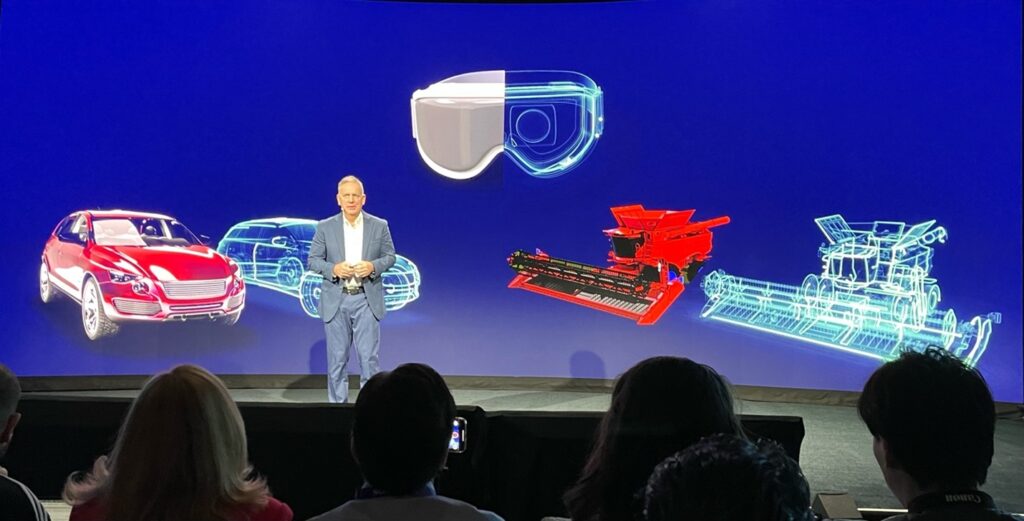
3. The Sony XR head-mounted display. Apple may have lost interest in XR, stopping production on its XR, headset but Siemens thinks an XR headset, if made right, would be great for immersive viewing. “Your used to have to do this with CAVEs,” says Tony Hemmelgarn, president and CEO of Siemens Digital Industries.
4. NVIDIA collaboration. The Teamcenter Digital Reality Viewer will be powered by NVIDIA’s Omniverse technology.
5. Designcenter. Hemmelgarn joined Koerte onstage to announce the Designcenter suite, which will include Solid Edge and NX. Both will use one data file format. Could this be the happy ending to the Solid Edge story, with the parent Siemens finally adopting Solid Edge, which it once kept under the stairs, and telling its favorite child, NX, to play nice?
Siemens, by being a big presence at CES, while its competitors in design software, stayed home, is establishing itself as a technology leader. Jensen Huang, CEO of NVIDIA and today’s tech darling said Siemens had become the operating system of the industry.
LAS VEGAS, NV (CES), Jan 7, 2025 – NVIDIA announced generative AI models and blueprints that expand NVIDIA Omniverse integration further into physical AI applications such as robotics, autonomous vehicles and vision AI. Global leaders in software development and professional services are using Omniverse to develop new products and services that will accelerate the next era of industrial AI.
Accenture, Altair, Ansys, Cadence, Foretellix, Microsoft and Neural Concept are among the first to integrate Omniverse into their next-generation software products and professional services. Siemens, a leader in industrial automation, announced today at the CES trade show the availability of Teamcenter Digital Reality Viewer — the first Siemens Xcelerator application powered by NVIDIA Omniverse libraries.
“Physical AI will revolutionize the $50 trillion manufacturing and logistics industries. Everything that moves — from cars and trucks to factories and warehouses — will be robotic and embodied by AI,” said Jensen Huang, founder and CEO at NVIDIA. “NVIDIA’s Omniverse digital twin operating system and Cosmos physical AI serve as the foundational libraries for digitalizing the world’s physical industries.”
New Models and Frameworks Accelerate World Building for Physical AI
Creating 3D worlds for physical AI simulation requires three steps: world building, labeling the world with physical attributes and making it photoreal.
NVIDIA offers generative AI models that accelerate each step. The USD Code and USD Search NVIDIA NIM microservices are now available, letting developers use text prompts to generate or search for OpenUSD assets. A new NVIDIA Edify SimReady generative AI model can automatically label existing 3D assets with attributes like physics or materials, enabling developers to process 1000 3D objects in minutes instead of over 40 hours manually.
NVIDIA Omniverse, paired with new NVIDIA Cosmos world foundation models, creates a synthetic data multiplication engine — letting developers easily generate massive amounts of controllable, photoreal synthetic data. Developers can compose 3D scenarios in Omniverse and render images or videos as outputs. These can then be used with text prompts to condition Cosmos models to generate countless synthetic virtual environments for physical AI training.
NVIDIA Omniverse Blueprints Speed Up Industrial, Robotic Workflows
During the CES keynote, NVIDIA also announced four new blueprints that make it easier for developers to build Universal Scene Description (OpenUSD)-based Omniverse digital twins for physical AI.
The blueprints include:
Mega, powered by Omniverse Sensor RTX APIs, for developing and testing robot fleets at scale in an industrial factory or warehouse digital twin before deployment in real-world facilities.
Autonomous Vehicle (AV) Simulation, also powered by Omniverse Sensor RTX APIs, that lets AV developers replay driving data, generate new ground-truth data and perform closed-loop testing to accelerate their development pipelines.
Omniverse Spatial Streaming to Apple Vision Pro that helps developers create applications for immersive streaming of large-scale industrial digital twins to Apple Vision Pro.
Real-Time Digital Twins for CAE, a reference workflow built on NVIDIA CUDA-X acceleration, physics AI and Omniverse libraries that enables real-time physics visualization.
Market Leaders Supercharge Industrial AI Using NVIDIA Omniverse
Global leaders in software development and professional services are using Omniverse to develop new products and services that are poised to accelerate the next era of industrial AI.
Building on its adoption of Omniverse libraries in its Reality Digital Twin data center digital twin platform, Cadence, a leader in electronic systems design, announced further integration of Omniverse into Allegro, its leading electronic computer-aided design application used by the world’s largest semiconductor companies.
Altair, a leader in computational intelligence, is adopting the Omniverse blueprint for real-time CAE digital twins for interactive computational fluid dynamics (CFD). Ansys is adopting Omniverse into Ansys Fluent, a leading CAE application. Neural Concept is integrating Omniverse libraries into its next-generation software products, enabling real-time CFD and enhancing engineering workflows.
Accenture, a leading global professional services company, is using Mega to help German supply chain solutions leader KION by building next-generation autonomous warehouses and robotic fleets for their network of global warehousing and distribution customers.
AV toolchain provider Foretellix, a leader in data-driven autonomy development, is using the AV simulation blueprint to enable full 3D sensor simulation for optimized AV testing and validation. Research organization MITRE is also deploying the blueprint, in collaboration with the University of Michigan’s Mcity testing facility, to create an industry-wide AV validation platform.
Katana Studio is using the Omniverse spatial streaming workflow to create custom car configurators for Nissan and Volkswagen, allowing them to design and review car models in an immersive experience while improving the customer decision-making process.
Innoactive, an XR streaming platform for enterprises, used the workflow to add platform support for spatial streaming to Apple Vision Pro. The solution enables Volkswagen Group to conduct design and engineering project reviews at human-eye resolution. Innoactive also collaborated with Syntegon, a provider of processing and packaging technology solutions for pharmaceutical production, to enable Syntegon’s customers to walk through and review digital twins of custom installations before they are built.
To address traffic and safety concerns in Richmond Township, Berks County, Pennsylvania, Michael Baker provided preliminary and final highway design, post-design and environmental services for the S.R. 0222, Section 19S roundabout. Image: Michael Baker International
To address traffic and safety concerns in Richmond Township, Berks County, Pennsylvania, Michael Baker provided preliminary and final highway design, post-design and environmental services for the S.R. 0222, Section 19S roundabout. Image: Michael Baker International
PITTSBURGH, PA, Jan 7, 2025 – Michael Baker International has announced that the firm’s portfolio company, Akela Engineering and Consulting, has merged with Michael Baker’s Sustainable and Resilient Solutions (SRS) business vertical. The SRS vertical encompasses the firm’s current mechanical, electrical and plumbing (MEP), structural engineering, telecommunications, cybersecurity, fire protection and architectural services.
The merging of Akela, a national MEP+ firm with deep expertise in California, into Michael Baker offers clients holistic, smart and resilient building solutions across market sectors. The combined team will continue to partner with clients to achieve the highest levels of building design, comfort, safety and energy efficiency.
The action strengthens Michael Baker’s position as the firm focuses on growing private sector work in San Diego and the Southern California region and nationally with the broader SRS team. The Akela portfolio of projects, clients and capabilities will make an immediate contribution to the growth of the SRS vertical with private sector clients. This will allow the company to deliver significant growth over the next five years and bring the full suite of Michael Baker services and capabilities to support private sector clients in various markets. The firm plans to expand in sectors including Industrial, Defense OEMs, Aerospace, Data Centers, Semiconductors, Life Sciences, Energy Transition, Higher Education and Healthcare.
“With growth in the MEP space continuing to accelerate, concentrating our Akela and SRS teams into one cohesive entity strengthens our ability to expand our client base and position ourselves to deliver complex smart and resilient buildings, something only a full-service engineering firm can do well,” said Pankaj Duggal, president, Sustainable and Resilient Solutions at Michael Baker International. “The merger will continue to strengthen our competitive position in the growing MEP engineering and consulting market since acquiring and uniting Michael Wall Engineering and DEC Engineers in 2022 to form Akela. This combined team also allows us to offer our clients access to even more expertise and services as we support their businesses and enables us to create and embrace new opportunities that enhance our pursuit of larger, more complex MEP projects.”
Adding the expertise of Akela team members to Michael Baker’s SRS vertical provides its combined client base with greater access to the depth of resources, best practices and subject matter expertise across Michael Baker’s 4,900 colleagues in more than 20 practices and specialty practices located across more than 90 offices in the U.S.
BAD HOMBURG, Germany, Jan 7, 2025 – Maxon has announced Laubwerk GmbH joining the creative community. Laubwerk is a CG software company that creates customizable 3D plant models for architects, CG artists, and VFX experts.
This initiative is part of Maxon’s ongoing Capsules project, that aims to provide content creators with assets to jumpstart creativity and realize their visions. Following Maxon’s integration with Laubwerk, subscribers will have a broader range of assets available in the future.
David McGavran, CEO of Maxon, said, “With the Laubwerk team joining Maxon, they bring synergies that will result in even greater innovation in our products and enhanced creative possibilities for artists. Laubwerk’s vast library of plants and trees, some of which we already added to Maxon One as part of our long-standing partnership, is widely used by artists working in architectural visualization and visual effects. Their solutions and extensive experience will be instrumental in supporting our efforts to accelerate artist’s workflows by delivering ready-to-use, parametric assets to help kickstart their projects.”
Philip Losch, chief technology and product officer at Maxon, commented, “The acquisition of Laubwerk is a natural and exciting extension of our long-standing partnership. Their expertise in high-quality 3D plant modeling complements our own technologies perfectly. Together, we can enhance the creative capabilities and workflows of our users around the world.” Philip Paar, CEO and founder of Laubwerk, remarked, “Laubwerk’s mission has always been to create the most authentic, versatile, easy to use digital plant models, grounded in the expertise of experienced landscape architects and botanical experts. Our previous collaboration with Maxon has been incredibly rewarding and our relationship has always been characterized by a shared passion for innovation and a commitment to enhancing the creative process for digital artists. Joining forces with Maxon allows us to leverage their extensive resources and reach, enabling us to elevate our offerings and continue pushing the envelope in 3D plant modeling and visualization. We look forward to the incredible new possibilities this union will bring to the industry.”
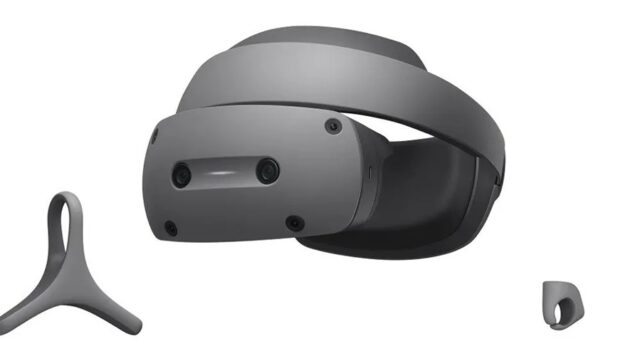
Sony Group has received CES Innovation Award 2025 for “XR Head-Mounted Display SRH-S1”. This headset is designed for diverse spatial content experiences. It features a 4K micro OLED panel that provides clear and detailed visuals. The Sony XR Head-Mounted Display SRH-S1 headset is suitable for creators and professionals working with interactive 3D objects.
The headset supports mixed reality creation with video see-through functionality, allowing users to view both physical and virtual environments simultaneously. It is powered by the Snapdragon XR2+ Gen 2 Platform, Qualcomm’s latest XR processor, offering effective performance for immersive experiences.
Designed for comfort and stability during long use, the headset has balanced weight distribution and made up of quality materials. The flip-up mechanism lets users switch between physical and virtual space.
Peter Koerte, Member of the Managing Board, chief technology officer and chief strategy officer, Siemens AG at CES 2025, Las Vegas. Image: Siemens
Peter Koerte, Member of the Managing Board, chief technology officer and chief strategy officer, Siemens AG at CES 2025, Las Vegas. Image: Siemens
LAS VEGAS, NV and MUNICH, Germany, Jan 7, 2025 – Siemens has presented its vision for the future where data, AI and software-defined automation will converge to enable unprecedented flexibility, optimization and continuous improvement across the world’s industries, for companies of any size. This ambition is at the heart of Siemens’ presence at CES 2025, the world’s most influential tech event. Siemens – the global leader in industrial software –demonstrated how its technologies are empowering customers to take bold leaps in industrial innovation.
“Industrial AI is a game-changer that will create significant positive impact in the real world across all industries. Industrial AI allows us to harness the vast amounts of data generated in industrial environments and turn it into insights that drive real business impact. We are adding new industrial AI capabilities across the Siemens Xcelerator portfolio to enable our customers to stay competitive, resilient and sustainable in an increasingly complex world,” said Peter Koerte, Member of the managing board, chief technology officer and chief strategy officer, Siemens AG.
Siemens is bringing Industrial AI directly to the shop floor with the new Siemens Industrial Copilot for operations, enabling AI tasks to run as close as possible to machines. This facilitates rapid, real-time decision making for shop floor operators and maintenance engineers, boosting productivity, operational efficiency and minimizing downtime. The Siemens Industrial Copilot ecosystem is continuously evolving to offer AI capabilities across the industrial value chain and into sectors including discrete and process manufacturing, infrastructure, and mobility. This suite of copilots can enhance human-machine collaboration across all experience levels, helping to accelerate development times and innovation cycles. The Siemens Industrial Copilot will be integrated with the Industrial Edge ecosystem, which has been enhanced with AI for deploying, operating and managing AI models within the production environment.
JetZero Selects Siemens Xcelerator Platform
Blended wing aircraft by JetZero. Image: SiemensDuring Siemens’ press conference at CES 2025, the company announced an agreement with JetZero, a pioneering aviation startup working to build the future of sustainable air travel, to collaborate on the development and production of JetZero’s revolutionary blended wing aircraft. The innovative blended wing design aims to improve fuel efficiency by 50 percent, reduce noise and deliver the promise of zero carbon emissions by 2035. JetZero will leverage the Siemens Xcelerator open digital business platform to design, manufacture and operate their new aircraft.
JetZero is planning to build “Factory of the Future”, a new greenfield factory in the United States where they intend to tightly integrate Siemens’ automation hardware, software and services to help it achieve its remarkably ambitious vision encompassing electrification, automation and digitalization of both the aircraft and its production. The JetZero aircraft and its associated manufacturing operations will be simulated virtually using comprehensive digital twins – enabling the company to de-risk the manufacturing process, validate the approach and scale processes long before any ground is broken or jets take to the skies.
“Siemens is giving us the confidence to take a leap, not just a step, in revolutionizing air travel,” said JetZero CEO Tom O’Leary. “Their digital twin and industrial metaverse technologies will be instrumental in helping us design, build and operate the world’s first fully digital aircraft, delivering a better experience for passengers and airlines while also reducing fuel consumption by 50 percent.”
Siemens Democratizes Industrial Tech for Startups
Siemens’ presence at CES also highlighted the company’s commitment to enabling startups and companies of all sizes to use its industrial metaverse technologies. Through the new Siemens for Startups program, innovators of any size have access to the intelligence, ecosystems and technologies they need to turn their big ideas into world-changing innovations. Siemens is providing access to venture partnering and clienting services along with dramatically reduced cost access to software and hardware from the Siemens Xcelerator open business platform. In addition, Siemens is collaborating with Amazon Web Services to offer AWS credits, business development resources and access to the AWS Activate program for technical and go-to-market support.
Collaborating with NVIDIA to Bring Photorealism to PLM
Together with NVIDIA, Siemens announced new additions to the Siemens Xcelerator open digital business platform, including the Teamcenter Digital Reality Viewer powered by NVIDIA Omniverse, which brings large-scale, physically based visualization directly into the product lifecycle management (PLM) system. This capability also enables teams to collaborate in a secure, digital twin environment using their live 3D data, reducing errors and data discrepancies while streamlining workflows and decision-making.
“Our continued collaboration with NVIDIA will be transformative for our customers, empowering them to virtualize and visualize product and plants like never before. Bringing together the best-in-class capabilities of each company, we’re equipping customers with the tools they need to make informed decisions, optimize their operations and accelerate their digital transformation,” said Koerte.
Enabling Immersive Engineering with Sony
In collaboration with the Sony Corp., Siemens is delivering a new solution for immersive engineering that brings together Siemens NX software for product engineering with a breakthrough head-mounted display from Sony to enable content creation for the industrial metaverse. Now available for pre-order and shipping beginning in February, Siemens’ new Immersive Engineering toolset brings the power of mixed reality to the product engineering and manufacturing community, enabling high-fidelity mixed reality and 3D-focused collaboration.
“In the era of digital twins, Siemens and Sony have collaborated closely to bring NX Immersive Designer to market. With 4K OLED Microdisplays, intuitive controls and the comfortable design, closely integrated with Siemens’ advanced software, we firmly believe this new immersive engineering solution will pave the way for the future of engineering.” said Seiya Amatatsu, Incubation Center, XR Technology Development Division, Sony Corp.
Introducing DesignCenter for Product Engineering
Koerte was joined on stage at CES by Tony Hemmelgarn, president and CEO, Siemens Digital Industries Software, to unveil Siemens’ new Designcenter software suite, which brings together its portfolio of design and engineering software including Solid Edge and NX software in one unified offering so that companies of any size can design and collaborate using the industry-leading Parasolid modeling kernel.
“A lot of companies make their design software available to small businesses or to the very largest enterprises. Designcenter is unique in that it is truly open and accessible for everyone – companies of every size can scale with the same solution set, their data in the same format – without interruption,” said Hemmelgarn.
Technology to Transform the Everyday
At the Siemens booth in the North Hall of the Las Vegas Convention Center, Siemens is showcasing how its technology transforms the everyday, for everyone, through examples of solutions created by Siemens and its customers that impact personal, local and global communities. In addition to JetZero , these examples include:
Spinnova is a Finnish technology company that enables circularity in textile manufacturing with sustainable and chemical-free fabric production using Siemens’ Digital Twin technologies and factory automation.
Wayout International , a Swedish water technology company developing a proprietary drinking water production solution to improve personal health and well-being in daily life using Siemens’ edge computing, digital twin technologies and Insights Hub, the industrial IoT as a service solution from Siemens.
Desert Control is a Norwegian startup aiming to revolutionize sustainable agriculture and urban greening in regions suffering from desertification, fostering agricultural prosperity and healthy green space using Siemens’ Industrial Operations X.
Arc is an American company focused on the electrification of the marine industry and making boating more modern, enjoyable, and sustainable using Siemens’ NX, Teamcenter and Simcenter STAR-CCM+ software.
Just when you thought car ownership was on its way out and most of the current generation were perfectly content in using Uber when they needed a ride, along comes DTS, Inc., a subsidiary of Xperi Inc. with “Vehicle Ownership and its Role as a Third Space: Alive, Well and Enduring.” The study confirms the importance of owning a personal vehicle. It highlights the evolving role of vehicles as a third space, separate from home and work, for relaxation and personal time.
Based on a survey of 3,217 U.S. vehicle owners, the report reveals that 92% consider their personal vehicle essential. Luxury car owners and Gen Z respondents were most likely to view their vehicles as third spaces. Notably, 61% of participants imagine their cars as extensions of their living rooms or offices.
Key findings include a growing demand for comfort and personalization. Improved physical comfort, personalized settings, voice controls, expanded entertainment options, and auto-pay functionalities were highlighted as desirable changes.
People use vehicles for entertainment more than before. Audio remains a primary focus, with 88% of respondents regularly listening to music or radio. Video consumption has increased significantly, from 31% in 2022 to 47% in 2024, mainly for short-form content when parked or on long road trips.
Stress relief is another significant factor. Over 40% of respondents spend at least 30 minutes in their vehicle for personal time, while 30% park in quiet areas to relax. Additionally, 29% have taken drives without a destination to clear their heads.
These findings indicate that car manufacturers need to improve comfort, personalization, and entertainment choices to keep vehicles attractive, especially to younger individuals.
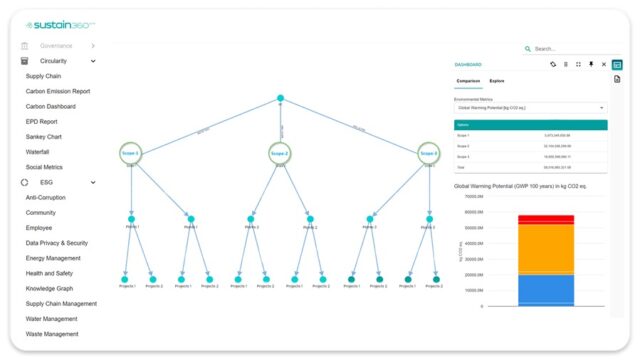
Carbon pathways via knowledge graphs (image source: Sustain360° website)
Carbon pathways via knowledge graphs (image source: Sustain360° website)
HUNTSVILLE, AL, Jan 6, 2025 – Sustain360° has announced its integration with Autodesk Construction Cloud, a portfolio of software and services that combines advanced technology, a builders’ network and predictive insights for construction teams.
The new integration allows project stakeholders to import 3D Revit models from Autodesk Build or Autodesk Docs directly into Sustain360° to evaluate building materials and carbon emissions at the earliest stages of project design.
Conceptual design decisions determines a project’s environmental footprint, and allows architects and designers to:
Evaluate carbon emissions at the design phase.
Identify opportunities for alternative materials, energy, sourcing, and waste reduction.
Incorporate environmental metrics into design workflows to reduce carbon emissions.
Data (1) shows that over 80% of decisions impacting embodied carbon emissions are made in the design stage.
“These decisions are pivotal in shaping the sustainability of a project’s lifecycle,” said Baz Khuti, founder and CEO of Sustain360°. “Through our integration with Autodesk Construction Cloud, we’re giving construction professionals the capability to create projects that not only meet but exceed environmental standards. Together, we’re shaping a greener and more resilient future for the construction industry.”
“Incorporating sustainable materials early in the design phase can help reduce carbon emissions throughout the construction process,” said James Cook, director of Industry & Technology partnerships at Autodesk. “Using Sustain360° to generate and evaluate carbon and cost metrics from 3D models that designers and builders trust to Autodesk Construction Cloud, project managers can ensure reports are current and promote sustainability from the project’s start.”
With Autodesk Construction Cloud’s robust API, Sustain360° can integrate environmental data directly into project workflows, providing actionable insights that align design innovation with sustainability goals. The integration not only enhances project efficiency but also reinforces a commitment to tackling global climate challenges.
LAS VEGAS, NV (CES), Jan 6, 2025 – Neural Concept has announced partnership with OPmobility. They will unveil a range of AI-driven automotive innovations from their partnership at the OPmobility booth (West Hall) at CES 2025 in Las Vegas.
The partnership with Neural Concept has enabled OPmobility to integrate 3D generative AI into its product development process, accelerating automotive innovation, improving design quality and reducing both cost and time to market.
Over 70 OEMs and Tier 1 companies, like Bosch, LG Electronics, General Electric, and Subaru, in industries like automotive, consumer electronics, aerospace, and microelectronics, use Neural Concept’s platform to streamline product development, speed up simulations, and improve various multi-physics aspects including efficiency, safety, acoustics and aerodynamics.
Product development teams across OPmobility’s multiple business units leverage Neural Concept’s platform to embed “Engineering Intelligence” into their engineering processes. This integration enables them to deliver advanced design solutions tailored to complex automotive challenges. One example of AI-driven product innovation being showcased by OPmobility at CES 2025 is a novel fuel tank design for pressurized hybrid electric vehicle (PHEV) tanks.
During vehicle acceleration and deceleration, fuel in conventional fuel tanks moves from side to side, causing unwanted noise. Simulating this complex phenomenon in PHEV fuel tanks previously required approximately 12 hours per design, making rapid design iteration and optimization impossible. Using Neural Concept’s 3D AI platform, engineers at OPmobility can now simulate and predict 3D acoustics pressure changes and fluid dynamics in seconds, rather than days. This capability delivers immediate multi-physics insights, speeds up design iterations, and optimizes product development. As a result, OPmobility can minimize noise, and significantly reduce time to market.
Pierre Baqué, CEO and co-founder at Neural Concept said: “We’re excited to announce our partnership with OPmobility at CES – the world’s premier showcase for product innovation. OPmobility uses Neural Concept’s end-to-end 3D generative AI platform to put Engineering Intelligence at the heart of their product innovation, rapidly simulating complex multi-physics attributes and making data-driven design decisions at speed and scale. Integrating AI into all aspects of product design is the new competitive edge for OEMs and Tier 1s, and it is also the key to solving global challenges with safer, more efficient and sustainable products.”















 Just when you thought car ownership was on its way out and most of the current generation were perfectly content in using Uber when they needed a ride, along comes DTS, Inc., a subsidiary of Xperi Inc. with “