Getting Ready for CES 2025

I’m getting ready for CES 2025 by watching scenes from last year’s show, lining up interviews and booth visits and studying a venue that sprawls over the Las Vegas Strip, taking over multiple conference spaces in several casinos. Compare that to the largest CAD show (Autodesk University), which can be comfortably housed in one.

CES is expected to have 170,000 attendees. It is the biggest trade show in the U.S. and one of the biggest in the world. I will be one of over 5,000 journalists there.

Here’s what I find most fascinating about CES.

It’s Not Just Electronics
CES features innovations across industries, including healthcare, automotive, smart cities, sustainability, beauty and food. Impossible Foods gained early traction through CES appearances. CES has also added an emphasis on software and services driving technological innovation.

Long-Running History
CES was first held in 1967 in New York City, with 250 exhibitors and 17,500 attendees. Since 1978 it has been held in Las Vegas. Damn.

CES is an Innovation Launchpad
Iconic products debuted at CES include the VCR (1970), CD player (1981), DVD (1996), and OLED TVs (2008).

So Many Exhibits
More than 4,500 companies exhibit at CES.

So Many Asians (not that there’s anything wrong with that)
A significant portion of CES attendees come from outside the U.S., including a large contingent from China, South Korea, and Japan.

A Start-up Area
Eureka Park will give 1,200 startups a spot to exhibit their technology.

Automotive Hub
CES has become a major event for the automotive industry, with autonomous vehicles, electric vehicles, and mobility technologies playing a central role.

Pandemic Closed Live Event
During the pandemic in 2021, CES went fully virtual for the first time in its history.

Celebrity Appearances
High-profile speakers and attendees include Elon Musk, Bill Gates, and even celebrities like Shaquille O’Neal and Alicia Keys promoting tech innovations. NVIDIA CEO Jensen Huang is scheduled to deliver a keynote on January 6, 2025 at Mandalay Bay

I Like Big Booths and I Cannot Lie
Companies like Samsung, LG, and Sony create some of the largest and most elaborate booths, often covering thousands of square feet.


What Awaits Us at CES 2025? How About a Land Aircraft Carrier?

Even with the blizzard of press releases from companies exhibiting at CES 2025, Expeng AeroHT flies out. Flying cars may be passé for CES veterans (the company displayed its first flying car at CES 2024), but even the most jaded tech journalist will have to admit that a two-seat chopper stored in the back of a 6-wheel Cybertruck-looking vehicle is a first.

In a video, we see the Land Aircraft Carrier in CG. It automatically unloads the six-rotor aircraft, which unfurls its rotor blades and takes off with a pilot and a passenger.

Pilots of fixed-wing aircraft will make fools of themselves trying to fly helicopters, but Expeng AeroHT says that an ordinary person can learn to fly their chopper in 5 minutes and master it in 3 hours.

The company will be previewing it to the media at the Las Vegas Convention Center at CES 2025. As it is indoors, I expect we won’t see it fly.

One might dismiss the “land carrier” as outlandish, unlikely to pass aircraft regulations in the US and the EU and relegated to airspace over countries where dollar-billionaires flaunt their wealth over millions less fortunate. Still, we can no longer dismiss China’s commitment to EVs and with Xpeng AeroHT, to the new air mobility. The company had its first flying car prototype in 2016 and has since managed to get what looks like a full-size car off the ground. It has rolled out a super-futuristic eVTOL (electric vertical takeoff and landing) aircraft that keeps its blades tucked under its back (like a ladybug but sleeker), converting Transformer style into a quadcopter. That’s radical. To have cameras instead of side view mirrors and a pillar-to-pillar LED display is to be expected.

Xpeng AeroHT will be taking advanced orders by year-end and promises to ship by the end of next year. Cost: 2 million yuan ($280,000).

No, You Did Know Those Are Smart Glasses

The list of products technology has promised that remain forever on the horizon includes smart glasses. Google tantalized us with them, but the company was too sensitive to name-calling (Google Glass wearers were called “glassholes.”) and the company withdrew them from the consumer market.

We get wind of another smart glasses manufacturer that seems to have learned from the Google failed attempt and made smart glasses 1. good looking 2. cheaper and 3. safer. As in, you will not get beat up for filming people without their consent. Unlike Google Glass, Even G1 has no camera.

The Even G1, and the rest of the company’s smart glasses, benefit from the oversized dark frames style now very much in vogue (see Why Do So Many Women Wear Giant Eyeglasses? New York Times, September 30, 2024). Smart glasses may have branded you a nerd 10 yearsago. Now you’re a fashionista.

Instead of the huge arms of fashion eyewear that usually serve only as  a designer label, Even’s smart glasses house twin micro projectors that project an image. With a 2-piece fused lens/waveguide “glass” that still manages to transmit 90% of the light, the image appears 2 meters in front of you. Behind the ear are small box-like shapes that house the batteries and controls. The device communicates (Bluetooth?) with your smartphone.

The image seems to be confined to text and simple lines, reminiscent of the early days of CAD. Its 640 x 200-pixel image may seem primitive compared to the gorgeous display of an Apple headset, but then, on the other hand, the G1 doesn’t cost $3500, you can wear it all day, and you’ll not like a gamer with too much money.

Speaking of price, the G1 starts at $599. Grinding a prescription costs another $129. The G1 is said to be usable for a whole day and a half, though I imagine users would charge them overnight in their charging case (another $150). Adding it all up? It’s still 40% less than Google’s smart glasses ($1500) and 75% less than the Apple VIsion Pro.

The name, Even Realities, is a play on words. There are 2 realities in the company’s playbook: physical and digital. Unlike optical eyewear – all about the physical world – and digital headgear – all about the virtual world – the company wants them to be even.

The company has its origin in Shenzhen, China, but has a “significant presence” in Berlin, Germany. Find out more about Even Realities on the company’s website here.

Even Realities will be showing its G1 digital glasses during CES 2025 at PEPCOM in Caesars Palace, Monday January 6th, 7-10:30 PM.

Hey, AI. Make Me An Airplane.

Would you fly in an airplane that AI created? As an engineer in awe of what fellow engineers have done to get an aircraft in the air and back down safely, my gut reaction is: definitely not. But after a momentary reflection of Boeing’s safety issues (Why Boeing’s Top Airplanes Keep Falling, New York Times, Feb 12,2024 and Downfall: The Case Against Boeing, Netflix, 2022, just two of many worrisome reports), I am willing to give AI a try.

Enter PhysicsX, a UK-based  startup that promises a “quantum leap” with its software that blends AI with shape optimization.

PhysicsX showcases its technology in AI.airplane, a free online app that lets you design aircraft. You may not be able to design an aircraft down to its rivets nor create an aircraft of any commercial or military value, but you can have a lot of fun pretending to do real simulations on unreal aircraft.

AI.airplane will evaluate the overall shape for its lift, drag, stability and stresses, though that be the gross exterior shape only.

Granted the shapes are rudimentary, even playful – not the stuff of serious commercial or military aircraft. Nor is that PhysicsX’ intent. To use AI.airplane, you must sign off on the terms of service which state “Output may not always be accurate. Our Services are provided for technology demonstration and You should not rely on Output from our Services as a reliable source to create real outputs.“

In other words, don’t try this at work. It’s intended for hobbyists, for toys. Maybe you could use it for conceptual design. But it is not to be used for accurate, detail design of any type.

That being said, what a lot of fun AI.airplane can be.

Enter the weight of the aircraft and AI. airplane presents 20 possible shapes, each a deformable mesh that behaves like a sub-D model. You can deform it by pushing and pulling on deformable points. In a twinkling, you get what appear to be realistic pressure gradients (highest at nose and where wings meet the fuselage). Stresses are also highest where you would expect them to be.

How is PhysicsX’ so fast? AI.airplane’s speed and seeming accuracy are indeed remarkable. It is most certainly not painting colors for effect, a common marketing trick.

PhysicsX is, in effect, cheating. To put it more mildly, it is making an educated guess.

AI.airplane is a technology demonstrator, a publicly available app based on LGM-Aero. LGM stands for large geometry model, which is to shapes what large language models (LLMs, like ChatGPT) are for language.

LGM-Aero is trained on 25 million meshes and “tens of thousands” CFD and FEA simulations generously supplied by Siemens’ Simcenter, according to the company’s announcements. This is what is known in the AI world as unsupervised machine learning. In theory, if done well and if the shapes and conditions are similar from one to the next, the AI-based application can forego the millions of calculations FEA and CFD require and make an educated guess as to the result.

Having gone public with aircraft design has created tremendous buzz for PhysicsX. It may just be the shape of things to come. PhysicsX plan is to apply itself to more than just aerospace. It has already been used in automotive and has its sights on chip design, renewable energy and material research.

Hexagon to Buy Geomagic from 3D Systems for $123 Million

Hexagon has announced that it will be buying the Geomagic assets, including IP, from 3D Systems for $123 million. The deal is expected to close early in the 2nd quarter of 2025.

Geomagic, long with a reputation for having the best modelers for point data, is adept at creating meshes, surfaces and even history-based solid models, from laser scans. The Geomagic group may have finally found a good home after living under the 3D Systems stairs for over a decade.

Hexagon, one of the leading manufacturers of laser scanners, maker of many point clouds, will now own what is regarded as the gold standard of mesh modeling software. Hexagon also has an active manufacturing division and makes metrology equipment, and 3D inspection and metrology are other Geomagic superpowers.

3D Systems acquired Geomagic amidst a flurry of software acquisitions meant to create a software portfolio, a 3D Systems that lived up to its name, but after refocusing on its 3D printing business, its main use of Geomagic was to repair STL models, those used for 3D printing.

Geomagic’s most prominent product lines are:

  1. Geomagic Design X for reverse engineering software, transforming 3D scan data into CAD models
  2. Geomagic Control X for 3D inspection and metrology software used for quality control. It also uses scanned data.
  3. Geomagic Wrap for converting 3D scan data into 3D models. It is popular for creating surfaces and watertight 3D meshes.
  4. Geomagic Freeform, a digital sculpting and design software used in healthcare, product design and automotive, with haptic feedback that mimics the feel of clay model sculpting.
  5. Geomagic for SOLIDWORKS: A SOLIDWORKS plug-in that lets SOLIDWORKS users scan directly or import 3D scan data into SOLIDWORKS.

Geomagic has about a hundred dedicated employees who made around $30 million in revenue in 2023. Profitability was not disclosed, but an order of magnitude estimate of employee wages ($100k/employee), an equal amount for R&D plus overhead), leaves about $10 million of annual profit.

Hexagon paid about 4 times the revenue, which is not bad considering recent deals. Siemens is acquiring Altair for a whopping 14 times revenue.

“As a former Geomagic employee, I am of two minds about this news. On the one hand, I’m sad to see what’s happening, but on the other hand, I’m hopeful that Hexagon will protect the amazing IP in this software portfolio,” says Rachael Dalton-Taggart in a LinkedIn post.

The valuation of Geomagic has gone up substantially (2.2X) since 2013, when it was acquired by 3D Systems for $55 million from founder Ping Fu, which at the time was 3.2 times revenue.

Quantum Computers. Now Can Monkeys Create Shakespeare Plays?

A fanciful depiction of the Google chip. Image: Google.

How long before a million monkeys at typewriters could produce the works of Shakespeare? There’s not enough time in the world, concluded researchers in “A Numerical Evaluation of the Finite Monkey Theorem,” published earlier this month in Franklin Open,  a peer-reviewed journal by Philadelphia’s Franklin Institute. The researchers calculated the odds of the entire works of Shakespeare (approximately 885,000 words) before the heat death of the universe (10100 years off, don’t worry) as being about 6.4 x 10 -7448254.

That is a ten with over 7 million zeros.

This has, of course, some really big IFs. If the monkeys survive. IF their population remains constant. IF their bananas are plentiful until their demise. IF they can keep pressing keys at the rate of one every second. IF they never need rest.

Clearly, monkeys would not be a good fit for this job. A fast human typist could increase the probability by a couple of orders of magnitude. Still not likely, though.

Enter the Quantum Computer

But what if the flesh and blood monkey was replaced by its digital twin and was powered by a quantum computer? How would that change things? (Skip ahead for the answer).

In what may be a relief to playwrights everywhere, Google’s quantum computer is not yet ready to create the next big play. In fact, it may be useful for only a few esoteric tasks, according to the New York Times, and none of them of any practical use, such as drug discovery, code-cracking, etc.

On Monday, December 9, Google unveiled Willow, a “state of the art” quantum chip and claimed itself #1 in the race to create a quantum computer. The chip has 105 qubits or quantum bits.

On hand was Julian Kelly, Director of Quantum Hardware at Google Quantum AI. Computing. Kelly has PhD in physics from UC Santa Barbara and has worked for Google for the last 9 years.

Surface code logical qubits of increasing sizes, each able to correct more errors than the last. The encoded quantum state is stored on the array of data qubits (gold). Measure qubits (red, cyan, blue) check for errors on the neighboring data qubits. Image and caption: Google

Kelly explains that the advances made are less in the hardware and more in the error correction. Quantum computing, because of the temperamental nature of qubits, is apparently quite error-prone, making bits flip from 0 to 1 or vice versa. But Google, in a paper published in Nature magazine, says it has found a way to correct errors as more qubits are added to the Willow chip.

The error correction appears to be Google’s real breakthrough. With a sophisticated error-checking scheme, each qubit does a parity check on its neighbors.

Google claims it can run 10 billion cycles of error correction without seeing an error. However, it admits to having a long way to go before quantum computing can achieve the trillions of error-free cycles needed to solve “tomorrow’s problems.” Though the team expresses confidence they can get past the error threshold, as it did with Willow’s predecessor (Sycamore), they are aware they may encounter physics that is not yet understood.

The Answer

Even a 10 to tenth power speed improvement, as quantum computing promises, is insufficient to solve the Finite Monkey Problem. As pointed out above, the likelihood of monkeys generating the works of Shakespeare is on the order of 10 to the millionth power. However, there are certainly more practical problems that quantum computing could help with than duplicating Shakespeare’s plays. May we suggest creating the play Shakespeare would have written next, or a play that is written for our time?

Only You Can Prevent Insurance Fraud – If You Have a Dashcam

A dashcam, short for dashboard camera, is a compact video recording device that is mounted to a vehicle’s dashboard or windshield. Dashcams always record the view through the windshield and, depending on the model, can also look at the rear, sides and inside the vehicle. They may or may not record sound.

Footage from dashcams has been used by forensic experts, law enforcement, personal injury lawyers, insurance companies, trucking fleets, ridesharing services, taxicabs and more. They can be used in parked vehicles, recording automatically in the event of a low-speed collision, such as in a parking garage. They can be used for recording scenic drives, though that is more common with thrill-seeking motorcyclists with GoPros. I wish for one this Christmas so I can record instances of drivers running red lights, which seem to be on the uptick in my sleepy little town (Novato, California).

In the U.S., I have only seen a dashcam in a Lyft vehicle and wondered if A) the camera was there to record me, the driver, or both and B) if dashcams were soon going to be a requirement for rideshare drivers. As of now, while both Lyft and Uber allow the use of dashcams and may even encourage their use, neither has made their use a requirement and it is up to the driver to pay for the dashcam, install it and inform their passengers that they are being recorded.

Dashcams are prevalent with consumers overseas. Their popularity is particularly pronounced in Russia, presumably due to extensive insurance fraud, and in South Korea, for its strict adherence to rules and love of gadgets.

If there is one poster child for dashcam use by U.S, consumers, it is Asphia Natasha, a Queens resident, who because she had a dashcam, was able to record a viral TikTok video of a gang of fraudsters who veered into the lane ahead of her on a New York highway, jammed on the brakes but failing to cause a rear-end collision (a near certain payout from the victim’s insurance company), put their car in reverse and slammed into her vehicle. The gang fled when they saw Natasha’s dashcam. A shook-up Natasha is heard in the video asking, “What is going on?” and why the road rage, not realizing it was an insurance scam until a later review of the footage with New York police.

One company is thinking Natasha’s experience is reason enough to buy its product. That’s VUEROID, which claims to be the best-selling dashcam manufacturer in South Korea after selling over 4 million dashcams in the last 5 years. The company will be promoting its latest model, the S1 Infinite dashcam, at CES 2025, hoping to open up the US market. The 4K front camera (2K rear) promises several advantages over the competition, including a higher resolution and an AI-assisted license plate identification. And when it is not used to prevent insurance fraud, it can help you find parking spaces.

U.S. buyers can look for the VUEROID S1 Infinite on Amazon and Best Buy, where it will list for $349 with a street price of $299.

Imagry Drives Drive Cars Like a London Cabbie. Without Maps

The autonomous vehicle experiments being conducted in San Francisco, other US cities and around the world are made possible by variations of AI and software. Most rely on tens of thousands of dollars in sensors and computing hardware as well as maps. Imagry, an Israel-based startup, shuns quite a bit of that. It is vision-based, needs only cameras, and does not have expensive lidar or radar. And in what may be a first, it doesn’t need maps.

Indeed, it seems to sense its way around the same way as a good London cabbie, who only gets a license if they can negotiate the entire city without resorting to maps.

Having to store an entire city, along with its environs, takes too much storage, says Imagry. Their software knows where to go and how to go about it by being able to sense its environment in real time. We watch an autonomous vehicle in Arizona approaching a road crew directing traffic by alternating “slow” and “stop” on a sign, usually a tense situation for any autonomous vehicle. But the Imagry-equipped Kia negotiates the scene smoothly without hesitation or error. In another situation, we see gentle nudges from the person behind the wheel, such as tapping the turn signal, to which the vehicle quickly responds.

Imagry uses “supervised learning,” a type of machine learning where a system is trained on labeled data, a dataset of input-output pairs where each input (e.g., an image) is associated with a known object which presumably also associated with certain behaviors  (e.g., speed, ability to change the path). A training process ensues by which the model learns to map inputs to outputs by identifying patterns in the labeled examples. It makes predictions and adjusts its internal parameters to minimize the difference (error) between its predictions and the actual outputs. The goal is to enable the system to generalize and make accurate predictions on new, unseen data based on the patterns it learned during training. Using supervised learning to mimic human driving by training on datasets where the camera images are paired with the corresponding driving actions.

Imagry uses supervised learning because it provides a direct way to train autonomous systems with clear examples of how to respond in specific situations. By leveraging annotated datasets, Imagry can fine-tune its autonomous driving algorithms to handle real-world scenarios.

The what-would-a-good driver-do approach is not entirely a new concept. Elon Musk suggested this approach, according to Walter Isaacson’s biography of Musk. By identifying “good drivers” and learning how they respond to some situations, Musk projected that Teslas could react to any situation and not be limited to the many – though never enough – programmed scenarios autonomous vehicles have to drive around with.

Imagry will be on display at CES 2025 in booth #5976 in LVCC West Hall.

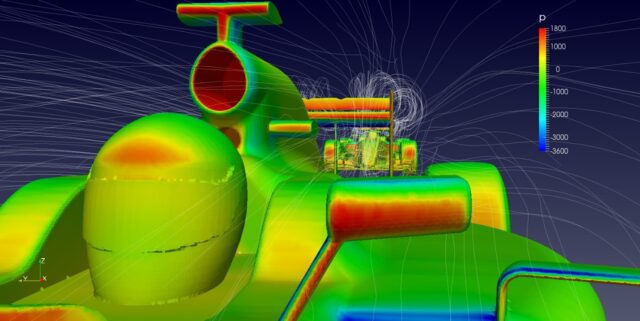
AI Simulation 100,000 Times Faster than CFD

CFD can be about 100,000 times faster using a trained neural network, but there is a catch. Image: Neural Concept.
CFD can be about 100,000 times faster using a trained neural network, but there is a catch.
Image: Neural Concept.

An analyst studying Formula 1 race cars may want to know how a racecar’s design would react to the turbulent wake of the car ahead. But if each tweak of the shape or angles of the vents requires a CFD simulation, it could take forever. But what if you could learn from previous CFD simulation results and apply what you learned to the next simulation?

Providing the changes are gradual, not radical, Neural Concept, a small Swiss firm, can do just that: predict the solution without the time and resources required for CFD simulation.

I interviewed Pierre Baqué, CEO, for an article in engineering.com published in April 2023. I was glad to see they will be exhibiting at CES 2024. The technology looked quite promising then. Now, it seems compelling.

A simulation to calculate Cd (coefficient of drag) can take 4-8 hours. With a trained neural network, it can take a tenth of a second, according to Neural Concepts. That’s more than 100 thousand times faster?

But as was explained to me in our previous conversation, there is a catch. You can’t throw any arbitrary shape and Neural Concept and have it solved immediately. The example above relies on Neural Concept being fed a steady diet of F1 car flow simulations. If we gave it an aircraft with radically different geometry, it would not work.

Neural Concept is ideal for repetitive simulation. Airbus is a user. I imagine them using it to study a thousand what-ifs, varying winglet angles, for example.

Neural Concept claims to make short work of sifting through your simulations, learning from them, and applying what was learned to suggest potentially thousands of optimized designs. But instead of a mind-boggling array of choices, the company uses proprietary algorithms to sort them.

Look for Neural Concept in the SWISSTECH pavilion at CES 2025 at the Venetian Expo (Eureka Park Booth #61033, Level 1, Hall G ).

What If Your Bike Could Understand Brospeak?

Urtopia’s electric motor in titanium frame e-bike to be shown at CES 2025.

Urtopia, the self-proclaimed leader in lightweight e-bike design, will showcase its next bike technology at CES 2025

  1. Quark Motor. With a weight of 1200g, Urtopia claims this to be the lightest and most potent e-bike motor ever.
  2. Titanium Zero, with a 3D-printed titanium frame.
  3. Urtopia GPTs: The world’s first voice assistant for cyclists.

The Urtopia Titanium Zero e-bike includes a solid-state battery with an energy density of up to 300Wh/kg but weighs only 10 kg. It is compatible with SRAM’s 12-speed electric shifter and can be equipped with premium components, including carbon wheels, carbon forks, and a titanium alloy seat post.

The Titanium Zero includes a UI by ChatGPT. With this, you can ask you can interact with your bike as if was your riding buddy. Example given is where to go after post ride. ChatGPT suggests a coffee shop.

“Bro, don’t you have something more exciting?”

This leads to a whiskey bar but that is cut short with a reminder of an appointment and having to go home in “turbo mode.” It’s scary fast. The rider is not heard from again.

Despite the obvious staging, it’s apparent how well a natural language interface would be better than having to deal with pressing buttons on a cycling computer when zipping down the road on two wheels.

Explore more about Urtopia GPTs here.

0FansLike
0FollowersFollow
0SubscribersSubscribe
Google search engine

Recent Articles

Trending Now