Dallas-based MedCAD has announced that its AccuPlate titanium reconstruction plates for the mandible and midface will now be 3D printed. This will allow MedCAD to supply the implants faster and better fit the patient.
“MedCAD’s expansion of 3D titanium printing capabilities has enabled us to reduce delivery times dramatically for our high-demand implants while offering more design features requested by our customers,” said Nancy Hairston, CEO and president of MedCAD. “These improved turnaround times for each patient-specific plate can quickly provide surgeons with bespoke, creative reconstruction options within timeframes that were previously unavailable.”
The plates can be ordered in thicknesses of 2.0, 2.4 and 2.8 mm and will now be able to include features such as inferior border hooks, graft trays and have precise allowances for off-the-shelf mesh between the plate and mandible.
The AccuPlate 3DTi implants can be delivered in as little as 5 days after surgeon approval.
Titanium is preferred for medical implants due to its exceptional biocompatibility, allowing it to integrate seamlessly with the body without triggering adverse immune responses. It has excellent corrosion resistance against bodily fluids. With its high strength-to-weight makes for lighter, tougher parts than steel. It is non-magnetic, making it safe for MRI scans, and hypoallergenic, reducing the risk of allergic reactions. Titanium’s fatigue resistance allows it to withstand repeated mechanical stress, which is crucial for load-bearing implants.
MedCAD is a Dallas-based, privately held medical technology company.
There is no better argument for simulation than a virtual wind tunnel. Wind tunnels cost millions to make, thousands to rent, and unless you are near an automotive or aviation center, there’s no wind tunnel nearby. Their cost alone would steer you towards simulation. Siemens estimates the cost of one shift in their wind tunnel could easily exceed €20,000. You also have to factor in the cost of a full-scale prototype. Product design cries out for a virtual wind tunnel. So many product shapes would benefit from streamlining. Think of boxy trucks, railroad cars with their miles of containers, and cargo and tanker ships, all of which use brute force to shove air and water out of their way. But the flow separation, the turbulent wakes, trailing vacuums and other phenomena that add up to enormous energy costs are all out of sight and out of mind.
Computational fluid dynamics, or CFD, means to make fluid flow visible. However, the computational power required to solve the millions of equations in even a simple CFD analysis is daunting. To simulate smoke trails for something the size of a car model in detail, in real-time, was impossible.
Until now.
Introducing OMNIVERSE Blueprint
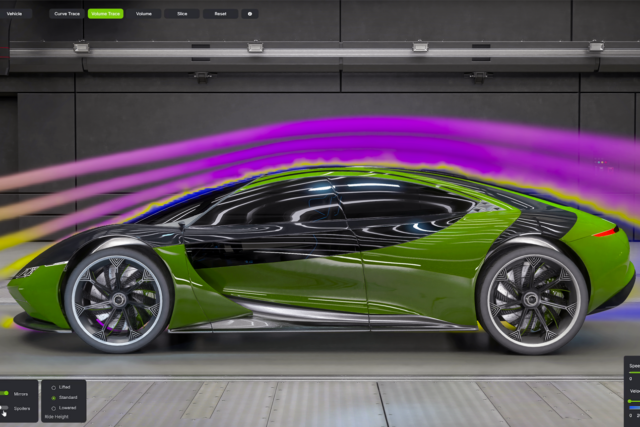
NVIDIA’s CEO and founder, Jensen Huang, in a special address at SC24, the Super Bowl of supercomputing recently concluded in Atlanta, Georgia, showed a fully operating virtual wind tunnel. It was a proof of concept, meant to show the potential of “infinite computing,” as racks of GPU servers are being sold, but nevertheless an eye-popping sight. We see a virtual tunnel that a frustrated engineer, denied an actual wind tunnel, could only dream of. We see the flow around a vehicle with smoke trails like in a wind tunnel. We see game-quality graphics, but we are assured the flow is real, i.e., based on CFD results. We see it in streamlines and pressure fields the way a CFD analyst would study it.
We see changes made at the push of a button. The car body swapped for another. At different heights above the ground, mirrors added and removed. We see the flow change immediately for every change.
What don’t we see? We don’t see the CFD mesh. We have to wonder how carefully the mesh was generated; knowing the mesh in the boundary layer is critical. We make a mental note to check before use. Only if the boundary layer mesh is adequate would we be able to enjoy freedom from meshing. We think of all the time that must be spent in getting a CAD model ready for simulation and meshing of the flow volume. A vehicle’s carefully detailed features, the wipers, trim, grill, and tire treads are removed in a process known as “defeaturing.” We do it so we don’t choke the computer, so we get results this week. NVIDIA has done away with that, as to say the size of the mesh, the number of equations to be solved, is of no concern. In other words, with the limitations of computing power eliminated, we may have entered the hallowed world of infinite computing.
In the video, we see the model geometry change and the flow immediately adapt.
Wait for It
Alas, the virtual wind tunnel is not yet a product you can buy or rent. It is a technology showcase named Omniverse Blueprint that is shown to various simulation vendors, such as Ansys, Altair, Siemens, and Luminary Cloud. These existing simulation vendors can plug their CFD into NVIDIA’s Omniverse to get a dynamic real-time simulation and, as an added bonus, also get gorgeous game-quality graphics.
NVIDIA has made a habit of supplying industry-specific software, such as for gaming and, more recently, AI, that makes use of their hardware, specifically GPUs. Omniverse Blueprint is that for simulation, with “powerful NVIDIA acceleration libraries, physics-AI frameworks, and advanced interactive rendering techniques, delivering simulation speeds up to 1,200 times faster and enabling real-time visualization.”
“Omniverse Blueprints are reference pipelines that integrate NVIDIA’s AI technologies, empowering leading CAE software developers to build next-generation digital twin workflows that will transform industries—from design and manufacturing to operations,” said Huang.
CFD is the first of the CAE applications shown. Presumably, FEA would follow. Next: design optimization?
We can only hope. NVIDIA can lead horses to water, but they can’t make them drink. Will simulation companies take advantage of the infinite computing being offered if it makes simulation invisible, like an engine under the hood, with only its results visible? Or will they want to keep showing off their finely crafted mesh, their cantankerous engines, their source of pride?
The Lymow robot lawn mower may not be the world’s first robomower, but it is the first to be equipped with mulching blades, boundary-wire-free navigation and tracked treads that, like a tank, can traverse most any terrain and overcome small obstacles. With those tracks, it can manage rough terrain and “slopes up to 45° slopes.”
Unlike a tank, your children and pets will be safe. Lymow’s Intelligent Adaptability identifies and adapts to objects like animals, hazards, or debris, and users can customize whether to avoid or cut through obstacles for seamless, smart mowing, according to the company.
Lymow is a promising Kickstarter project at the moment. The startup has raised more than 100 times its goal of $30K. Apparently, there are a lot of us for whom riding mowers are not the do-all, end-all of lawn care.
Chouette, a French startup, used Sculpteo 3D printing service to develop machine-mounted sensors for a system that can analyze a plant’s condition on a leaf-by-leaf basis. As the farm machine goes down the rows of grapevines, the sensor’s synthetic vision, coupled with AI trained on agronomic models, can:
Shoot the plant with an exact dose of whatever is needed.
Detect withered or otherwise unproductive vines or branches so they can be culled.
Used throughout the growing season, the system can detect if a vine is slow to grow or bear fruit.
Detect a variety of blights that grapevines are subject to before they spread.
Léo Chassery, embedded systems engineer at Chouette, explains: “3D printing enabled us to design and mass-produce a custom model in record time, which is essential if we don’t want to miss the start of the wine-growing season.”
Chouette is a French startup established in 2015. The company’s precision viticulture solution is in use at over 100 vineyards covering over 30,000 hectares. The company secured €5 million Series A funding in February to expand into more of France and Europe.
Paris-based Sculpteo offers a 3D printing service that lets users upload their design files (in native format), creates the part or parts in their U.S. or French facilities, and then ship the finished part or parts to the customer. In addition to this push-button service, Sculpteo offers Design Studio that lets businesses integrate additive manufacturing into their product development and production systems.
Mercedes-Benz is actively developing a “solar paint” to provide energy to its electric vehicles (EVs). This technology involves applying a photovoltaic layer, approximately 5 micrometers thick to all of the vehicle’s exterior surface, which converts sunlight into electrical energy or charges the battery.
Mercedes says this solar paint has an efficiency rate of about 20% – almost the efficiency of a good solar panel. But it is non-toxic, made from readily available materials and free from rare earth metals and silicon. This makes it cost-effective to produce and easy to recycle.
So why is it not in production? We want to know.
Mercedes was not reached out to for comment, but they would certainly say:
“Patience, please. There’s a lot to consider in an exterior finish. Does it have the right look as befits our brand? How will it weather? What will it add to the price of the vehicle, and will consumers accept it?”
Well, Mercedes, in California, where it’s all about solar and paying the premium to save the world is not an issue, we got you. For the rest of America, who knows anymore?
Covering a mid-size SUV with this solar paint could generate sufficient energy to power the vehicle for up to 7,456 miles per year under optimal conditions, such as those found in sunny climates like Los Angeles, according to Mercedes math. In less sunny environments, such as Stuttgart, Mercedes HQ, not so much…. But still, every little bit helps.
The photovoltaic paint remains active even when the vehicle is turned off, charging the high-capacity battery.
The solar paint was floated during a car show. Mercedes-Benz has shown a commitment to electrification with its Ambition 2039
“A core element of our sustainable business strategy is Ambition 2039, with which we already set the course in 2019 for a holistic approach to climate protection and air pollution control,” Mercedes states on its site. “The ambition is to make our entire fleet of new vehicles net carbon-neutral along the entire value chain and over the vehicles’ entire life cycle by 2039.”
To have done it with solar paint could be somewhat of a breakthrough. Mercedes, with solar paint with an efficiency of “about 20%” is somehow able to almost match the state of the art in commercially produced solar panels with efficiencies of over 22% is all by itself somewhat of a tech miracle.
Mercedes offered something like this 10 years ago when in November of 2014, it showed the Mercedes Vision G-Code concept vehicle at the company’s then-new Product Engineering Centre in Beijing.
Just like the recent photo paint, the Vision G-Code featured a distinctive “multi-voltaic” paint that functioned as a continuous solar panel capable of generating electrical energy from sunlight. However, no specifics were given. We can only assume that this time around, the photopaint has better efficiency.
Mercedes is not to propose the use of solar energy in its vehicles. The Toyota Prius Prime had a Solar Roof option. It added a modicum of miles to the range. In my estimation, it has not been a runaway hit.
The Hyundai Sonata Hybrid introduced an integrated solar roof capable of charging the car’s hybrid battery. Like the Toyota Solar Roof option, it does not seem to have set the world on fire.
There have been several startups that have tried to use solar power for vehicles (the Dutch Lightyear 0, Sono Motors Sion, and Aptera Solar EV. Bless their hearts. We do sincerely wish them the best of luck.
Oops. I’m a little short. Someone spot me a couple billion? Siemens had $9.16 billion in cash and cash equivalent but had agreed to pay $10.6 billion for Altair.
Siemens AG has secured a $10.5 billion bridge loan to finance its acquisition of Altair Engineering Inc., marking its largest-ever software company acquisition. The loan was fully underwritten by Goldman Sachs and is slated for syndication among more than ten of Siemens’ partner banks.
The acquisition agreement, announced on October 30, 2024 and covered here, involves Siemens purchasing Altair at $113 per share, representing an 18.7% premium over Altair’s closing price on October 21. The acquisition price represents 14 times the annual revenue Altair was projected to make in all of 2025.
“Starting in fiscal 2025, we will take Siemens to the next level of value creation,’ said Siemens CEO Roland Busch in the company’s Q4 financial report. “We will continue to invest in R&D and M&A to secure faster growth based on our technological strengths and ability to scale across industries. Our planned acquisition of Altair reinforces our leadership in industrial software and AI.”
Siemens’ strategy is to integrate hardware and software solutions to bridge the real and digital worlds.
Altair, a Detroit-area company known almost entirely for its simulation software is big in the automotive sector, but also has customers in other manufacturing industries, consumer goods, and energy.
But Siemens getting a loan was a bit of a surprise to us. It was a change of plans for Siemens, which initially announced it had all the means to buy Altair without assistance.
“The acquisition will be fully cash-financed from Siemens’ existing resources and its capacity to fully finance the transaction based on Siemens’ strong balance sheet,” reads the October 30 announcement of the acquisition.
Keeping the money in the bank lets Siemens make more big acquisitions, which the company seems eager to do.
“This was definitely not the last acquisition we make in the area of software,” said managing board member Cedrik Neike to German newspaper Handelsblatt in an interview published on Friday. “We have the financial strength to be able to do further deals.”
The World of Asphalt Show & Conference, set for March 25–27, 2025, at the America’s Center Convention Complex in St. Louis, Missouri, is the must-attend event for anyone designing or making roads using asphalt and aggregate. This is one place you can be sure of in 2025 to see the latest innovations, products, and services that will be shaping the future of road construction and maintenance.
With an expansive exhibition floor featuring over 430 equipment manufacturers, technology providers, and industry suppliers, the show delivers unparalleled access to solutions that drive efficiency and productivity in the road construction business. The conference program includes expert-led sessions covering topics such as sustainable paving practices, equipment optimization and workforce development.
This is also a place with endless networking opportunities. Fifteen thousand of your people will be there. You will connect with and learn from peers, exchange ideas, and build relationships within the industry.
What’s in St Louis?
If you want to take your spouse or significant other along, you may not sell the trip with “It’s the wonderful world of asphalt, honey.” Try these instead:
The Gateway Arch, the iconic 630-foot monument is the symbol of westward expansion. Take the specially-built ride that goes up and over the top. There’s nothing like it in the world. Don’t leave town without at least standing under it. After that, there’s 7 more reasons to use this opportunity to visit St Louis:
Union Station: A railroad station that has been converted into a hotel?! Even if you can’t stay at the hotel, at least have a drink at one of the restaurants and admire the architecture.
Rich History: St. Louis, close to the center of the continental U.S., is a center of transportation and commerce and was pivotal in the nation’s first interstate project and Route 66.
Sports Scene: Home to passionate fanbases and teams. The St. Louis Cardinals may not be playing, but you can catch the St Louis Blues when they play the Canadiens on March 25. (See NHL schedule)
Cultural Institutions: Attractions like the Saint Louis Art Museum, Missouri History Museum, and City Museum offer enriching experiences.
Culinary Highlights: Famous for local specialties like toasted ravioli (they’re actually quite good) and butter cake.
Affordable Entertainment: Many attractions, including the St. Louis Zoo and Forest Park, are free.
Our infrastructure projects, including the construction of roads, bridges, and utilities, are significant contributors to carbon emissions. Fifty billion tons of carbon are released into the air worldwide every year. 40% of that comes from the built environment, according to KPMG. Embodied carbon, the carbon that is used to make the concrete, steel and other materials of buildings and structures, plus the carbon used in their construction, represents 22% of all carbon emissions. Unlike operational emissions, which can be reduced over time through energy efficiency measures, embodied carbon emissions are locked in once construction is completed.
Carbon is emitted in all aspects of infrastructure, including the extraction of minerals, the manufacturing of materials, their transportation, the construction of buildings and structures, the use and maintenance, to their end of life, when building material is disposed of. Addressing carbon emissions through the full lifecycle is crucial for addressing climate change.
“We’re not decarbonizing fast enough,” says Thomas Kiessling, CTO of Siemens Smart Infrastructure. “We have to ask ourselves: can we accelerate progress and scale up our efforts?”
In a recent report, Digital Transformation, Sustainable Returns. The New Pathway of Infrastructure, Siemens suggests that getting to net-zero carbon emissions and meeting lower embodied carbon goals before it’s too late is only possible if those that design, build, operate and own infrastructure undergo a complete digital transformation.
Only by integrating advanced digital technologies to enhance data utilization and improving operational efficiency can we make progress happen at speed and scale that our present situation warrants.
Of course, this is Siemens presenting a problem for which it has a solution. Siemens has practically reinvented itself as a vendor of digital transformation applications. The company estimates the market for digital transformation market to be it estimates to be $2.5 trillion by year’s end, up 30% from last year.
Siemens gives several examples of how its digital tools have helped to decarbonize.
Southern Methodist University upgraded several buildings, including the central utility plant and mechanical systems and installed submeters and sensors. They integrated fire safety and security systems into platforms and installed an energy management program with fault-detection and demand flow optimization for chilled water plants. All this digitalization is estimated to save the university $9.5 million over the 1st five years.
Norway has the highest proportion of EVs and electric heat pumps and a great variety and number of entities that both produce and consume power. This creates uneven demand and supply and often strains the existing power network. Elvia, Norway’s largest power grid operator, has created a digital twin of the country’s low voltage grid which it says has reduced outages by 30%.
In healthcare, Switzerland’s Insel Gruppe AG also created digital twins but of a new medical center.
“This is an important area for our industry as it is fundamental to both optimizing performance and improving sustainable operas, said says Abel Müller-Hübenthal, director of Real Estate and operation at Insel Gruppe. “We were the first in our sector to transfer data successfully from our digital twin to our operation system, and we continue to build on this.”
Hundreds of bottles of beer on the wall. Heineken made a digital twin of a “typical” brewery. Image: Siemens.
Heineken, one of the world’s biggest breweries, made a digital twin of a typical brewery and used it to determine energy use patterns so they could optimize thermal systems, which if implemented across the board would reduce carbon emissions by 50% and save 20% of energy cost.
Woman about to find out why wearing shoes with spike heels in a data center is not a good idea. Seriously, data centers are big energy consumers and many more are being planned. Image: Siemens.
Datacenters may consume 1.5% of the world’s energy today, but that will grow 5X by 2030 according to Siemens. Estonia’s Greenergy outfitted one of its data centers with thousands of sensors to monitor temperature and airflow. AI-enabled technology allows Greenergy to manage the data and control cooling in real time. This has allowed the data center to operate at a power usage effectiveness (PUE), of 1.2, down from 1.6. A PUE of 1.0 is a theoretical ideal when all of the energy supplied to a data center is used for computing and nothing else, such as cooling or Iighting.
The report’s key findings:
A little over half (55%) of the respondents think digital solutions will play a pivotal part in decarbonization but 45% do not.
A little over half (54%) think their operations are data-driven, but 41% are taking baby steps or haven’t started walking.
AI is seen, more than any other technology, as having the most impact on decarbonization in the next three years. Digital platforms and ecosystems were 6th.
Not enough data is available. Over 40% don’t have data or can’t access it because data is not centralized. 30% lack consumption data.
The report is based on interviews with subject matter experts and a survey of 650 senior executives from 13 countries.
At 9:58 pm on March 18, 2018, Elaine Herzberg was killed as she walked her bike across a street in Tempe, Arizona. She was 49, homeless and may have been battling addiction. The vehicle that struck her was a Volvo XC-90 SUV outfitted by Uber’s Advanced Technology Group to be self-driving.
I write this more than 6 years and 8 months after the accident. Elaine Herzberg is all but forgotten, and Uber’s dreams of a fleet of self-driving robotaxis, ended.
The last walk. More than 6 years after covering the story, I trace Elaine Herzberg’s path across Tempe’s Mill Avenue. She didn’t make it. She was struck and killed by an Uber self-driving vehicle.
At the Scene of the Crime
I am in Tempe, Arizona, on business, and after two days of meeting, I make my way out of town on an overcast Saturday morning. I am seeing quite a few Waymo robotaxis in the area. It is as if Waymo has snuck in to fill the void left by Uber. I am reminded of the unfinished business of the Uber accident coverage. I feel compelled to visit the scene of the Uber accident. I had only covered the accident from afar with a series of articles. I had never checked my assertions against the official report on the accident by the National Transportation Safety Board (NTSB), nor had I reported on the aftermath.
I had initiated coverage with the sincere belief that self-driving technology could save us from running into each other and the hope that a single death would not make the public pull the plug on self-driving projects, of which many had sprouted all across the U.S. Almost 38,000 people died in the U.S. the previous year (2017) according to the National Highway Safety Administration.
In my 2018 reporting, I pored over the accounts in the local news and watched the videos from cameras inside and outside of the Uber vehicle released by Tempe police for my series. I came to realize this was not a story of Luddites wanting revenge against machine owners or of technology companies insisting they can be better than humans despite failures, but a story of failures of one technology company.
Who to Blame?
Uber settled a lawsuit brought on by Elaine Herzberg’s husband and daughter very quickly. CNN said a settlement this soon after a fatal crash is unusual in a report dated just 11 days after the accident. Then Uber shuttered its self-driving program and moved out of town, possibly avoiding criminal prosecution.
The victim’s family then went after the city of Tempe, seeking $10 million for having a pathway on the median but no crosswalks or lighting. It is not known how or if the case was settled, but cities usually have ironclad immunity in place and can usually pass the burden of proof to victims.
Location of main sensor components on the 2017 Volvo XC90 that struck and killed Elaine Herzberg. Image: NTSB
Volvo was quick to clear itself of any wrongdoing. According to the NTSB report, Volvo took it upon itself to run 20 simulations, varying the speed and angle of the victim, to determine if its own automatic braking and evasive action disabled by Uber would have prevented or mitigated the accident. In 17 cases of those cases, Volvo would have been able to avoid Herzberg altogether. In the other 3 cases, it would have hit her at speeds of less than ten mph — instead of the actual fatal speed of 39 mph.
Had the Volvo been left to its own devices, Elaine Herzberg would still be alive.
A Convenient Culprit
That leaves “operator” Rafaela Vasquez as the remaining suspect.
For regulatory compliance, self-driving cars run tens of thousands of miles, initially with two operators in the front seats. The primary job of the operator on the passenger side is to monitor the operator at the controls. By the time of the accident, Uber had gone to single-operator configuration and made it the operator’s job to take control of the vehicle if needed — or, as we found out 5 years later when Vasquez pled guilty — to take the blame if they didn’t.
Uber was able to video Vasquez looking down towards a smartphone for a full 6 seconds before the accident only to look up “about 1 second before the crash.” However, the ambiguity of blame kept Vasquez in legal limbo for 5 years until she finally pled guilty to “endangerment” in July of 2023. You can read the details of the case here in Wired. She is currently serving 3 years of supervised probation.
Last Steps
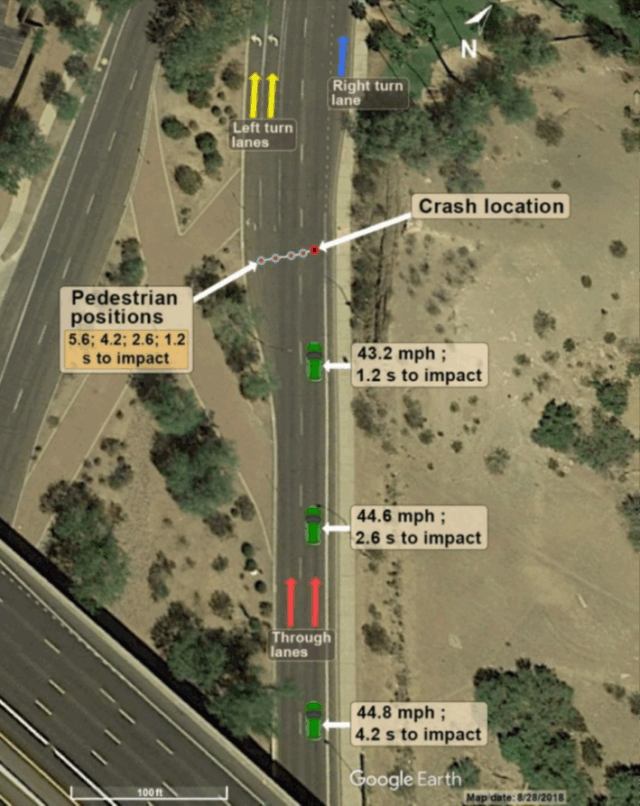
Image: NTSB
I reconstruct Elaine Herzberg’s last footsteps on Earth and imagine tracing her path from a parking lot underneath an overpass as she crosses the southbound lane of Mill Avenue. She is walking her bike, which she is using to convey some, if not all, her belongings in two white plastic bags.
She stepped onto a median with an X-shaped crosswalk that provided a smooth passage for her and the bike she was walking over the relatively rough ground and scrubby vegetation. But retracing the path offers a surprise. Instead of a smooth walkway, there are loose, broken rocks. The city of Tempe has done this to discourage the X-shape as a walkway.
The signs that tells people to cross at the intersection are still in place, but I wonder if anyone who had come this far would go back the way they came and go 380 feet to the intersection.
I have to imagine the city of Tempe saying, “We put up signs” when the victim’s family sued them.
Erzberg steps off the median curb to cross 4 lanes of northbound traffic. She makes it across two turn lanes and the left through lane. As she is in the last lane, she looks up, startled by the lights of the Uber vehicle bearing down on her. It’s too late.
Automation Complacency
Approximate position of bicycle at impact. The primary deformation in the front of the vehicle corresponds to the position of Elaine Herzberg, who was walking the bike. Image: NTSB.
My trip to Tempe was part of a 1500-mile road trip from my home in the Bay Area, which also included San Diego. Over long spells of straight-line driving, for which Arizona is known, there were many a time when I felt as if I could have taken a break. I did not watch videos, but there were times when a hand left the wheel and my attention was elsewhere. My vehicle (Mercedes E400 with Level 2 autonomy: automatic braking, lane centering and adaptive cruise control) inspires that kind of confidence.
It’s a false sense of security. Automation complacency, with humans in the loop mostly in a monitoring role in highly automated systems, has a habit of not paying attention. The NTSB has examined automation complacency in Level 2 automation and concluded it to be the cause of two fatal crashes.
If Level 2 autonomy can make me inattentive, I wonder how much more inattentive would have been operators in Uber self-driving vehicles with Level 4 autonomy. Level 4 autonomy allows vehicles to go point to point or loop without any human intervention whatsoever. Did Uber ATG (Advanced Technology Group) not know about automation complacency and expect lone operators not to lapse into inattentiveness or seek distraction?
It is a question the NTSB answers in its conclusion: “…the Uber ATG did not adequately recognize the risk of automation complacency and develop effective countermeasures to control the risk of vehicle operator disengagement, which contributed to the crash.”
Since announcing a partnership with Microsoft in October 2021, Trimble has steadily stayed on the path with its vision to assist the agriculture, construction and transportation industries on their digital transformation journeys. The company recently added another way to promote collaboration and streamline data management with its Reality Capture platform service.
Launched in September, the service offers a secure, cloud-based way to manage, share and visualize datasets from various technologies, including 3D laser scanning, uncrewed aerial vehicle (UAV) systems and mobile mapping. The web-based platform offers users an intuitive method for managing point clouds and 360-degree imagery with design data.
“This new service applies cloud technology in a new way for large data packages, allowing users to scale performance and maximize data value significantly,” said Boris Skopljak, Trimble vice president of geospatial. “Anyone can now benefit from accessing complicated reality capture data through a simple web interface, making it easier than ever to leverage geospatial information to drive better outcomes at every step of the design-build-operate lifecycle. With this launch, we are a step closer to realizing living digital twins and artificial intelligence applications at scale.”
The new platform is an extension of Trimble Connect, which is a tool for open collaboration that enables a single source of data for in-house and third parties. It elevates the ability for a connected workflow between the digital and physical worlds while making it easier to maximize the usage of reality-capture data.
“Utilizing the power and multilayered, built-in security controls of Microsoft Azure in combination with Trimble’s reality capture capabilities transforms scanning workflows to reduce point cloud analysis time from hours to minutes,” said Wangui McKelvey, general manager of Azure data analytics at Microsoft. “Enabling datasets of virtually any size to be easily shared and analyzed across teams means better, safer and more efficient output both on the job site and in the office.”
Designed for industries that rely on geospatial data, the Trimble Reality Capture service assists users in accessing datasets, whether using Trimble’s terrestrial laser scanners or third-party hardware. The data can then be used seamlessly alongside any 2D or 3D data.
The platform is integrated with Microsoft Azure Data Lake Storage and Azure Synapse Analytics. Whether in the field or off-site, key stakeholders can review, search, download, make model comparisons and analyze the data to make better-informed decisions and increase efficiency from a centralized, single source of truth. According to Microsoft’s Wangui McKelvey, general manager of Azure data analytics, integrating Trimble’s reality capture capabilities with Microsoft Azure reduces point cloud analysis times from hours to minutes.
Thanks to Trimble’s focus on connected solutions, reality capture data can be used with any of the company’s solutions—SketchUp 3D modeling tool, Trimble ProjectSight construction management software, Tekla structural BIM software—and third-party system integrators. Along with seamless integration, the Reality Capture platform service has a user-friendly interface, making it easy for contributors to manage data without extensive training better.
The Trimble Reality Capture platform service is offered as a subscription service through Trimble Geospatial distribution partners.




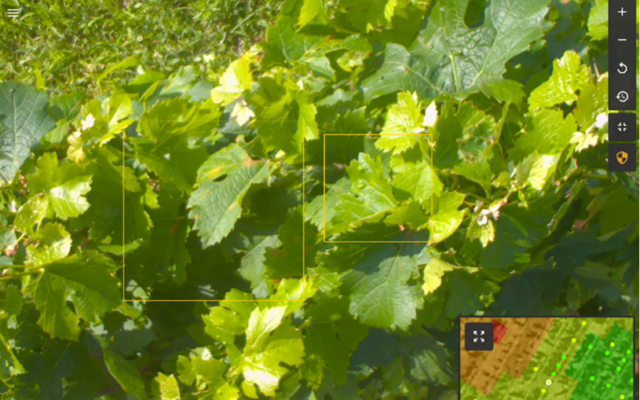
 Chouette, a French startup, used Sculpteo 3D printing service to develop machine-mounted sensors for a system that can analyze a plant’s condition on a leaf-by-leaf basis. As the farm machine goes down the rows of grapevines, the sensor’s synthetic vision, coupled with AI trained on agronomic models, can: