Trimble has launched a free version of ProjectSight, its project management software for the construction sector, aiming to increase the adoption of digital tools in an industry notorious for being slow to adopt them. Making software free removes one, though not all of the barriers to adoption.
ProjectSight enables contractors to manage tasks like document control, budgeting, and managing communication between the office and the field with a centralized platform. It ought to improve project efficiency and coordination, reduce miscommunication, and streamline workflows. While large firms have big budgets and are early adopters, getting it into the hands of those in small and midsize firms has proven to be a challenge,
The free version includes a new AI-powered feature that automates document tracking and management by recognizing drawing numbers, versions and other text content. “A no-cost version of ProjectSight removes barriers to entry and presents a simple way to experience the project management benefits,” says Jon Fingland, vice president and general manager for Trimble construction software solutions. “Some contractors have viewed powerful construction management tools like ProjectSight as too expensive or complicated.”
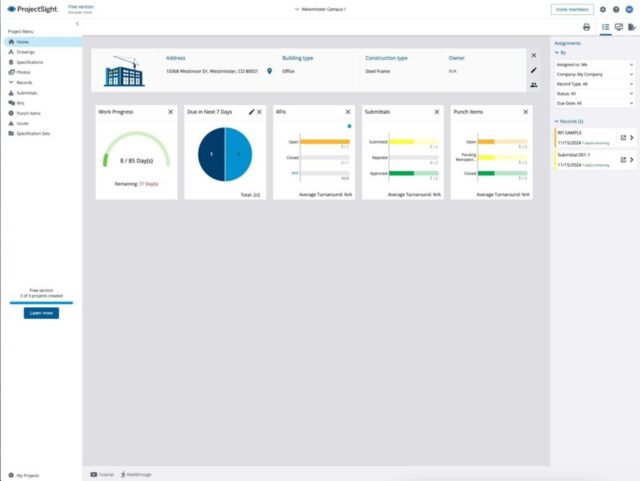
The free version of Trimble ProjectSight provides a centralized environment to manage and share drawings, photos, specifications, submittals, punch lists and RFIs for up to 3 projects and includes 3 GB of storage. The next level is called “Go” and has an unlimited number of projects and 15GB of storage. No price has been set for Go.
Trimble launched ProjectSight in 2014 and was selling it for $15 a month, discounted to $120 a year.
SketchUp Diffusion: A generative AI-powered tool introduced by SketchUp Labs at last year’s Dimensions conference is being well received this year. One reason is that Dimensions now includes 3D Base Camp, the once-standalone SketchUp user meeting. SketchUp puts rendering, which used to have to be done with 3rd-party applications by experts, in the hands of everyday users. Diffusion is still in the Lab, so still a work in progress, but definitely worth a look.
ProjectSight, Trimble’s project management application, now has an AI-driven import feature that automatically extracts critical information from drawings and documents.
Trimble LiveCount, which counts mechanical, electrical and plumbing components for the purpose of bidding, is now equipped with AI to detect and count symbols on construction drawings automatically. This feature, especially beneficial for electrical contractors, saves time by automating the counting of receptacles, switches, and other common electrical items in takeoff processes. Live Count is available with Accubid subscriptions.
Trimble Business Center, a “field to finish” survey CAD program, now integrates AI for point cloud data processing, able to detect and quantify objects on a site, such as volumes of stockpiles, features and conditions of roads.
The American Welding Society (the other AWS, not to be confused with Amazon Web Services) is marking the 10th National Apprenticeship Week (November 17-24, 2024) by urging manufacturers to expand apprenticeships to meet the demand for skilled welders.
“National Apprenticeship Week is an opportunity for us to invest in the future of our industry,” said AWS President Michael Krupnicki. “Through registered apprenticeships, we can address the skills gap and create rewarding, lucrative career paths through hands-on, paid training in welding, inspection, and automation.”
It’s got to help address what has become a critical labor shortage that is affecting manufacturing, steel building construction and holding back the spread of renewable energy infrastructure.
To assist employers in creating or expanding apprenticeship programs, the AWS Foundation has launched weldingapprenticeship.com, a resource for structuring training programs for welders, inspectors, and automation technicians. For further information on AWS’s apprenticeship initiatives, visit the official National Apprenticeship Week website or aws.org.
The American Welding Society (AWS), founded in 1919, is a nonprofit organization with over 65,000 members dedicated to advancing welding science, technology, and applications globally. AWS provides industry professionals with standards, certifications, and educational resources.
Trimble’s SketchUp has reached a significant milestone, surpassing one million active paying subscribers, according to a press release today. That number does not include users of the free version.
A million is a nice number and certainly worthy of a press release. However, it is a far cry from the numbers previously associated with SketchUp, which has been estimated as high as 38 million!
A Little History
SketchUp was launched in 2000 by @Last Software, acquired by Google in 2006 and then adopted by Trimble in 2012. SketchUp was quickly accepted at the onset due to its ease of use by architects. It could create 3D models of buildings with wondrous ease. Then it caught on with an unintended demographic, makers and hobbyists for mechanical design, What helped SketchUp’s popularity immensely was that it was totally free.
But Trimble, who acquired to gain access to architects, is not a non-profit. The company did not buy SketchUp to give it away. The free desktop version of SketchUp was gradually disappeared, replaced with a too-limited online version.
Clearly, Trimble goal is to have SketchUp used by every architect who can afford it. However, it seems that ratcheting the cost up from free, which is what most architects – and curmudgeon editors — remember SketchUp to be, is proving to be more difficult than Trimble would have liked.
A Few Hundred Dollars Would Not Kill You
In our humble opinion, $349/year is really not a lot to pay for what is still the easiest-to-use 3D architectural CAD program ever. Architects, known to be as penny-pinching as any job group, may just have to get over it.
To Trimble, we request that SketchUp be spun off as a wholly owned subsidiary, once again offering a free version with decent capability. The free version may not generate immediate revenue, but the goodwill and appeal to a universal demographic is worth much more than what can be extracted from a million architects. Only if Trimble is willing to do this long play will SketchUp be restored to its once-exalted heights.
Bombs away. Low-cost drones cost only a few hundred dollars but can take out military targets more effectively than artillery and more destructively than a sniper’s bullet. Image: OneWay Aerospace
Bombs away. Low-cost drones cost only a few hundred dollars but can take out military targets more effectively than artillery and more destructively than a sniper’s bullet. Image: OneWay Aerospace
The Russian bear that was to have run over Ukraine has been stopped by a swarm of bees. Such are the aerial drones, produced by the tens of thousands every week, according to the Wall Street Journal. Ukraine may not be able to kill the bear with drones but has been able to hold it at bay. We read about Russian soldiers afraid to venture out of bunkers, fleeing at the first sound of a drone. In one video shown to the reporter, two soldiers jump into an outhouse to escape, but a drone no bigger than a dinner plate flies through an impossible opening and blows them to bits. Russian soldiers are pleading for their lives as drones swoop down on them. In one particularly harrowing video, a soldier with legs made useless by grenades dropped from drones, in a field set on fire by drones, put a rifle barrel in his mouth and blows his brains out.
Drone pilots create fear as do the deadliest of snipers. One drone operator in Clear Eyes, a drone group operating in Ukraine, counts over 300 kills. Others have more. By comparison, Chris Kyle, the American Navy SEAL played by Bradley Cooper in American Sniper, had 160 confirmed kills.
Drone warfare, as is conducted by Ukraine, is more ingenuity and resourcefulness than high tech. Ukrainians have adapted consumer drones and improvised to make them into weapons. A small drone can carry as much as 9 lbs of explosives. We read about Soviet-era artillery shells dismantled, their explosive material melted in slow cookers and poured into plastic shells so they could piggyback on quadcopters.
Drone operators are a far cry from the swaggering fighter pilots shown in Hollywood movies like Top Gun or super macho test pilots in The Right Stuff. With their nimble thumbs and race-car fast reflexes, they fit more into the gamer genre. With their POV (point of view) headsets, they can be seen propelling their acrobatic aircraft through courses in arenas such as the FAI World Drone Racing championships, the Super Bowl of drone games, reaching speeds of up to 90 mph.
The fun and games of drones turn into not just life and death but intergalactic war science fiction in Ender’s Game, where a teenage game whiz is tricked into joining the planet’s military, all the time thinking he was only playing a video game.
Back to the Real Battlefield
Ukraine uses civilians as drone operators and embeds them with regular military units. While one drone operator expresses guilt for killing humans as if playing a game, most are more than up to the task, intoxicated at the idea of killing Russians in defense of their country.
The drones have a range of 12 miles, longer and more accurate than artillery shells. They cost about $500. Their Achilles heel is they have to be guided towards the target. The Russians are getting better at jamming the signal. It’s a cat-and-mouse game. Then they are overwhelmed by the sheer numbers of drones.
Still, the bear does not retreat. The makeshift nature of drone manufacturing, the malfunctioning, the limits of battery life, all that which cause many drones to simply crash harmlessly to Earth, with only a third of aerial drones hitting their targets, is good news for the bear.
The times, they are a-changing. Productivity tracking is a thing now. Last week, two articles appearing the Wall Street Journal about companies monitoring employee activity through tracking software and notifying HR. More on that later.
CAD is No Exception
I am reminded of a conversation months ago with a CAD company executive about AI. He let it drop that his company had been collecting and analyzing user data for years. And they are about to step it up. Data about user activity was collected while they were using the company’s cloud-based CAD product. The CAD product was to be “instrumented.” That meant that whatever users did with it was a matter of record and it would be kept with the company so it could be analyzed. The executive tries to be reassuring: the users’ proprietary design is at no risk; they are merely getting feedback on how commands are used in the hope of improving them.
How can anyone collect your data without your permission? They can because you unwittingly gave them permission. You may not remember the fine print because you didn’t bother reading it. I do it all the time. I’m always in a hurry to install the software or one of its updates. That fine print I never read constituted an EULA or end user license agreement?
Unless you are running open-source software, freeware, or custom code, you have signed off (checked off, most likely) on an EULA or a Terms of Service. Not having read one or wanting to, I call on the all-knowing ChatGPT and my suspicions are immediately confirmed: “Improving user experience” and “analytics and development” are two of the five rights I have probably granted to hundreds of software companies over the years, including many CAD programs.
What gives software companies the right to monitor the usage of the software?
EULA and Terms of Service. EULAs define the terms under which users can use the software, often including clauses that allow companies to collect data about software usage. This data can encompass general usage statistics, error reports, and user behavior, depending on the agreement’s specifics.
Anti-Piracy Measures: Monitoring helps detect unauthorized or pirated versions of software. By tracking license validation and access patterns, companies can ensure only legitimate users access the software.
Improving User Experience: Usage data enables companies to understand user interactions, identify popular features, and detect issues, guiding updates and new feature development to enhance usability.
Security: Some software includes monitoring to detect unusual usage patterns that could indicate security risks, such as unauthorized access attempts.
Compliance and Audits: Companies operating under regulatory standards may monitor software use to ensure compliance, especially when handling sensitive data.
Analytics and Development: Usage data allows companies to analyze trends, guide research and development strategies, and inform decisions about feature development.
While all that seems benign and maybe even helpful, it raises the questions “Who owns the data?” and “What can’t they do with the data?” And specifically, to our original concern, can they share the individual user and usage data with your boss? What rights do users have? Since users don’t typically pay for the software they use, I fear the answer would not be too reassuring.
In a world enthralled with AI and in love with NVIDIA’s founder/CEO Jensen Huang for making the chips that make it happen, NVIDIA’s stock is gold.
At the company’s annual developer conference, GTC 2024, held earlier this year, Huang made it quite clear: he was betting all his chips on humanoid robots.
In an Acquired podcast, Huang is on top of the world yet humble enough to give credit to OpenAI for the AI revolution. He only takes credit for positioning NVIDIA near enough to AI technology so that when it bloomed, his company and his company alone would have the chips available for it.
“You want to be near where the apple falls,” says Huang. Even if I’m not sure what and when I position the company to be near the tree, we may have to do a diving catch for it. Even if you don’t catch the apple before it hits the ground, you want to be the first one to pick it up.”
Eyes up here. Driver expressions and whether they are nodding off, a use of Nvida’s OmniVision system. Image NVIDIA.
AI was not the first apple Huang picked up. Before AI, he was equally gung-ho about autonomous vehicles. Previous GTC’s featured vehicles emblazoned with NVIDIA logos, their backs filled with GPU-laden computers. A massive TuSimple tractor cab was on the show floor, and their CEO was on stage. AVs needed enormous computing power on the spot. There was no time to bounce signals off remote servers. The lag caused by accessing far-off servers could kill.
However, when an AV did kill, as it did on March 18, 2018, in Tempe, Arizona, the fallout caused Uber to abandon its plans for AVs. TuSimple laid off 75% of its US workforce and abandoned its plans to automate the truck industry. The auto industry and investor community lost interest. There was not to be a world full of people being driven around by their vehicles any time soon, nor the windfall NVIDIA may have expected.
AI may not be as intelligent as we would like it to be, but since it hasn’t killed anyone yet, the AI fever continues unabated. Because of it, NVIDIA’s revenue, profits and valuation are through the roof.
What’s Next?
Where’s the next apple going to fall? At the company’s annual developer conference, GTC 2024, held earlier this year, Huang made it quite clear: humanoid robots. And once again, he had the hardware for it. NVIDIA’s hardware, and only NVIDIA’s hardware, would allow humanoid robots to finally hit their stride.
Humanoid robots have been the stuff of sci-fi movies for a century. Fritz Lang’s 1927 Metropolis starred a humanoid robot. Since then, most robots have depicted robots as killers, culminating in Terminator. Sex robots caused a brief sensation. Disney kept the dream alive with robots in their theme parks, but robots for home use were mainly novelty items. We had all resigned ourselves to evil robots in the movies and good robots on the assembly lines.
Then came GTC 2024 and Jensen Huang on the main stage… and materializing from the darkness behind him an entire chorus line of robots. Were they about to dance and high kick like Dallas Cowboy cheerleaders? I prayed not. They were far too close to Huang. I could not imagine NVIDIA without Jensen.
I was, in my moment of panic, missing the point Huang was making: Humanoid robots were going to be the next big thing. And luckily for us all, the humanoid robots remained safely stationary. The only robot action was with a harmless, knee-high robot on wheels that responded to Huang’s commands about as much as my pug dog.
What Would Jensen Do?
Since Jensen Huang has shown a Midas touch with AI, he easily commands our attention.
NVIDIA’s interest in humanoid robots is driven by its vision for a future where robots can seamlessly operate in human environments. CEO Jensen Huang explains that since the world is structured around human needs—like factories designed for human workers—humanoid robots are well-suited to perform tasks in these spaces. By training robots with data based on human movements and behaviors, NVIDIA aims to create machines that can learn and adapt to complex tasks autonomously, ranging from assembly line work to complex navigation.
This aligns with NVIDIA’s broader mission to advance embodied AI and autonomous robotics, areas they believe will not only support industrial productivity but also create jobs. Through projects like Project GR00T and platforms like NVIDIA Isaac, NVIDIA is building a comprehensive toolkit for developing and training humanoid robots. This approach allows these robots to better understand and perform human-like tasks, which Huang sees as foundational to the future of robotics and artificial intelligence. NVIDIA’s investments also capitalize on the potential of AI to handle global challenges, such as labor shortages and industrial efficiency, positioning the company as a leader in the robotics and AI sectors.
Holoscan and Machine Vision
NVIDIA Holoscan is a comprehensive AI sensor processing platform developed by NVIDIA that is tailored for the low-latency processing of sensor data. It includes optimized libraries for AI data processing and offers core microservices for managing streaming, imaging, and networking applications. Holoscan supports embedded devices, edge computing and cloud platforms.
NVIDIA Jetson is an edge AI and robotics platform designed to provide high-performance computing for applications in robotics, autonomous machines and AI at the edge. It includes compact, powerful modules and a software development kit (NVIDIA JetPack).
NVIDIA offers Jetson for products that need object recognition, autonomous navigation, and complex data processing. It integrates with NVIDIA’s Holoscan, Metropolis, and Isaac, which simplify development for applications in industrial automation, smart cities, healthcare and more.
The “eyes” of humanoid robots are sensors and processors like OMNIVISION’s OG02B10 image sensor and OAX4000 processor. The sensor captures visual data, much like a human eye, enabling robots to see their surroundings in precise, high-resolution detail, even in motion. Meanwhile, the OAX4000 processor acts like the visual cortex, interpreting this data by enhancing image quality, managing multiple camera inputs, and processing it for the robot’s AI system to make decisions.
The ”brain” in a humanoid robot is typically the AI and processing unit, which interprets sensor data, makes decisions and drives the robot’s actions. In robots built on NVIDIA platforms, this is often handled by processors like the NVIDIA Jetson or more advanced AI processors such as NVIDIA’s Thor and Project GR00T. These processors are designed to run complex AI algorithms and machine learning models that allow the robot to “think” and respond in real-time.
Yes, NVIDIA Jetson and similar processors in humanoid robots are considered edge computers. Edge computing refers to processing data close to where it is generated (at the “edge” of the network), which reduces latency and enhances responsiveness. This approach is crucial for real-time applications like robotics, where immediate processing is needed for tasks like obstacle avoidance, facial recognition, and decision-making.
For instance, NVIDIA Jetson modules are built to perform AI and deep learning computations directly on the device, without relying on remote cloud servers. This capability makes them ideal for powering the “brain” of a humanoid robot, enabling it to process sensor data from machine vision components quickly and act in real time.
For example, NVIDIA Jetson is equipped with powerful GPUs and AI acceleration capabilities that enable the robot to process visual and environmental data from vision sensors. This information is then used by the AI models running on Jetson or another processor to interpret surroundings, plan movements, and interact with humans in a responsive manner.
The Market for Humanoid Robots
The humanoid robot market is expected to experience rapid growth over the next decade, driven by advances in artificial intelligence, robotics, and increasing demand across industries such as healthcare, personal assistance, and retail. The global market, valued at around $1.5 billion in 2023, is projected to expand significantly, reaching up to $66 billion by 2032, with a compound annual growth rate (CAGR) ranging from 34% to 62%, depending on the market segment and region.
Aging populations and the need for automation in caregiving are major growth drivers, as humanoid robots are increasingly used for companionship, healthcare assistance, and rehabilitation. In industries like retail and hospitality, robots enhance customer service through tasks like guiding, providing product information, and handling transactions. In addition, regions like Asia-Pacific, led by countries such as Japan and South Korea, are at the forefront of adopting humanoid robots, driven by strong governmental support and robust tech infrastructure.
However, challenges remain, such as high costs, security from hacks, and safety, especially as humanoid robots integrate with humans. But with mass production and technical advances, the humanoid robot market is bound to advance — as long as they don’t kill someone.
Forma Board is integrated with Docs, where all Autodesk files will eventually be atomized. Relax. There may be little downside and a bunch of benefits. Image: Autodesk.
Forma Board is integrated with Docs, where all Autodesk files will eventually be atomized. Relax. There may be little downside and a bunch of benefits. Image: Autodesk.
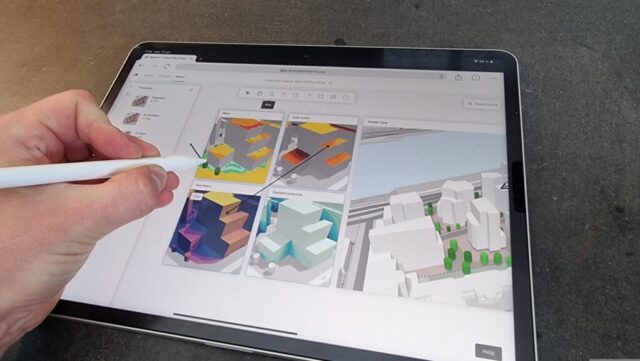
At AU2024, Autodesk announced that Forma, the AEC generative design app, was “connected” to Docs, allowing Forma Board to get visuals from Docs without having to have Forma. Forma Board is like PowerPoint and a view/markup app had a baby. You still need Forma to create the content, but with Forma Board, anyone can view and markup the content. It’s the much-copied Adobe Creator/Viewer model: pay to create, view for free.
A Review of Files vs Databases
With Docs getting so much attention, let’s review what it is, what it does and what it allows you to do that could not be done before.
Since there has been CAD, there have been CAD files. For AutoCAD, there were DWG files. Inventor also had a proprietary file format, as did Revit. Other vendors, SOLIDWORKS, Creo, NX and CATIA… all did, as well.
Then came this upstart, Onshape, which, instead of files, kept a database on the cloud – and because of that setup, they were able to do strange and wondrous things, like collaborate and version and the Holy Grail, the single source of truth. Okay, fine, whatever, said most CAD users. This strange cloud-based CAD program would not change how they were going to go about their business.
But while most of us were not paying attention to the back-room database vs. file debate, Autodesk was. And, without much of an announcement, Autodesk decided to favor a database approach. Perhaps they did not want to admit Onshape had the right idea all along.
At Autodesk’s annual user meeting, Autodesk University 2024, we were to find out just how seriously they were about going full database – instead of files.
The disadvantage of starting from a user base of zero was also its advantage. It afforded the startup the luxury of being able to change everything. An established CAD vendor cannot do that. It’s the old good news, bad news joke that is often told about Autodesk.
The good news: AutoCAD has a lot of users.
The bad news: Autodesk has a lot of users.
Get it? A large user base discourages innovation. A user base of millions is a million votes for preserving the status quo. For them, innovation is disruption.
Blowing Up Files
Autodesk wants to blow up our files. That might not be so bad.
With so much of the talk from the stage about data and the advantages of “granularity,” we had to ask what this meant for the CAD user and their files.
Answer from Autodesk: If we do this right, the user will never notice. The hard work is all on us.
Apparently, “doing it right” involves a lot of work for Autodesk. The organism that is the file is no more than a collection of cells. It is a total of the graphics and data of a CAD model. It can be broken down into its cells, stored in the cloud, and rebuilt in the same file – or, if the need arises, another file.
This collection of cells is what Autodesk confusingly calls Docs. We had previously associated “docs” with Microsoft Word files. “File” is the very opposite of “database” in this story, but let us finish.
Autodesk Docs is what Autodesk calls a “common data environment” for all in the AEC industry plus owners. The plan is for all Autodesk applications, including AutoCAD, Autodesk Construction Cloud, Revit, Tandem, Civil 3D, and Autodesk Workshop XR, to have their databases in Docs. Some are already there; the rest will follow.
Autodesk is not abruptly ending the use of files. The plan is that as long as file-based CAD programs exist, so will files. However, on the cloud (in Docs, in this case), there will be a parallel universe with the same drawings and models in databases, in other words, the database equivalent of the file. It will update automatically – any change in the file, say, caused by the Revit user, and the database in Docs will update automatically.
One advantage of the database, the cloud-based copy of the file, is that it can be accessed by those who would not be able to access the file. In the case of the Revit BIM model, these would be stakeholders, like owners, who have no access to Revit.
Like users of other CAD programs? Would Autodesk tolerate Bentley or Graphisoft users being able to access Revit databases, for example? There was no mention of different CAD programs expressly, but Autodesk has conceded more openness lately.
However, several Revit users could access the same database, even simultaneously. Such real-time collaboration by multiple teams and interests is vital for complex projects involving several disciplines and trades. HVAC guys, piping, structural steel, etc., all accessing one database, a single source of truth…
Sounds like heaven, right? But there is the devil in the details.
Autodesk University 2024 was all about selling the deconstruction of files into databases, and the most used word for the event was “data.” By the middle of day 1, “data” had knocked “AI” off the top of the podium by our rough count. By the end of day 2, it was no contest. Data was raining down on us.
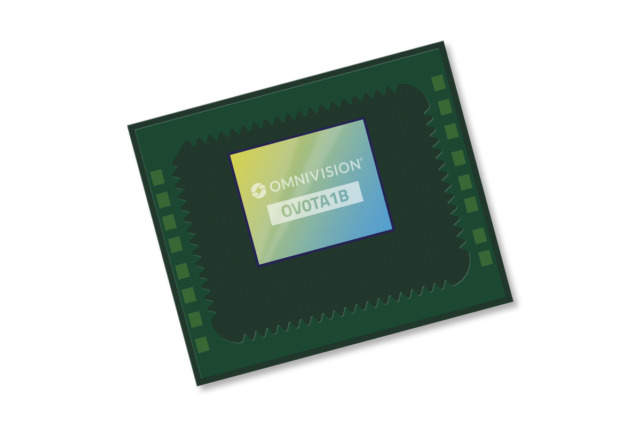
OMNIVISION has introduced the OV0TA1B, which it claims has the smallest footprint of any IR CMOS sensor, able to fit in the tight quarters found in ultrathin devices such as smartphones, tablets and laptops, some of which have a “3mm Y dimension” requirement.
For comparison, the bezel of the latest iPhones is an impossibly thin 1.15 mm, but its expanded bezel, the “Dynamic Island,” provides a generous 7.7 mm of height.
The small form factor of the OV0TA1B makes it ideal for human presence detection (HPD) and facial recognition on such devices. It has a 2-micron (µm) pixel, and it provides 440 x360 resolution at 30 frames per second. The company claims it requires such little energy consumption that the sensor can be kept on at all times.
The OVOTA1B use cases offered by OMNIVISION:
User validation by facial recognition, which has become common in smartphones and tablets
Counting people with webcams, such as those found in surveillance systems. (OMNIVISON may or may not be used in surveillance systems.)
OMNIVISION competes with several companies in the miniature infrared (IR) CMOS sensor market, including Sony, STMicroelectronics, ON Semiconductor, Samsung and Canon.
These companies, along with OMNIVISION, are key players in the development and production of miniature IR CMOS sensors. Apple has primarily utilized Sony’s CMOS image sensors in its iPhones for over a decade. In December 2022, Apple CEO Tim Cook confirmed this longstanding partnership. However, recent reports indicate that Apple is considering incorporating Samsung’s image sensors into future iPhone models, potentially as early as 2026.
Were it not for the barrel and a few other metal parts, the FGC-9 would be virtually invisible to metal detectors. The brutally efficient assault weapon has quickly emerged as the most popular 3D-printed gun ever. Modified Wikipedia image
Were it not for the barrel and a few other metal parts, the FGC-9 would be virtually invisible to metal detectors. The brutally efficient assault weapon has quickly emerged as the most popular 3D-printed gun ever. Modified Wikipedia image
The FGC-9 (for F**k Gun Control 9mm) may be the most popular 3D-printed gun in the world. You can see it being brandished, slapped and fired with great whoops of delight by masked men on YouTube. They look and sound as if they are in the U.S. Its origin can be traced to Germany, but it has gone worldwide. Reports of armed gangs and militias using FGC-9s are coming from Myanmar (formerly Burma), Syria, as well as several countries in Europe.
No country or company takes credit for the FGC-9. It is the spawn of a masked man known until recently as JStark1809. (a reference to Tony Stark? John Snow from the House of Stark?) sometime between 2018 and 2020. Most of the gun’s parts can be made with polymers with a 3D printer. Parts that are pressurized, heated or both, like the barrel, can be easily bought or manufactured. All together, the parts will cost about $500.
The design files have been made open-source and widely shared online, contributing to widespread production. With anyone now able to produce a lethal assault weapon with only a 3D printer, the FGC-9 has sparked concerns among law enforcement and policymakers. The gun is untraceable; it manufacture unlimited and its ability to slip through metal detectors worrisome. The FGC-9 has been lumped with “ghost guns,” though ghost guns are mostly made with metal parts.
The FGC-9 is the next-generation homemade weapon, more like an assault rifle weapon than the first 3D printing scare, the Liberator, which was only a single-shot handgun. The FGC-9 will fire 9mm rounds as fast as you can pull the trigger.
We watch a trigger-happy YouTuber gleefully emptying a 40-round magazine on what sounds like metallic targets, marveling at the gun’s reliability and, literally, it being cool under fire – quite important for a plastic gun.
The FGC-9 is not the first semi-automatic assault weapon, but it is the first to have so many of its parts 3D printed.
Skirting Laws
In the U.S., it is legal to 3D-print guns for personal use under federal law as long as the firearm is not sold, transferred, or made for commercial purposes. However, the weapon must contain enough metal to be detectable by metal detectors, which makes fully plastic guns illegal under the Undetectable Firearms Act, signed into law by President Ronald Reagen in 1988. States can be stricter yet. In California, 3D-printed firearms must be registered and assigned a serial number, even for personal use. New Jersey and New York have also passed stricter laws to protect against homemade and ghost guns.
3D-printing guns is illegal in most of Europe. The U.K. vies with Germany to have the most stringent regulations against the creation or possession of unregistered firearms, including 3D-printed ones. Individuals found making or possessing such firearms can face severe legal consequences,
In Japan and Australia, even having drawings, files or computer models of 3D-printed weapons can be illegal.
How to Stop the FGC-9?
With anyone with a 3D printer able to skirt the laws against undetectable, untraceable guns, what can be done to control their proliferation? Perhaps a law that 3D printers have to be registered? This is precisely what the State of New York tried with a bill introduced a little over a year ago. That bill still needs to be passed.
3DPrinterOS and Montclair State University think they have a better way. They are working together to limit the production of 3D-printed guns and gun parts by developing an innovative algorithm designed to identify firearm components created through 3D printing. This algorithm will use unique design signatures to detect gun parts, aiming to enhance safety and regulatory compliance.
The announcement does not mention the FGC-9 specifically.
The project is being conducted in Montclair State University’s MIX Lab, which is known for its research in digital fabrication and prototyping. This effort targets improved tracking of firearm components, benefiting manufacturers, regulators, schools, and law enforcement agencies.
“We believe that this collaboration will pave the way for safer 3D printing practices,” said Rene-Oscar Ariko, VP of Global Sales at 3DPrinterOS. “By working closely with the MIX Lab at Montclair State University, we can harness academic expertise to create a robust solution that addresses a critical issue in our society.”
“This partnership allows us to explore the intersection of technology and public safety,” adds Jason Frasca, co-director of the MIX at Montclair State University. “We are excited to contribute our knowledge to develop a system that can make a real difference in identifying and mitigating risks associated with 3D printed firearms.”
The algorithm developed by 3DPrinterOS and Montclair State University will work by analyzing 3D-printed objects to identify specific design characteristics associated with firearm components. This involves using advanced pattern recognition and machine learning techniques to detect unique signatures in the STL files that correspond to known gun parts.