AI Cannot Replace Professional Accountability in Engineering

Mark Coates, Bentley's Vice President of Infrastructure Policy Advancement, on stage at Berlin's 2026 Illuminate Conference (source: Bentley).
Mark Coates, Bentley’s Vice President of Infrastructure Policy Advancement, on stage at Berlin’s 2026 Illuminate Conference (source: Bentley).


Artificial intelligence is changing engineering work, from finding information and developing designs to evaluating alternatives and managing projects. Yet Bentley Systems argues that greater AI involvement does not transfer responsibility from engineers to technology. Firms remain accountable for the quality, safety, and integrity of engineering decisions.

The article draws on an ACEC Research Institute report identifying eight interconnected AI risk areas, including technical reliability, professional liability, data governance, workforce capability, ethics, cybersecurity, commercial models, and leadership. These risks make AI governance an organizational issue rather than simply an IT responsibility.

Regulatory approaches differ internationally. The United States emphasizes AI adoption while relying heavily on existing professional responsibilities and voluntary frameworks such as the NIST AI Risk Management Framework. The European Union has established more formal statutory requirements through the EU AI Act, including obligations for certain high-risk applications. The United Kingdom is pursuing a principles-based approach using existing regulators and professional standards.

Despite these differences, engineering firms face similar practical responsibilities. They need to know where AI is being used, what project or client data enters AI systems, and whether important outputs are independently verified. Using the same AI model, data, or assumptions for both engineering work and peer review could undermine independent assurance by reproducing the same errors.

Increasing AI accuracy may actually make professional scrutiny more important. Obvious mistakes could become less common, while subtle errors and plausible but incorrect conclusions become harder to detect.

AI also creates a workforce challenge. If routine calculations, research, and document reviews are increasingly automated, younger engineers could lose opportunities traditionally used to develop professional judgment. Firms may therefore need to rethink training while improving AI literacy across their workforce.

Bentley concludes that competitive advantage will come not simply from adopting AI, but from combining it with trusted engineering data, domain expertise, independent assurance, and accountable professionals. AI can support engineering decisions, but responsibility for those decisions must remain human.
Engineering Drawing Data Strengthens VAVE Cost Reduction

Source: CADDi.
Source: CADDi.


Engineering drawings contain far more than geometric information. They capture materials, dimensions, tolerances, assembly requirements, and manufacturing specifications that can help manufacturers make better value analysis and value engineering, or VAVE, decisions. CADDi argues that extracting and comparing this information can turn drawing archives into a useful source of cost-reduction opportunities.

Material analysis is one application. By examining specifications and dimensions across drawings, manufacturers can identify opportunities to reduce material consumption, substitute lower-cost alternatives, improve allocation, or strengthen purchasing negotiations. Drawing data can similarly expose unnecessarily tight tolerances that increase machining costs without delivering meaningful functional benefits.

Assembly information provides another avenue for improvement. Engineers can use historical drawings to identify opportunities to reduce part counts, simplify components, improve assembly sequences, or introduce automation. Drawing geometry can also support failure analysis by highlighting potential stress concentrations and supplying data for finite element analysis. This allows teams to investigate design changes before failures reach production or customers.

Manufacturing processes can benefit as well. Comparing designs can reveal parts suited to alternative production methods, while design changes can reduce setup time, scrap, rework, and manufacturing complexity.

CADDi illustrates these principles with an aerospace example involving a landing gear assembly. Drawing analysis identified opportunities involving alternative materials, relaxed tolerances, and fewer fasteners, resulting in a reported 15% overall cost reduction without sacrificing quality or safety.

The article also explains how CADDi Explorer supports this process. The platform extracts information from PDF and even handwritten drawings, connects drawings with cost and supplier information, and enables keyword, image, and shape-based similarity searches across historical archives.

For VAVE teams, this ability to find comparable parts can reveal small design differences associated with significant cost differences. Instead of treating old drawings as static records, manufacturers can use them as evidence for more informed engineering and sourcing decisions.

Pirros Library Builder Turns Past Project Details Into Firm Standards

Source: Pirros.
Source: Pirros.


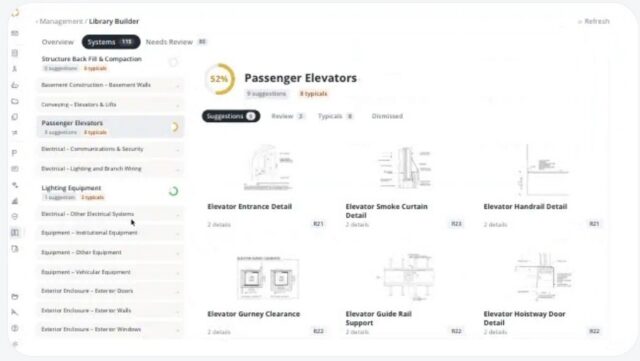
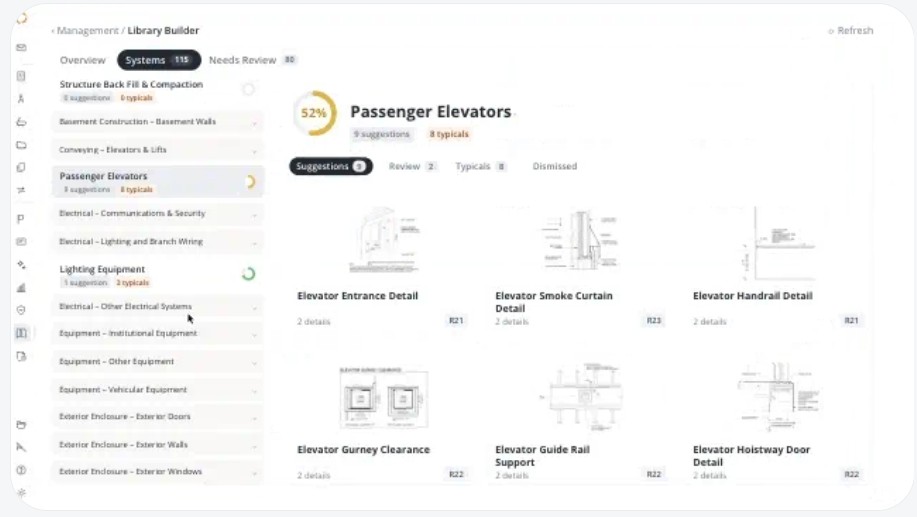
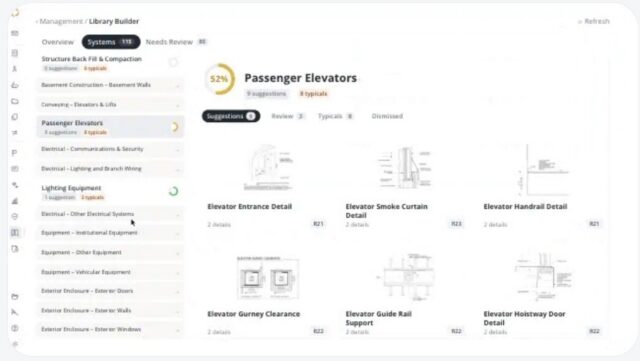
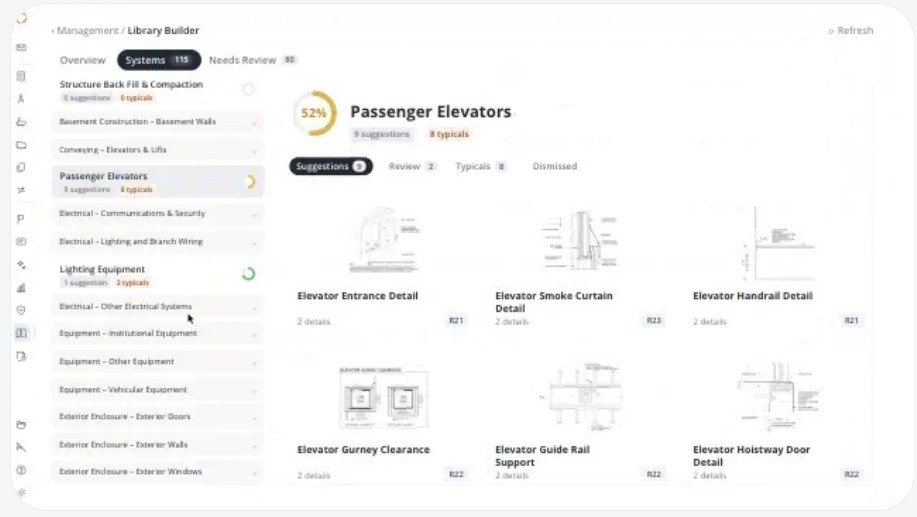
Architecture and engineering firms often have years of valuable construction details scattered across past projects. Pirros Library Builder is designed to turn this accumulated work into an organized standards library without requiring BIM managers and standards committees to manually compare hundreds of drawings, tells Pirros.

Library Builder analyzes details already stored in a firm’s Pirros library, including those uploaded from previous projects. Instead of depending on filenames, it examines what each detail represents and classifies it according to ASTM Uniformat II building systems. Details showing the same condition are then grouped together, even if they originated from different projects, offices, or naming conventions.

For frequently reused groups, the software recommends a detail that could become the firm standard. Recommendations consider reuse frequency and Pirros health scores, which flag potential issues such as misspellings, overlapping text, crossing leaders, and leaders that fail to connect with geometry.

The system also calculates coverage scores for building systems, helping firms see where standards are well developed and where important gaps remain. Library Builder reruns its analysis weekly, incorporating newly uploaded project details and updating recommendations as the firm’s knowledge base grows.

Pirros emphasizes that the tool does not automatically approve standards. Every recommendation passes through the firm’s existing review process, leaving BIM managers, standards committees, and other professionals responsible for final decisions.

The system can help firms create their first standards library, consolidate duplicate content, prioritize standards work, and resolve differences among offices. Approved details remain searchable in Pirros and can be placed into Revit.

Pirros recommends starting with 5-10% projects. By automating classification, comparison, and prioritization rather than professional judgment, Library Builder aims to transform existing project knowledge into a more consistent and maintainable standards resource.

Large Physics Models Accelerate Coupled Multiphysics Analysis

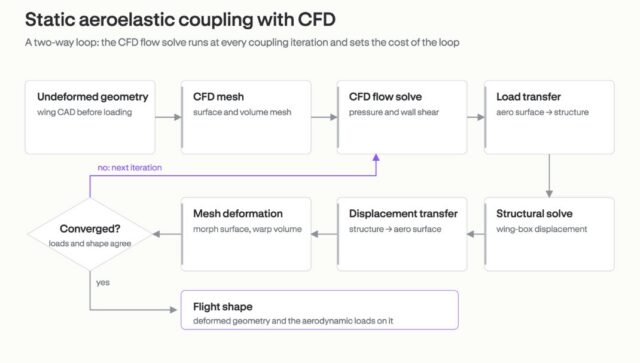
Static aeroelastic coupling with CFD. The CFD flow solve runs at every coupling iteration and sets the cost of the loop. (Source: Luminary).


Multiphysics analysis is essential when different physical phenomena interact, such as aerodynamic forces deforming an aircraft wing and that deformation subsequently changing airflow. Traditional coupled simulations repeatedly exchange results between specialized solvers, making the process computationally expensive and difficult to automate.

Luminary proposes large physics models, or LPMs, as a faster alternative. Trained on high-fidelity solver data, LPMs predict complete physical fields, such as surface pressure or structural displacement, directly from CAD geometry and operating conditions. Because they produce full-field results rather than individual quantities, they can replace conventional solvers within coupled simulation loops.

Luminary demonstrated the approach using the static aerostructural response of a transonic swept wing. The study examined wing twist and washout, which can reduce lift as aerodynamic loads deform the structure.

In the first test, Luminary replaced CFD with its SHIFT-Wing LPM while retaining the TACS finite element structural solver. Loads and displacements were transferred using MELD. The LPM-based workflow converged in 8–11 minutes on one Nvidia T4 GPU, compared with approximately four hours for CFD running on three Nvidia H100 GPUs. Across three wing geometries, predicted lift reduction differed from the CFD-based results by only 0.2–0.8 percentage points.

The second test replaced the structural solver with SHIFT-Wingbox, another LPM trained on about 1,400 TACS solutions. SHIFT-Wing and SHIFT-Wingbox then exchanged full-field aerodynamic and structural predictions directly. Results remained close to the solver-based reference, with tip twist within 0.04 degrees and lift reduction within 1 percentage point.

The demonstration suggests that coupled LPMs could make multiphysics analysis practical earlier in design. By reducing solver costs, meshing requirements, and dependence on separate specialist teams, Physics AI could allow engineers to evaluate coupled physical effects more frequently without abandoning validated engineering data.

Aitech Releases SOSA-Aligned Computing Suite for Defense

Image: Aitech
Image: Aitech

CHATSWORTH, CA, Oct 29, 2026 – Aitech has released the Aitech SOSA Suite, four modular computing and networking boards for embedded defense systems. The portfolio combines two single-board computers (SBCs), a managed ethernet switch/router and an AI general-purpose GPU board within a 40 Gbps ethernet and PCIe Gen4 architecture.

The boards align with the SOSA Technical Standard and can be deployed individually or integrated into a complete SOSA-aligned system. Applications include aircraft, ground vehicles, missile systems, helicopters and unmanned platforms.

“Defense programs need open architectures that make it easier to introduce new capabilities without creating additional integration complexity and preserve the flexibility to integrate new functionality as requirements evolve,” said Alex Trigoub, product manager, Aitech. “This SOSA Suite marks a significant expansion of Aitech’s SOSA-aligned portfolio, giving system integrators a flexible, pre-integrated and fully validated foundation for modernizing platforms, accelerating technology insertion and scaling performance as operational requirements evolve.”

The Aitech SOSA Suite includes:

  • U-C8600 I/O-Intensive SBC: Uses an Intel Core Ultra 7 processor SoC with a hybrid-core architecture and flexible power consumption levels for size, weight and power optimization. Onboard I/O and an XMC mezzanine site support applications requiring varied interfaces. A 40GbE data plane and PCIe Gen4 expansion plane connect sensors, communications resources and processing elements for Mission Control and I/O-intensive workloads.
  • U-C8601 Compute-Intensive SBC: Uses the same CPU cluster as the U-C8600 for AI inference, accelerated processing and sensor fusion within a single slot when a general-purpose GPU board is not required. Aitech reports up to 32 TOPS of combined AI acceleration from the Intel Arc GPU and neural processing unit (NPU). The board supports up to 40GbE and 256 Gbps of PCIe Gen4 bandwidth for applications moving high-resolution data, with an architecture designed to optimize size, weight and power.
  • U-C6850 Managed Ethernet Switch/Router: Provides up to 320 Gbps of nonblocking Layer 2/Layer 3 switching capacity. Configurations support up to eight 40GbE or 32 10GbE interfaces, with routing and network-timing capabilities for distributed mission systems.
  • U-C5300 High-Performance AI GPGPU Board: Adds up to 35.8 TFLOPS of general-purpose GPU performance, according to Aitech. Applications include AI inference, video analytics, image processing, sensor fusion and real-time rendering.

Customers can use the U-C8600 or U-C8601 for onboard AI processing and add the U-C5300 for workloads requiring greater GPU acceleration. The U-C6850 connects multiple SBCs and other resources over ethernet.

The Aitech SOSA Suite is available now.

Source: Aitech

About Aitech

Aitech is a U.S.-based defense and space manufacturer that provides rugged embedded computing systems. The company develops single-board computers, GPGPU systems, Ethernet switches, integrated systems, enclosures, I/O boards, memory and storage products, communication modules, and satellite electronics. It also provides obsolescence management, customization, integration, cybersecurity, and digital connectivity services. Aitech serves defense, aerospace, space, satellite, and commercial programs that require computing hardware for harsh environments. The company was founded in 1983 and is headquartered in Chatsworth, CA. Its products support land, sea, air, and space applications, including mission computers and radiation-tolerant systems. Aitech lists customers across defense and space programs, including prime contractors, government agencies, and commercial space companies.

AI Expands the Frontiers of Physics Research at Argonne

Source: Shutterstock/Taris Tonsa.


Artificial intelligence is becoming an important research tool at Argonne National Laboratory, helping physicists analyze experimental data, automate complex workflows, improve particle accelerator operations, and investigate fundamental questions about matter. Ian Cloët, deputy division director of Argonne’s Physics division, says AI is already changing research practices and could eventually reshape the scientific process.

One application involves studying the three-dimensional structure of protons and nuclei. Through the SciDAC-5 QuantOm project, researchers are developing AI methods to extract images of quarks and gluons from experimental data. The long-term objective includes real-time analysis at facilities such as Jefferson Lab and the future Electron-Ion Collider.

AI is also supporting nuclear many-body calculations. Researchers use neural networks to represent quantum wave functions describing interactions among protons and neutrons. This approach could extend the range of accurate calculations for complex atomic nuclei.

At Argonne’s Tandem Linac Accelerator System, or ATLAS, AI is helping optimize radioactive ion beam transport. An AI-assisted approach learns from measurements and identifies promising accelerator settings, potentially reducing tuning time and giving researchers more time for experiments.

Automation represents another major opportunity. AI can detect equipment problems early, execute complicated standard workflows, assist with coding, validate results, and shorten the path from a research idea to a tested calculation.

Cloët stresses, however, that greater productivity must not weaken scientific standards. Researchers remain responsible for understanding, assessing, and defending AI-assisted results. Sensitive or unpublished data also requires appropriate protection.

AI-generated findings must therefore satisfy established physical laws, reproduce known ground truth in closure tests, remain stable across modeling and training choices, and be reproducible. Rather than lowering validation requirements, AI may make broader cross-checking practical. At Argonne, its value lies in expanding what physicists can investigate while keeping scientific judgment and accountability firmly with researchers.

Engineering AI Needs Quantitative Grounding to Deliver Trustworthy Results

Source: Neural Concept.


Human-like conversational AI may explain engineering concepts convincingly, but that does not mean it can reliably calculate physical quantities. Neural Concept argues that the fundamental problem lies in training data. Large language models learn primarily from human-created descriptions, while engineering decisions require predictions grounded in simulations or physical measurements.

The article distinguishes conversational AI from physics AI. Conversational systems excel at language, reasoning, and interpreting user intent. Physics AI, by contrast, learns from numerical data generated through computational fluid dynamics, finite element analysis, laboratory testing, and other engineering methods. This distinction allows physics AI to predict quantities such as pressure, velocity, stress, displacement, and temperature while producing errors that engineers can measure.

According to the article, quantitative grounding requires three elements: numerical ground truth, a held-out test set that the model has never encountered during training, and a clearly documented applicability domain. Together, these allow engineers to determine whether a prediction is accurate enough for a particular design decision.

The limitations of conversational AI become apparent when it is asked to estimate physical quantities. Research cited in the article suggests that such models can rely on learned assumptions about typical objects rather than actual measurements. Their responses may therefore sound reasonable without being physically verified.

Physics AI is not immune to failure. Performance can deteriorate when new geometries, materials, or operating conditions fall outside the model’s training domain. Engineers must still judge whether a model applies to a particular problem, interpret safety margins, and investigate unexpected results.

The article ultimately presents conversational AI and physics AI as complementary technologies rather than competitors. A conversational interface can translate engineering intent and support design interaction, while a physics-based model supplies quantitatively validated predictions. For engineering organizations, measurable error bounds are crucial because an AI result that requires complete conventional verification may offer little practical time savings.

Coralboard Brings Private, Low-Power AI Prototyping to the Edge

Source: Acoroid Studio.
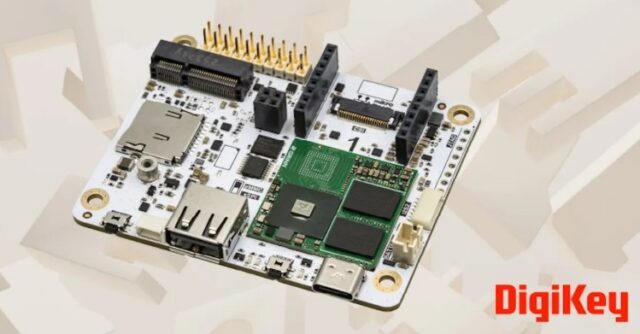
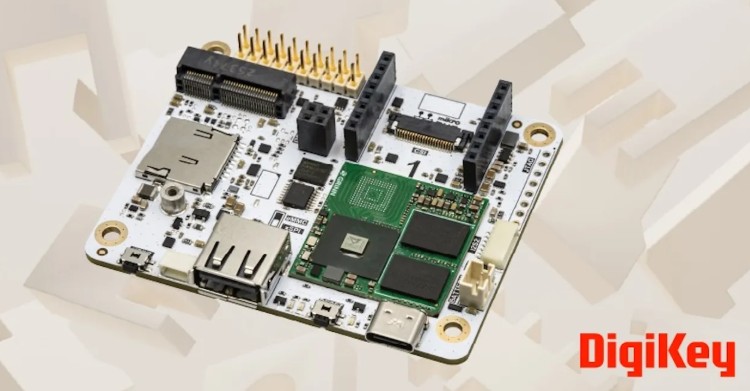
Coralboard, a developer-ready edge AI board powered by Coral NPU technology from Google Research and Synaptics Astra embedded processors, is now available from DigiKey (source: DigiKey).


Edge AI is gaining ground as engineers look for ways to process data locally rather than depend on cloud infrastructure. Coralboard, a new development board distributed by DigiKey, is designed to make that transition easier by providing an open, power-efficient platform for developing AI-enabled products, tells Design News.

Running AI directly on devices can reduce latency, bandwidth costs, connectivity risks, and cloud expenses. It also helps keep sensitive audio, video, and biometric information on the device, an important consideration for applications subject to privacy and cybersecurity requirements. These capabilities are particularly relevant for wearables, appliances, industrial equipment, smart cameras, and other systems that need fast, autonomous responses.

At the heart of Coralboard is the Synaptics Astra SL2619 processor, integrated through the Grinn AstraSOM-261x system-on-module. The board also incorporates Coral NPU technology from Google Research for dedicated AI acceleration. Synaptics’ open-source, MLIR-based Torq toolchain supports model development, optimization, and deployment. The platform can run different AI workloads, including hardware-accelerated Gemma 3 270M.

Rather than requiring developers to build AI models and supporting infrastructure from scratch, Coralboard can work with existing models and open-source resources. This approach lets engineers spend more time adapting AI to their specific products and applications.

A key feature is its path from experimentation to commercial deployment. Engineers can begin with the off-the-shelf Coralboard SL for evaluation and proof-of-concept work. They can then move to the Grinn AstraSOM-261x for product integration before transitioning to a custom design based directly on the SL2619 processor for higher-volume production.

Coralboard is also designed for ultra-low-power, always-on applications, including battery-constrained devices using ambient sensing. Plug-and-play support for cameras, displays, and audio, along with Ethernet-over-USB and optional Wi-Fi and Bluetooth connectivity, gives engineers a practical platform for developing responsive, private edge AI products.

Preparing CAD Assemblies for Accurate Installation Animations

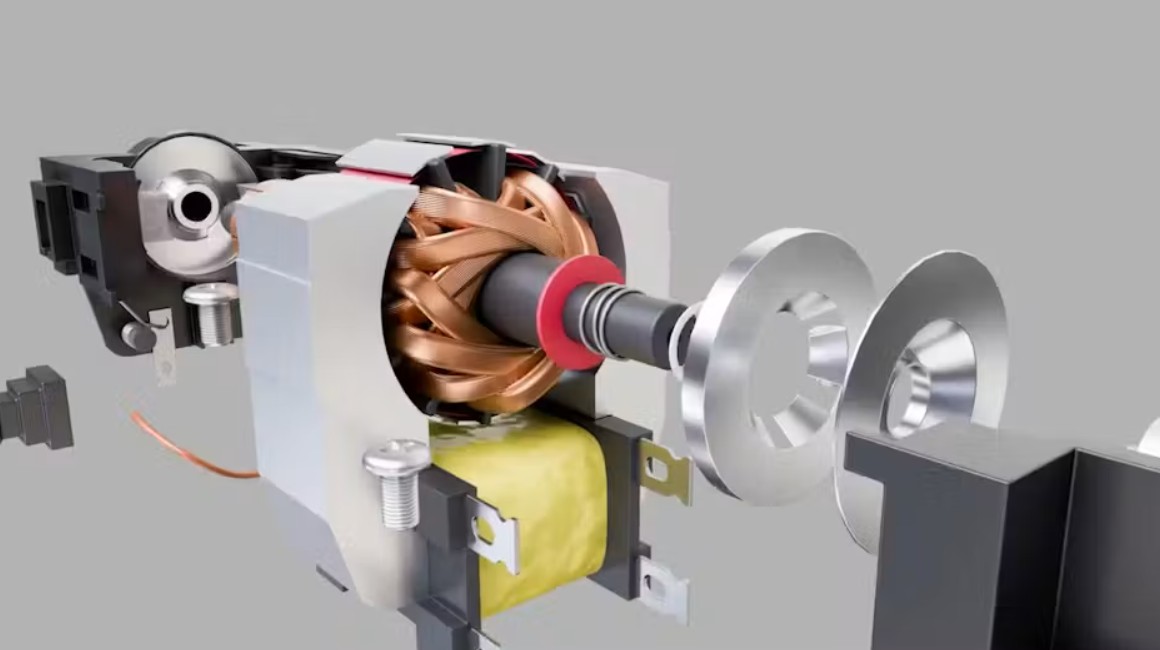
Source: Acoroid Studio.


Turning an engineering CAD assembly into an installation animation involves more than exporting a model and handing it to a visualization team. CAD systems represent geometry differently from animation software, creating conversion and preparation challenges that can affect accuracy, appearance, and production time, tells Machine Design.

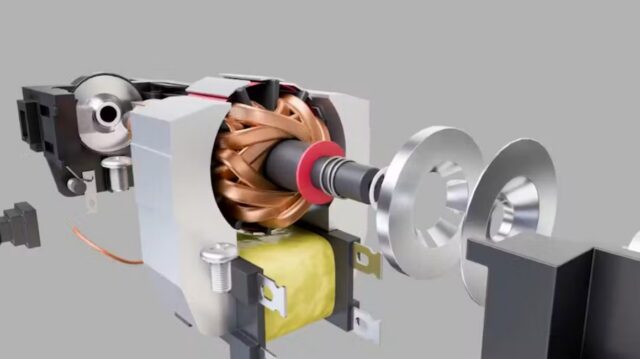
STEP files, commonly used to exchange CAD data, contain precise surfaces and solids. Animation applications such as Blender, Cinema 4D, and 3ds Max work with polygonal meshes. Converting CAD geometry into meshes can produce thin triangles, shading errors, and other visual defects that require cleanup or remodeling. Missing components, misaligned parts, and inconsistent units can create additional problems.

A CAD model also does not explain the installation sequence. Animators need assembly manuals, photographs of the finished product, information about the intended setting, and, for complex equipment, guidance from engineers. The manual effectively becomes the animation script, while photographs help reproduce materials, colors, and finishes accurately.

Large industrial assemblies present another challenge because they may contain thousands of components. Animators can improve performance by dividing models into manageable sections, removing unseen internal geometry, combining repetitive components such as bolts and washers, and organizing parts according to function. Any unusual geometry or component placement should be confirmed with engineers before animation begins.

Technical accuracy remains central to the finished animation. Parts should move along physically realistic paths, installation steps should follow the manual, and appropriate tools and torque specifications should appear when required. Repetitive operations can be demonstrated once in detail and then accelerated.

Engineers can reduce rework by checking exports before delivery. Confidential geometry can be simplified rather than deleted, assemblies should be checked for completeness and alignment, and consistent units should be maintained across files. Providing STEP alongside STL, OBJ, or FBX files can also simplify the animator’s workflow.

The article shows that a few minutes spent preparing CAD data can save days of animation cleanup while producing installation videos that remain faithful to the engineering documentation.

Hyphenate Raises $45M for AI Finance Automation

Image: Hyphenate
Image: Hyphenate

NEW YORK CITY, NY, Oct 29, 2026 – Hyphenate has raised $45 million in series A funding to expand AI agents that perform accounting and finance operations. Nexus Venture Partners led the round, with participation from B Capital and investors Foundation Capital, BoldCap and Gaia Ventures.

The round brings total funding to $54 million, following a $9 million seed round a year earlier. It comes less than a month after the company changed its name from Maximor to Hyphenate.

“Every finance team carries a long list of work it does because somebody has to,” said Ramnandan Krishnamurthy, co-founder and CEO of Hyphenate. “Our customers are watching that list shrink in production. Once a team sees the system handle one workflow to an auditor’s standard, they hand it the next one. That is the pattern this company is built around, and this round lets us run it across the whole function.”

Finance Workflows and Training

Hyphenate connects with customers’ enterprise resource planning (ERP) systems. Its agents reconcile cash, process sales orders, prepare invoices, maintain subledgers and perform financial closing tasks, with staff handling issues requiring judgment.

The software covers five areas:

• Order-to-cash.
• Treasury.
• General ledger accounting.
• Procure-to-pay.
• Reporting and insights.

Tasks also include revenue recognition, invoicing, collections, cash reconciliation, accruals, subledger maintenance, accounts payable, financial closing and board reporting.

According to Hyphenate, the software trains on historical spreadsheets, emails and system logs, then replays previous months to learn how a business handles exceptions. Resolved exceptions and policy decisions inform subsequent work, and actions retain supporting evidence. The company describes this as an alternative to using embedded engineers to build bespoke agents for each customer.

Reported Adoption and Customer Results

Hyphenate has reached multimillion-dollar annual recurring revenue and processes millions of transactions daily across hundreds of entities and thousands of bank accounts. Customers report 90% less repetitive work and 75% fewer audit exceptions. 40% of customers expand within their first year, and the average customer uses six modules.

“As a public company, we run finance at a scale where every number has to stand up to scrutiny: millions of transactions, multiple currencies and markets, and auditors who need the evidence behind all of it. We’re replacing legacy and home-grown tools with Hyphenate because it’s built for that bar, and we see it becoming the AI foundation for our entire finance organization,” said Rana Kashyap, CFO of Groupon.

“As an AI company, we expect our own operations to run on AI. The breadth of the Hyphenate platform has improved every functional area of our accounting and finance operations. We replaced point solutions with an autonomous finance platform that understands our business. Now the team focuses on exceptions and analysis, which helps make decisions faster,” said Daniel Kim, CFO of Synthesia.

“What makes Hyphenate compelling is that autonomy is already showing up in customer operations,” said Abhishek Sharma, managing director at Nexus Venture Partners. “Finance has an unusually high bar for accuracy, controls and auditability. Hyphenate has built around that bar from the beginning, and the expansion we are seeing inside customers shows what becomes possible once the system earns the right to take on more work.”

Hyphenate plans to use the funding to extend its agents across additional finance activities. It also sees the financial records generated through those activities as a potential basis for forecasting and capital decisions.

Source: Hyphenate

About Hyphenate

Ramnandan Krishnamurthy and Ajay Krishna Amudan founded Hyphenate in 2024. Headquartered in New York, the company previously operated as Maximor. Hyphenate develops AI software for accounting and finance teams. It connects with existing enterprise resource planning and other business systems. Its functions cover sales, invoicing, collections, cash management, general ledger accounting, purchasing and reporting. Tasks include revenue recognition, cash reconciliation, consolidation, fixed-asset accounting, accruals and board reporting. The company software learns existing workflows and how teams handle exceptions. It records actions, links reported figures to accounting entries and refers issues requiring judgment to staff. The software also supports continuous reconciliation of accounting records. Customers include software companies, an online auction business and a food manufacturer.


0FansLike
0FollowersFollow
0SubscribersSubscribe
Google search engine

Recent Articles

Trending Now