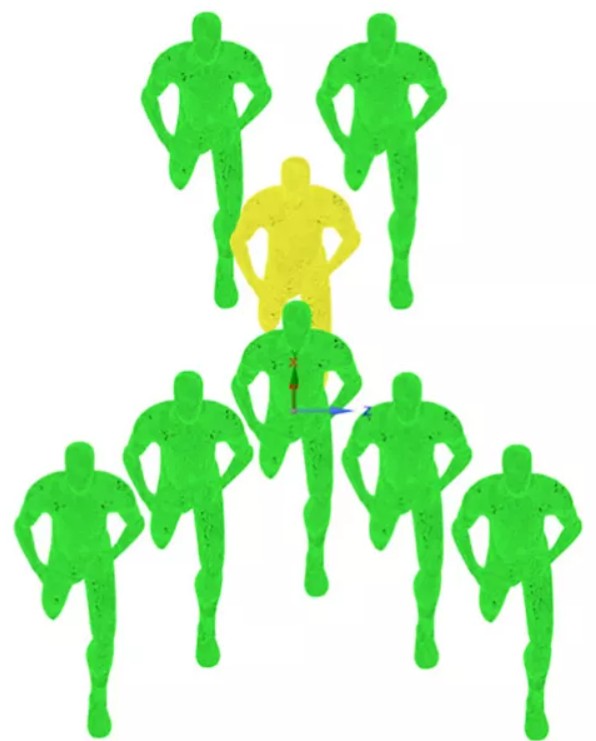
The formation used by Eliud Kipchoge in the 2019 INEOS challenge. This unique formation results in 74% less drag compared to running solo. (Source: Ansys Blog).
The formation used by Eliud Kipchoge in the 2019 INEOS challenge. This unique formation results in 74% less drag compared to running solo. (Source: Ansys Blog).
Aerodynamic simulation offers a way to improve marathon performance by helping runners conserve energy behind pacers. The Ansys article explains how computational fluid dynamics informed drafting strategies and anticipated the possibility of an official marathon finish under two hours.
Eliud Kipchoge’s earlier attempts established the importance of aerodynamic protection. He finished Nike’s 2017 Breaking2 event in 2:00:25, then completed the 2019 INEOS challenge in 1:59:40. However, the assistance used during the latter event prevented recognition as an official world record.
Researchers used Ansys Fluent to evaluate 12 running configurations at different speeds. Digital human models reproduced elite runners’ dimensions and posture, while simulations calculated air resistance around the main runner and pacers. Comparing formations showed that positioning matters as much as the number of athletes providing shelter. Running directly behind one pacer could reduce drag by approximately 43% compared with running alone.
The research combined aerodynamic calculations with models of running energy expenditure to estimate potential time savings. Its proposed strategy balanced the lead runner’s energy budget against the pacers’ ability to maintain speed. Keeping pacers involved longer extends protection, but slowing excessively to preserve them can undermine the finishing time. The resulting framework projected that Kipchoge could have completed his 2022 Berlin Marathon in 1:59:48 with improved drafting and pacing.
A separate analysis projected a possible 1:57:34 for Kelvin Kiptum, whose actual 2023 Chicago time was 2:00:35. These figures represent modeled possibilities rather than performances achieved on the road.
The article highlights Sabastian Sawe’s 1:59:30 London Marathon finish in April 2026, emphasizing his extended protection behind pacers. It argues that gains remain possible through optimized formations. However, the featured simulations lacked direct experimental validation and excluded external environmental factors, making their predictions conditional rather than guaranteed. For engineers, the story illustrates simulation’s role in evaluating tactics alongside physical capability.
Spacio’s Traffic Noise beta brings acoustic feedback into early building design, when changing a project’s shape and layout is still affordable. The Spacio article argues that conventional noise reports often arrive after building massing is settled, leaving architects to compensate with expensive glazing, ventilation, or revised floor plans.
The tool focuses on practical decisions: whether buildings have a quiet side, which facades suit bedrooms, and where nighttime noise permits open windows. Results use national guidance for Norway, Sweden, and Denmark, with the World Health Organization’s guideline elsewhere. Nighttime exposure is assessed against the WHO’s 45-decibel recommendation.
Users place a study area around their buildings and review nearby transport sources. Street inputs include speed, daily traffic volume, and heavy-vehicle share. Norway’s national road database supplies counts where available; other locations rely on street-type defaults unless users provide data. Railway and tram sources can also be adjusted.
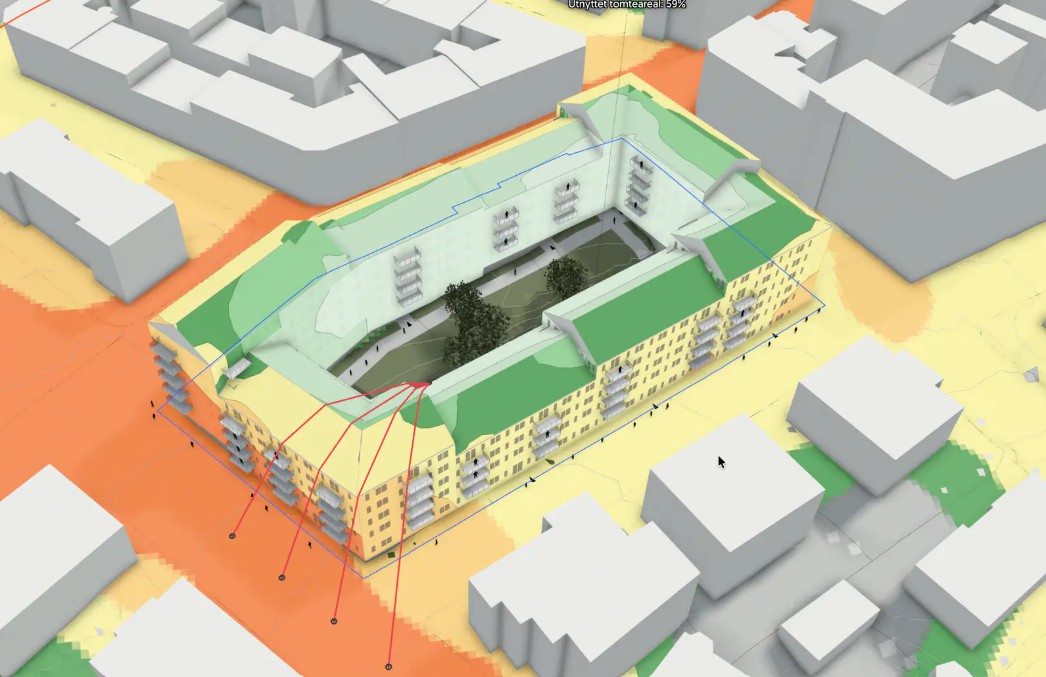
Results appear across ground surfaces, facades, roofs, and individual spaces. An inspection mode traces sound paths and identifies the roads contributing most to exposure. Architects can then test changes such as closing courtyard gaps, raising roadside blocks, or rotating buildings. Additional scenarios examine speed reductions, soft ground, quieter asphalt, and absorptive facades, with assumptions identified.
Spacio uses the CNOSSOS-EU assessment method. The company reports passing seven reference tests and matching NoiseModelling closely on a shared test scene. Comparisons with consultants’ models were typically within three decibels, but no field measurements have validated the tool.
The beta also compares results with official noise maps in selected locations. However, it provides early design guidance rather than compliance certification, excludes aircraft and industrial noise, and does not model maximum nighttime levels. It requires a WebGPU-capable browser. Its purpose is to help architects bring better layouts to acoustic consultants, reducing costly surprises before detailed design decisions become difficult to reverse.
Bentley’s OpenPlant 2026 targets the obstacles that slow industrial plant design: repetitive tasks, scattered project information, coordination difficulties, and sluggish performance in large models. The release combines AI assistance with improvements to collaboration, drawing production, data exchange, and modeling speed, tells Bentley.
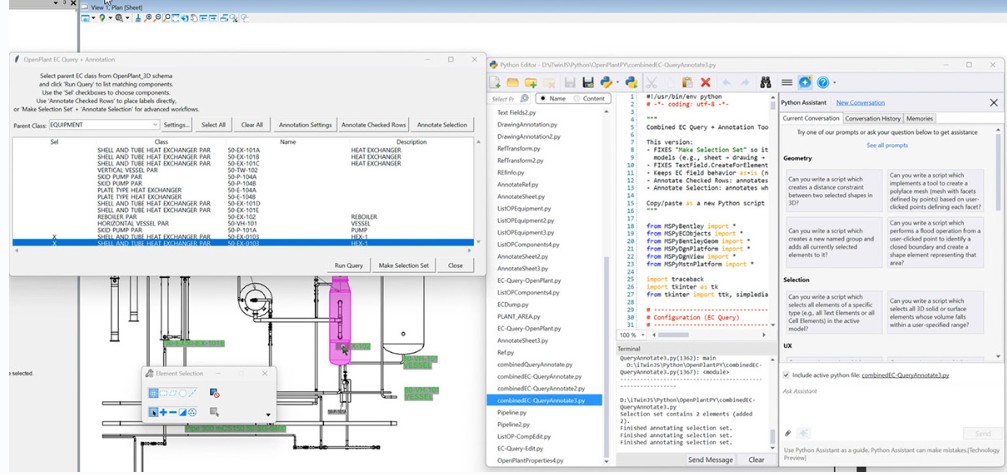
Python Assistant brings natural language automation to OpenPlant Modeler. Built on MicroStation’s scripting foundation, it allows users to create reusable workflows for reporting, data extraction, component placement, equipment creation, and model updates. Bentley presents the tool as a way to make automation accessible and standardize processes that require manual work.
Bentley Copilot focuses on learning and workflow guidance. Users can ask questions within the application and receive contextual documentation and step-by-step instructions. This could help new designers become productive sooner, particularly those moving from AutoCAD-based workflows, while reducing time spent searching for help outside the design environment.
Performance improvements address the demands of large, multidisciplinary projects. OpenPlant Modeler offers faster check-in and update operations, better responsiveness during component-based modeling, and refinements to synchronization when working with reference data. Enhanced locking capabilities support collaboration in shared project environments and help reduce access bottlenecks.
Bentley Raceway and Cable Management also receive upgrades. These include faster Cable Manager loading, quicker routing model refreshes, accelerated automatic cable routing, and faster saving of routing results.
For project deliverables, the release improves the stability, consistency, and usability of isometric drawing production. Interoperability updates support more reliable migration of older AutoPLANT projects. Improved IFC exports automatically include OpenPlant schemas and project data, helping stakeholders exchange information across software platforms.
Reality context enhancements let teams incorporate two-dimensional and three-dimensional map data into their design environment, providing better spatial context for coordination and decisions. Together, these changes position OpenPlant 2026 as a practical productivity update for engineering teams managing complex facilities, distributed contributors, and demanding delivery schedules and budgets.
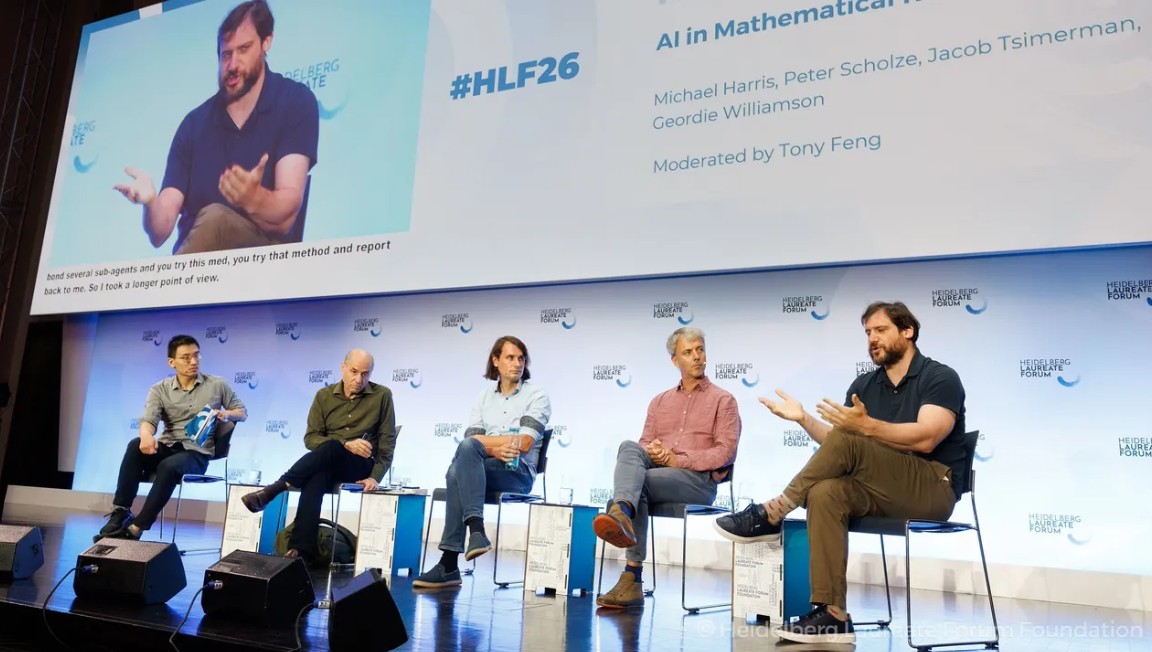
The panellists of the Heidelberg Laureate Forum 2026’s AI in Mathematics panel. From right to left: Jacob Tsimerman, Geordie Williamson, Peter Scholze, Michael Harris and moderator Tony Feng. (Source: Bernhard Kreutzer for the Heidelberg Laureate Forum Foundation).
The panellists of the Heidelberg Laureate Forum 2026’s AI in Mathematics panel. From right to left: Jacob Tsimerman, Geordie Williamson, Peter Scholze, Michael Harris and moderator Tony Feng. (Source: Bernhard Kreutzer for the Heidelberg Laureate Forum Foundation).
OpenAI’s claim that 10,000 AI agents solved the Navier-Stokes existence-and-smoothness problem has sparked a dispute over research ethics and the purpose of mathematics. Live Science reports on the debate at the Heidelberg Laureate Forum, where mathematicians offered sharply different views of AI’s growing role.
Tristan Buckmaster and Levent Alpöge allege that OpenAI learned about their ongoing research, rushed to beat them to publication, and discouraged them from speaking publicly. Columbia University mathematician Michael Harris criticized the company’s conduct and called for protections against actions that undermine the mathematical community.
Jacob Tsimerman, a Fields Medalist who joined OpenAI as an AI safety researcher, emphasized the claimed achievement. He suggested that AI could diminish the role of humans conducting frontier research while creating an abundance of new mathematics to explore.
Peter Scholze disagreed with that emphasis. He argued that solving famous problems matters because the methods can illuminate related questions and deepen human understanding. A lengthy machine-generated proof, he suggested, may contribute less to that goal than its headline achievement implies.
The Clay Mathematics Institute’s announcement reinforces the importance of understanding. Established in 2000, its seven Millennium Prize Problems each carry a $1 million award. The Navier-Stokes challenge concerns the existence and smoothness of solutions describing fluid motion in three dimensions. The institute welcomed the apparent breakthrough but said evaluating achievement and assigning credit would follow its unhurried process. An announcement therefore differs from a completed prize evaluation.
Meanwhile, the Association for Human Mathematics advocates protecting independent scholarship and preserving expertise developed through writing and careful thought. It warns that automated mathematics can weaken education, strain journals, and reduce opportunities for students to build deep understanding. Its response centers on collective action and policy proposals. The debate concerns who benefits from mathematical discovery and whether faster results also produce meaningful human insight.
RUEIL-MALMAISON, France, Sep 29, 2026 – Schneider Electric and Greenly are combining carbon accounting software with audits and consulting for small and medium-sized (SME) businesses. Through Schneider Electric’s Decarbonization Champion Program (DCP), partners can track Scope 1 and 2 emissions and develop reduction plans with SE Advisory Services.
The program serves panel builders, contractors and system integrators across Schneider Electric’s global partners. It is the company’s first sustainability initiative dedicated to SME partners in the electrical value chain.
Emissions Measurement and Planning
Schneider Electric estimates the program’s annual value at more than $34,000, or €30,000, per channel partner. It includes:
Greenly software to measure, visualize, track and report Scope 1 and 2 emissions.
SE Advisory Services support, including remote audits, strategy workshops and jointly developed decarbonization roadmaps.
Access to selected Schneider Electric decarbonization technologies and financial incentives.
Co-branded recognition for participating partners.
Pilot Audits Identify Potential Savings
Initial SE Advisory Services audits in the Pacific region identified potential savings at participating businesses. One contractor identified annual savings opportunities exceeding $28,500 (40,000 AUD).
A Queensland manufacturer identified more than $178,000 (250,000 AUD) in potential savings through air system efficiency, load shifting and equipment optimization. Schneider Electric reported these figures as opportunities identified through audits, not realized savings.
Schneider Electric linked the program to customer requests for supplier emissions data. It also cited the European Union’s Corporate Sustainability Reporting Directive (CSRD) and Australia’s Climate-Related Financial Disclosure (CRFD) regime as factors increasing demand for supply chain transparency.
“This program reflects our commitment as an Energy Tech Partner to creating value across our partner ecosystem. Together with Greenly, we are helping our partners build the capabilities needed to meet evolving market expectations, improve operational efficiency, and accelerate decarbonization,” said Bin Lu, executive vice president, power products, Schneider Electric. “By combining digital tools with expert guidance, we are enabling our partners to deliver long-term business value and sustainability impact.”
Alexis Normand, CEO and co-founder of Greenly added: “Many SMEs want to act on carbon reduction but lack accessible tools and guidance. By combining software with hands-on support, we aim to make decarbonization both measurable and actionable across supply chains.”
Source: Schneider Electric
About Schneider Electric
Schneider Electric, founded in 1836, is a leader in energy management and automation. Headquartered in Rueil-Malmaison, France, the company delivers digital solutions that integrate energy technologies, real-time automation, software, and services across multiple sectors. Schneider Electric serves many industries, including buildings, data centers, infrastructure, and manufacturing, helping businesses improve efficiency, safety, and sustainability. Its offerings span electrical distribution, industrial automation, and smart grid and digital building technologies. Schneider Electric operates in over 100 countries and has approximately 168,000 employees. Its ecosystem includes over a million partners, making it a key player in delivering scalable, innovative solutions for an electric and digital world.
About Greenly
Greenly, founded in 2019, develops software for corporate carbon accounting and sustainability reporting. Its tools support emissions measurement, reduction planning, supplier engagement, life cycle assessments and regulatory reporting. Customers include small businesses and large companies in manufacturing, finance, retail and technology. The software collects business data, including financial activity, energy use, cloud services and supply chain information, to calculate greenhouse gas emissions. Its reports cover Scope 1, 2 and 3 emissions and product footprints. Greenly and climate software company Normative combined operations in September 2026. The combined business serves more than 4,000 customers in more than 30 countries and tracks emissions data representing more than 500 million metric tons of carbon dioxide. It reports more than 200 employees across offices in Paris, London, Stockholm and New York.
LIVINGSTON, NJ, Sep 29, 2026 – Harell Data will deploy its platform on CoreWeave Cloud, bringing AI models to proprietary scientific datasets for training, fine-tuning and inference rather than moving the data to the models. Training jobs will run on NVIDIA A100 and NVIDIA Hopper GPUs, while raw data stays inside Harell.
“High-quality, domain-specific data is absolutely a primary catalyst for the next generation of AI breakthroughs,” said Harlan Robins, PhD, founder and president of Harell Data. “We created Harell Data to connect researchers to proprietary scientific datasets for model training and inference without requiring them to view or extract the underlying data.”
“CoreWeave gives us the scale and the technical engagement to move at the pace our customers expect,” added Saray Covey, head of operations, Harell Data.
“Biotech research teams need a cloud that lets them focus on the science and discovery rather than the systems underneath it,” said Jon Jones, chief revenue, CoreWeave. “We’re partnering with Harell Data to give researchers exactly that as their platform scales.”
Model Validation
Harell’s data partners keep validation test questions hidden from model builders. The company says builders have not seen the answers, and all results are published against a common standard.
Compute Billing and Model Sales
The platform meters compute use for each run. Data owners receive a revenue share from every training job that uses their dataset.
Model builders receive the trained model, intellectual property and the right to sell it. They can list models on the Harell marketplace under a “Models as a Service” arrangement and collect a fee each time someone runs a model.
Infrastructure Benchmarks
The announcement also cited MLPerf results and CoreWeave’s Platinum rankings in SemiAnalysis ClusterMAX 1.0 and 2.0, where it said it was the only AI cloud to rank Platinum in both. Artificial Analysis ranked Moonshot AI’s Kimi K2.6 No. 1 for inference speed and price-performance.
Source: CoreWeave
About CoreWeave
CoreWeave provides cloud infrastructure and managed services for artificial intelligence and high-performance computing workloads. The company operates GPU-based infrastructure, data centers, and software for training, inference, and large-scale AI deployment. Its services include cloud computing, Kubernetes management, storage, networking, and infrastructure orchestration. CoreWeave also develops software to manage GPU resources and computing infrastructure. Its customers include AI companies, cloud service providers, enterprises, research organizations, financial services firms, media companies, and software developers. Organizations use its infrastructure for AI model training, inference, visual effects, scientific computing, and other compute-intensive workloads. CoreWeave was founded in 2017 and is headquartered in Livingston, NJ. CoreWeave reported 2,100 employees worldwide. The company operates data centers in the United States and Europe.
About Harell Data
Harell Data, founded in 2025, is a scientific computing company based in Bellevue, Washington, U.S. Its Harell Cloud service lets research teams train and run AI models on proprietary scientific datasets. Users can search datasets, provision NVIDIA A100, H100 and H200 GPUs, train models and run predictions. Datasets cover antibody-antigen binding, T-cell receptor binding, protein stability, immune sequencing and protein interactions. Researchers can track jobs through live metrics and logs, then deploy models for inference. The service runs models against data in place, keeping raw datasets in owner-controlled environments. Data providers receive revenue shares when developers train on their datasets. Model developers retain intellectual property and may earn revenue when others use their models. Data partners include A-Alpha Bio and Adaptive Biotechnologies. Harell may add materials science and imaging datasets.
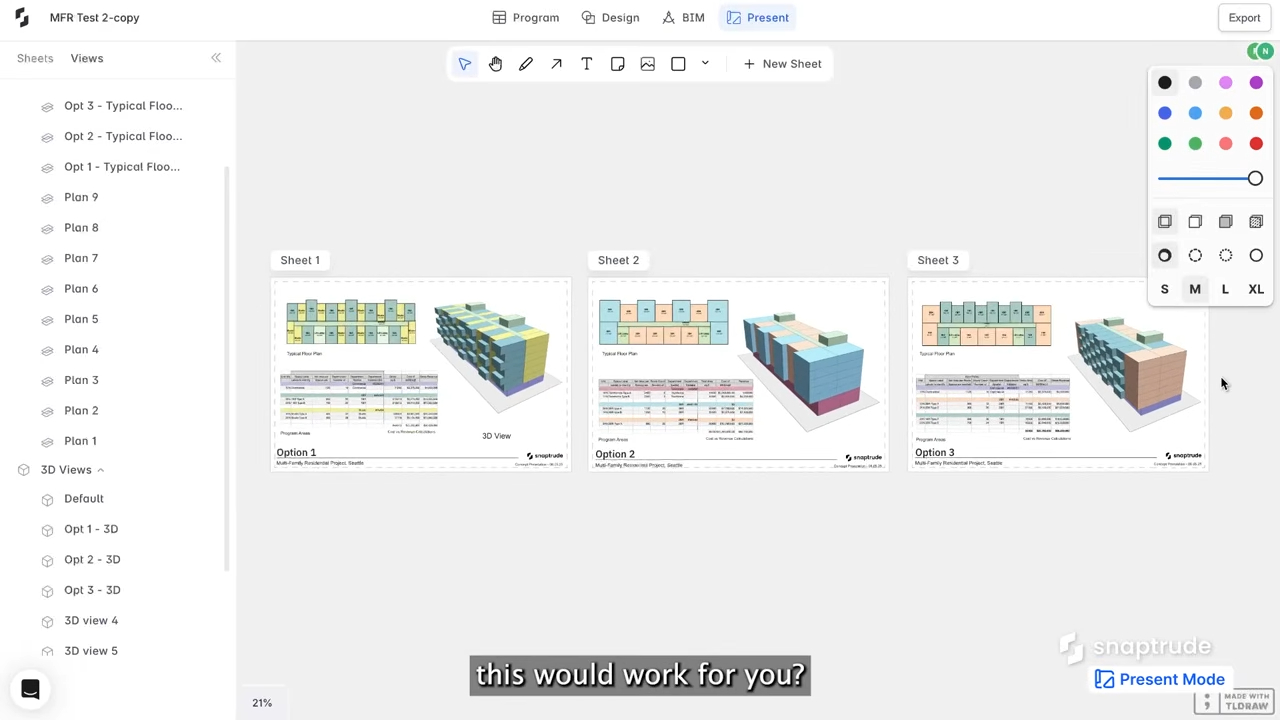
Snaptrude showing multiple BIM design options used for multi-building QA and coordination checks (source: Snaptrude).
Snaptrude showing multiple BIM design options used for multi-building QA and coordination checks (source: Snaptrude).
A multi-building BIM model can look coordinated while hiding errors in ownership, editing permissions, schedules, or exported data. Snaptrude presents a quality assurance checklist that tests whether each building remains identifiable and properly connected throughout a project’s development.
Coordinates establish how separate models relate to one another and to their site. A building’s internal coordinates describe its geometry, but linked models need shared coordinates to maintain their relative positions. Autodesk’s guidance, cited in the article, explains that teams can acquire or publish coordinates to establish these relationships. A common reference file provides the coordination basis for other models. This distinction matters because a model’s internal position and its position within a larger project serve different purposes. A dependable setup preserves both, allowing building models to work locally while participating in the same coordinated site arrangement.
The checklist also examines context isolation. When users switch buildings, editable levels, selections, newly created objects, schedule filters, and analysis inputs must follow the intended building. Neighboring structures should remain controlled references. Reopening the project should preserve the correct state.
Testing must continue through renaming, duplication, deletion, restoration, relinking, and changes to levels. These operations can expose broken references or unintended effects on other buildings. Destructive tests should use a disposable project copy.
Views, schedules, and analyses need explicit scope. Combined quantities should reconcile with individual building totals without counting linked objects twice. IFC exports require automated validation and human inspection to confirm that identities, spatial relationships, coordinates, properties, and quantities survive exchange.
Snaptrude supports collaborative modeling, documentation, schedules, quantities, and IFC export, but teams must establish acceptance criteria. The article recommends beginning with a controlled two-building model, retaining review evidence, and repeating checks when project structure or exchange settings change. Reliability depends on demonstrated behavior across the workflow, including saved and exchanged results.
NVIDIA has introduced Open Agent Safety Platform, combining OpenShell runtime controls with Sentry hardware monitoring for AI agents. The open software and reference system design covers testing and deployment across computing and robotics systems.
Organizations can deploy individual components according to their requirements. The controls operate outside the model and agent software to address attempts to bypass application-level restrictions.
“AI’s extraordinary potential for society will only be realized if we solve AI safety,” said Jensen Huang, founder and CEO of NVIDIA. “As we continue to discover the frontier of AI capabilities, we must accelerate discovery at the frontier of AI safety. Safety and security require full-stack engineering. NVIDIA Open Agent Safety Platform brings together industry, researchers and public-sector organizations to share best practices, align on evaluation methods and foster international cooperation. Together, we can raise the bar for global AI safety.”
Runtime Boundaries and Hardware Enforcement
OpenShell, now broadly available, sets runtime boundaries for agents running on CPUs. It controls task execution across open and closed models, independently of the model and the software managing the agent.
NVIDIA says OpenShell runs with minimal overhead on its Vera CPU. Developers can extend the open-source software to third-party computing platforms, including Arm and Intel.
The reference design includes NVIDIA Sentry, an out-of-band watchdog running on BlueField-4 data processing units. Sentry continuously monitors agent activity and enforces security policies independently of the software running the agent. NVIDIA says Sentry can quarantine and stop an agent within milliseconds if it attempts to leave its software boundary.
Sentry combines threat detection, hardware-based controls and data access protection within an isolated trust domain. NVIDIA describes this domain as invisible to agents and attackers and responsive in real time.
Built on NVIDIA DOCA software, Sentry inspects agent requests and responses, provides attested telemetry and verifies agent identity. It also enforces granular, zero-trust access policies for data, tools, application programming interfaces and services.
Agent and Enterprise Software Integrations
Anthropic and NVIDIA have integrated OpenShell and BlueField with Claude Managed Agents. Claude Managed Agents runs the agent loop on a separate server from the sandboxes where tasks execute. The integrations give enterprises controls over agent access through those sandboxes.
“Companies are giving AI agents more of their most important work, and they need to direct and verify what those agents do, especially in sensitive environments,” said Paul Smith, chief commercial officer of Anthropic. “Claude Managed Agents gives companies a clear view of what each agent is doing, and NVIDIA’s platform adds another layer of governance and control across hardware and software.”
SpaceXAI is using NVIDIA Open Agent Safety Platform for Cursor coding agents and Grok models.
“As customers rely more on agents to get real work done, safety should be enforced outside the model by additional controls the agent can’t get past,” said Mike Nicolls, president at SpaceXAI. “Customers should be able to set those limits for Cursor and Grok and trust they will hold.”
Scale AI is working with NVIDIA to incorporate the technologies into the agent infrastructure layer of Scale GenAI Portfolio.
“Scale AI is using the NVIDIA Open Agent Safety Platform reference design to build reliable agentic AI systems for our enterprise and government customers running mission-critical applications, with isolation, policy enforcement and auditability built in from the start,” said Francis deSouza, CEO of Scale AI. “We support agentic security with clear boundaries that define what agents can do, and controls that keep them operating within those permissions.”
Salesforce and NVIDIA have integrated OpenShell with Slack. Teams can view agent activity and audit events, then approve or reject requests for additional permissions directly in Slack.
SAP is embedding OpenShell into the Joule Studio runtime, part of SAP Business AI Platform. SAP is also contributing engineering work to OpenShell and working with NVIDIA on interoperability standards through the Open Secure AI Alliance.
Robotics, Infrastructure and Industry Participation
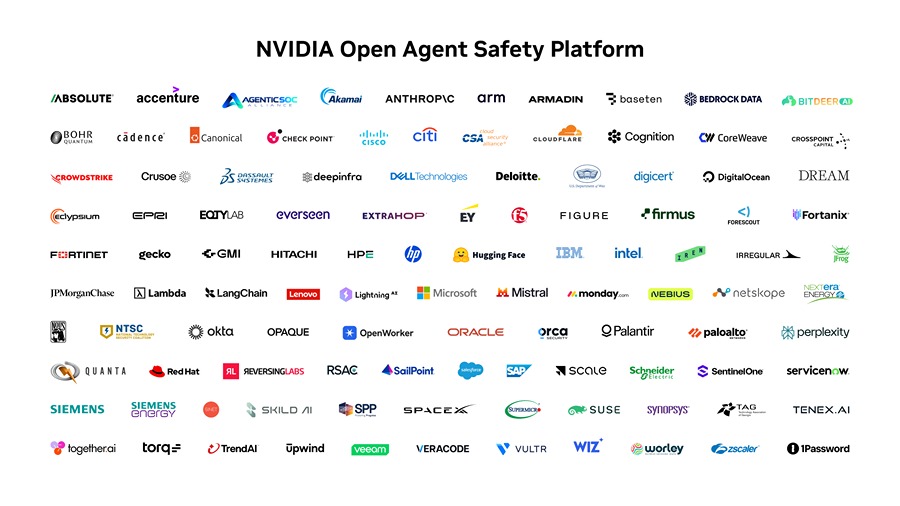
More than 100 organizations are working with NVIDIA Open Agent Safety Platform technologies. Alongside SAP and Scale AI, participants include Accenture, Armadin, Cadence, Cognition, CrowdStrike, Cisco, Dassault Systèmes, Deloitte, EY, Hugging Face, IBM, Irregular, Perplexity, Microsoft, ServiceNow, Siemens, Synopsys, OpenClaw, Palantir and Palo Alto Networks.
Figure, Gecko Robotics and Skild AI are building with OpenShell to incorporate agent safety controls into autonomous systems. Citi and JPMorgan Chase are collaborating with NVIDIA on shared open-source agent safety technologies.
Energy and infrastructure participants include Hitachi Energy, EPRI, NextEra Energy, Quanta Services, SPP, Schneider Electric, Siemens Energy and Worley.
Canonical, SUSE and Red Hat are integrating the technologies into operating systems. Red Hat runs OpenShell and DOCA on Red Hat AI Factory with NVIDIA, which supports building, deploying and managing AI across hybrid cloud environments.
Infrastructure providers offering systems that use or support the technologies include Baseten, Cisco, CoreWeave, Dell Technologies, GMI Cloud, HPE, HP Inc., Irregular, Lenovo, Microsoft, Nebius, Oracle Cloud Infrastructure, Supermicro and Together AI.
Availability and Open-Source Work
NVIDIA Open Agent Safety Platform software, including OpenShell and skills, is available through NVIDIA’s developer resources and GitHub.
The initiative supports the Open Secure AI Alliance, which NVIDIA initiated alongside more than 120 organizations. Governed by the Linux Foundation, the alliance supports open research, skills, tools and projects, including the Shared AI Findings Exchange (SAFE).
Source: NVIDIA
About NVIDIA
NVIDIA, founded in 1993 and headquartered in Santa Clara, CA, designs and manufactures graphics processing units, systems on chips, networking hardware, and AI intelligence software such as CUDA. Its products serve industries including gaming, data centers, autonomous vehicles, professional visualization, robotics, health care, and energy. The company introduced the GPU in 1999 and later expanded into accelerated computing and AI infrastructure. In gaming, its GPUs support high-performance rendering, while in AI and high-performance computing, its systems provide the infrastructure for training and deploying large-scale models. NVIDIA also develops tools for robotics and autonomous driving.
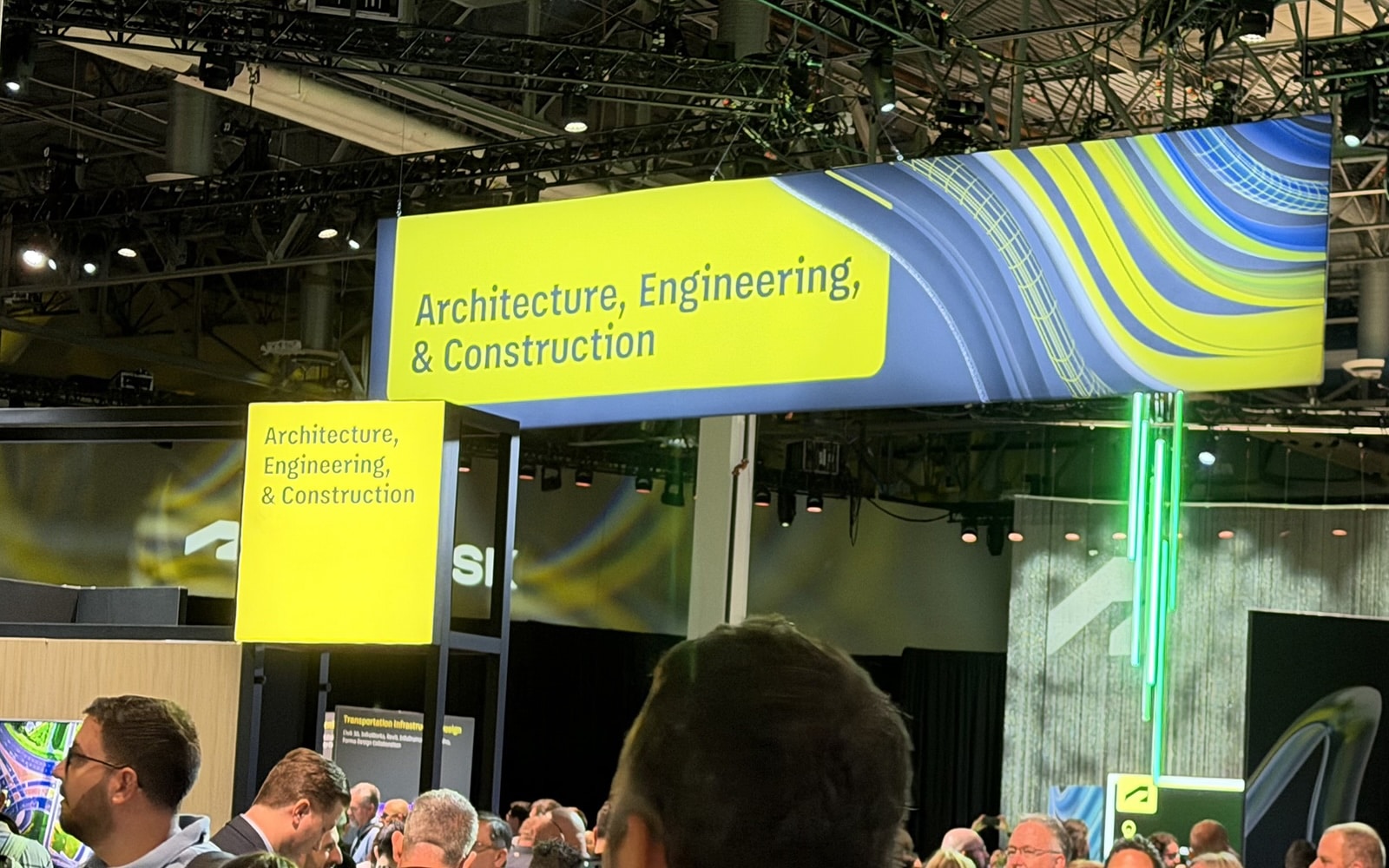
Forma is the cloud centerpiece of Autodesk’s AEC strategic direction for the global construction industry. Its booth at AU26 was jam-packed with attendees looking at how the Forma platform delivers new capabilities that traditional desktop-era software cannot, plus showing new AI and automation features across tools, including Autodesk Revit. (Source: Architosh).
Forma is the cloud centerpiece of Autodesk’s AEC strategic direction for the global construction industry. Its booth at AU26 was jam-packed with attendees looking at how the Forma platform delivers new capabilities that traditional desktop-era software cannot, plus showing new AI and automation features across tools, including Autodesk Revit. (Source: Architosh).
At Autodesk University 2026 in Las Vegas, the company presented a vision for connecting design, construction, manufacturing, entertainment, and operations through shared data and AI. Architosh’s report focuses on three clouds, Forma, Fusion, and Flow, alongside agents that could perform tasks rather than answer questions.
In architecture and construction, Autodesk is extending Forma beyond design. Its links with Revit and Civil 3D aim to keep project information consistent across disciplines and stages. Forma Board displays design information and changes, while a geolocation engine should reduce alignment problems between applications. Forma Street Design lets planners examine roads, intersections, transit, and buildings. Construction tools include Workflow Studio and a Daily Log Agent that turns a superintendent’s voice memo into a record. Agents address document search, submittals, drawing reviews, and bids.
Autodesk Assistant is evolving toward a standalone experience that draws on project data across products. Architosh notes that this version is not yet available and that details about timing and pricing are expected. In operations, Autodesk’s acquisition of MaintainX and its work with Tandem point toward connecting digital twins with maintenance and performance data.
Fusion demonstrations showed AI assisting with product assembly, design changes, and documentation. AutoAssemble placed components in a lawnmower model, while Auto Timeline Generator revised a part after a clearance issue surfaced. Inventor and Vault are becoming Fusion Connected Clients, and an Agentic Task Board aims to coordinate work as it moves between people. For media production, Flow demonstrations combined AI-generated models, rigging, performance capture, and animation.
The report describes a Fallingwater restoration exhibit built from laser scans and a digital model. Across these examples, Autodesk’s goal is to link information through a project’s life. The test will be whether the connections and agents preserve accuracy, support review, and save time on work, especially where features remain in development.
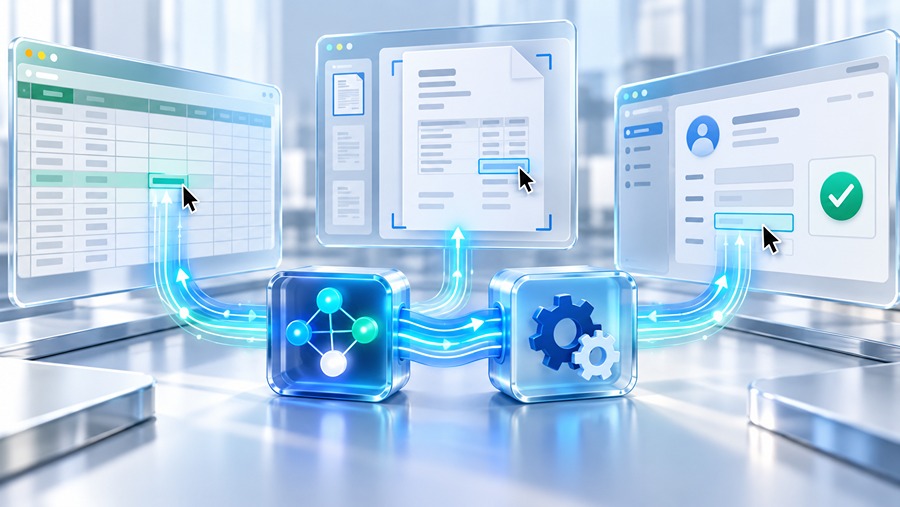
Robotiq.ai supplies software used by banks, insurance groups and telecommunications providers. Its software includes audit logs and flexible deployment options. HCLSoftware describes Robotiq.ai’s security as ISO-certified standard.
“Enterprises are looking beyond AI experimentation toward production-scale automation that is secure, governed and reliable,” said Kalyan Kumar, president, HCLSoftware. “Robotiq.ai strengthens HCL UnO Agentic by combining orchestration with enterprise-grade execution, helping customers confidently deploy and scale agentic AI across their operations.”
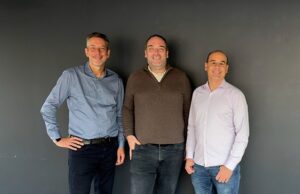
“We built Robotiq.ai on a simple belief: automation should be useful, fast to deploy, and reliable in production,” said Darko Jovišić, CEO & co-founder, Robotiq.ai. “Joining HCLSoftware gives our technology the enterprise reach, scale, and platform. Together with HCLSoftware, customers get automation that doesn’t stop at the task – it becomes part of an orchestrated, governed process across the entire enterprise.”
The acquisition is expected to close in November 2026.
Source: HCLSoftware
About HCLSoftware
HCLSoftware, formed in 2019 as HCLTech’s software division, develops enterprise software. The company is headquartered in Noida, India, and serves more than 20,000 organizations worldwide. Its product areas include customer and employee experience, business applications, data analytics, intelligent operations, automation and cybersecurity. Products include HCL Domino, AppScan, BigFix, Commerce, Volt MX and Actian. Customers include large companies and government agencies in financial services, manufacturing, retail, health care and telecommunications. They use its software for collaboration, digital services, IT operations, application development and security. HCLTech consolidated its software product families under the HCLSoftware name in 2022. The company reports more than 8,000 employees across 130 countries.
About Robotiq.ai
Robotiq.ai is a robotic process automation company founded in 2018 and based in Zagreb, Croatia. It develops software bots that automate back-office tasks, including data entry, reporting, reconciliations and enterprise resource planning work. Its software connects desktop applications, legacy systems, enterprise resource planning software and application programming interfaces. It includes process monitoring, exception handling, access controls and audit logs. Customers use Robotiq.ai in banking, insurance, telecommunications, finance, manufacturing, distribution and hospitality. Applications include invoice processing, customer onboarding, timesheet management, financial reconciliation and human resources administration. The company also provides consulting, implementation, monitoring and support. Robotiq.ai also works with Workato’s integration platform.