TORRANCE, CA, Sep 30, 2026 – Navitas Semiconductor will develop 10 kV silicon carbide (SiC) insulated-gate bipolar transistors (IGBTs) and associated PiN diodes under a U.S. Army prototype program, known as ALATTIS (Accelerated, Large-Area, 10 kV SiC IGBT). The project aims to establish and validate a manufacturing process through repeated design, fabrication and testing. The Army Research Laboratory, part of the U.S. Army Combat Capabilities Development Command (DEVCOM), sponsors the project.
The Joint Experimentation and Technology Accelerator (JETX) supports the program, which covers power semiconductor devices rated at 10 kV and above. Applications include high-power electronics for military systems and critical infrastructure.
Navitas plans to build the IGBTs using trench-assisted planar (TAP) architecture and integrate them with PiN diode technology. TAP currently underpins MOSFETs in the company’s GeneSiC portfolio, which spans voltage ratings from 650 V to 6.5 kV. According to Navitas, the portfolio uses a U.S.-anchored supply chain for engineering, manufacturing and support.
“The ALATTIS award marks a significant milestone in advancing ultra-high-voltage silicon carbide (SiC) power devices and recognizes Navitas’ over 20 years of innovation in delivering reliable, ultra-high-voltage, high-power SiC technologies,” said Siddarth Sundaresan, SVP and chief technology officer at Navitas. “This program enables Navitas to extend its leadership beyond SiC MOSFETs by developing next-generation 10 kV SiC IGBTs built on our unique, patented trench-assisted planar (TAP) architecture and integrated with advanced PiN diode technologies.”
Source: Navitas
About Navitas
Navitas Semiconductor, founded in 2014 and headquartered in Torrance, CA, designs and manufactures power semiconductors based on gallium nitride (GaN) and silicon carbide (SiC) technologies. Operating under the GaNFast and GeneSiC brands, the company develops integrated GaN power ICs and SiC devices for use in applications such as AI data centers, electric vehicles, renewable energy, energy storage, industrial systems, and consumer electronics. The company employs approximately 280 people. GaNFast ICs combine power switching with control, sensing, and protection features, while GeneSiC devices target high-voltage and high-reliability applications. Navitas holds over 300 issued or pending patents and offers a 20-year warranty on its GaNFast products. It is also recognized as the first semiconductor company to achieve CarbonNeutral certification.
Robotics needs better training data, but supplying it does not automatically make a sustainable business. Hardware FYI examines that distinction through the closure of Eidon, a startup collecting data for robots.
Video is becoming less commercially distinctive. More valuable recordings require specialized collection hardware, bringing shipping costs, sensor calibration, equipment failures, and data quality checks. Providers must manage the demands of physical products alongside the information they sell.
Their customers may eventually become competitors. Robotics laboratories want deployed machines to gather experience that improves their models. External collectors help establish this process, but demand for their services could shrink once laboratories generate enough data themselves.
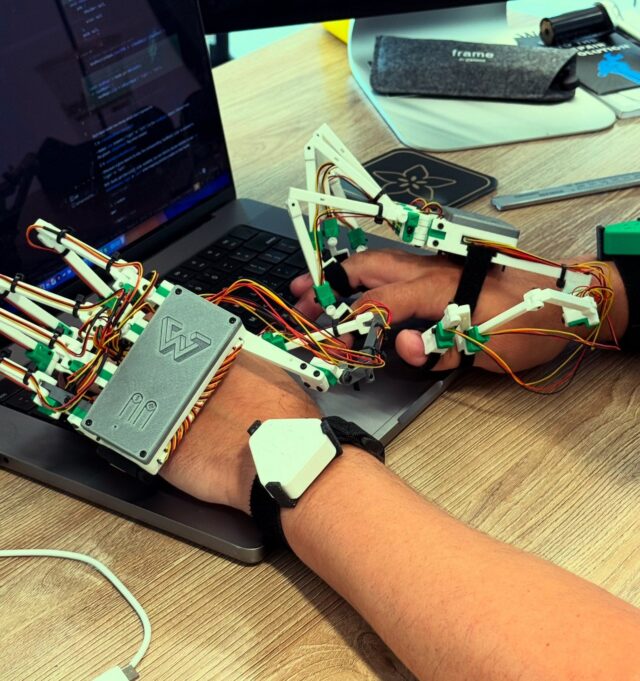
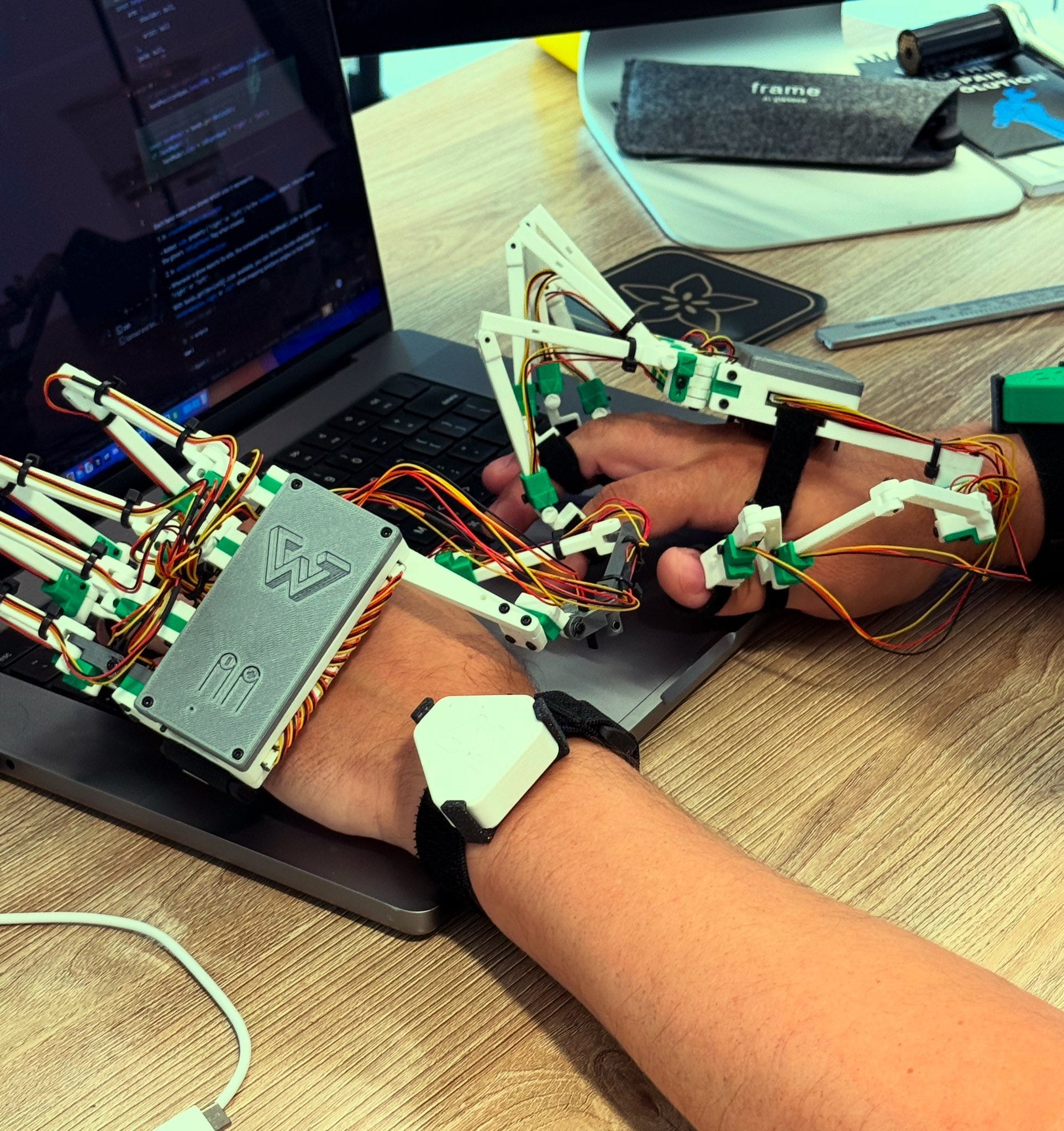
The newsletter also highlights interfaces that translate human demonstrations into robot training examples. These must balance natural human movement with robot mechanics. Adding dexterity introduces motors, tendons, and linkages that increase friction, wear, and failure risks.
Other selections explore giving unused industrial equipment to researchers and making chip design accessible through inexpensive student tapeouts. Together, these examples connect engineering opportunities with the practical resources needed to pursue them.
A featured examination of SpaceX’s Raptor engine offers another perspective on difficult hardware development. Its cleaner appearance reflects substantial engineering work beneath the surface. Raptor uses two preburners, producing fuel-rich and oxygen-rich streams that drive turbines before entering the main combustion chamber. This arrangement demands complexity even when the finished engine looks simple.
SpaceX reduced hardware by removing development sensors, combining valves, replacing bolted connections with welds, and moving plumbing inside components through metal additive manufacturing. These changes required extensive testing and refinement. Welding reduces potential leak points but makes servicing harder, illustrating the tradeoffs behind component reduction.
The Raptor example reinforces the newsletter’s interest in demanding engineering problems: apparent simplicity can depend on years of experimentation, manufacturing improvements, and careful decisions about which complexity to retain.
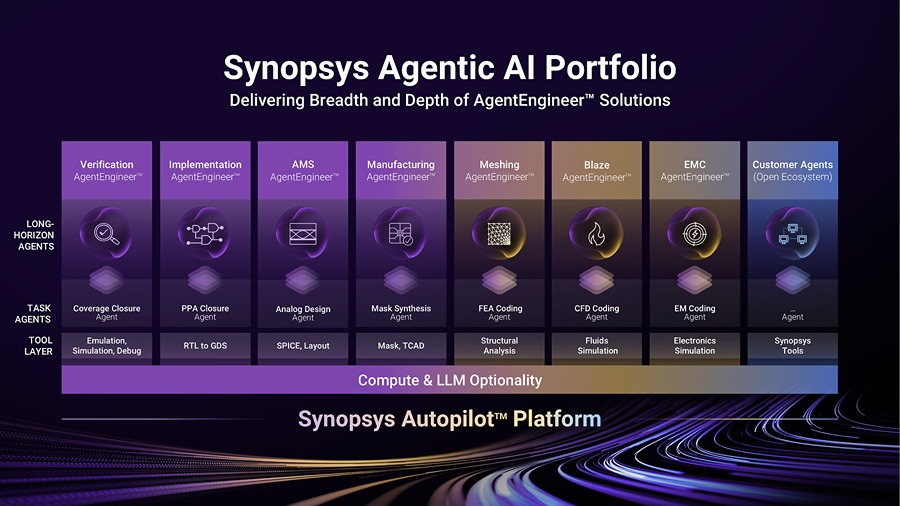
Synopsys Powers Autonomous Engineering with a Broad Portfolio of Long-Horizon Agents and Autopilot Platform
(Image: Synopsys)
Synopsys Powers Autonomous Engineering with a Broad Portfolio of Long-Horizon Agents and Autopilot Platform (Image: Synopsys)
SUNNYVALE, CA, Sep 30, 2026 – Synopsys’ new AgentEngineer portfolio uses AI agents to plan and execute chip and systems engineering workflows through its Autopilot Platform. The agents cover verification, system validation, implementation, analog design, manufacturing, and simulation and analysis.
“Our customers are re-engineering their engineering workflows across semiconductor and systems products to keep pace with increasing system complexity and tight market windows,” said Ravi Subramanian, chief product management officer at Synopsys. “Synopsys’ portfolio of AgentEngineer solutions and the Autopilot Platform enable customers to accelerate their shift from AI-assisted design to autonomous engineering, built on trusted EDA and simulation and analysis engines.”
Engineering Workflows and Tasks
AgentEngineer combines agents that manage extended workflows with agents assigned to specific tasks. Both use Synopsys electronic design automation (EDA) and simulation and analysis tools.
Supported tasks include autonomous coverage closure, software bring-up and validation, multi-die 3DIC assembly, and power, performance and area (PPA) closure. Other applications include analog layout synthesis, design migration, mask synthesis, combustion, resonance and signal integrity analysis.
Orchestration and Data Controls
The Autopilot Platform coordinates agents, manages access to design knowledge and controls workflow execution. It also provides telemetry and governance.
Infrastructure and model choice: Customers can use Synopsys, partner and third-party infrastructure, models, data, agents, workflows and integrations.
Engineering context: Synopsys’ cognitive model combines engineering knowledge, tools, reusable skills and memory to interpret design intent and guide workflows.
Security and data management: The platform uses access controls, encryption, runtime guardrails and configurable architecture to protect customer, partner and Synopsys intellectual property.
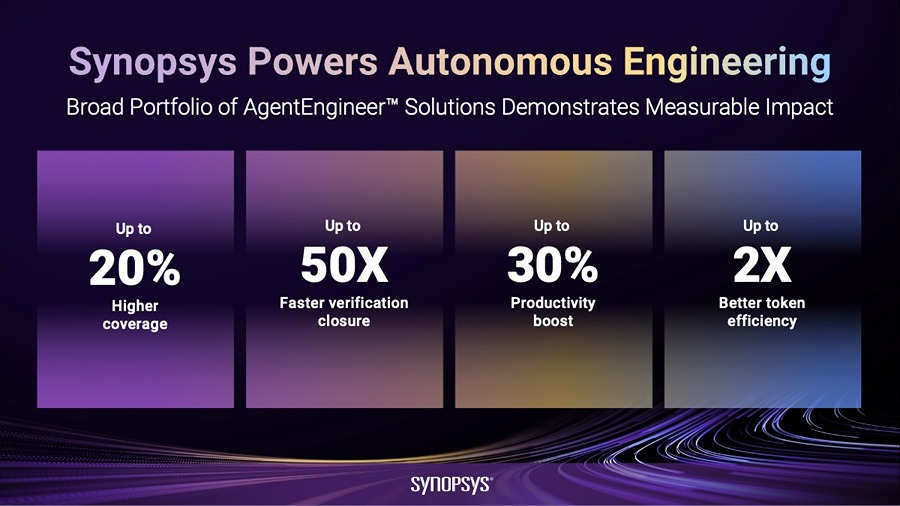
Execution efficiency: The platform uses APIs and reasoning over proprietary engineering context. This reduces token use, cost and latency; the announcement provides no comparative figures.
Customer and Technology Engagements
“As a fast-growing innovator developing next-generation processor architectures, we are continually looking for new ways to accelerate engineering execution and improve productivity across our design workflows,” said Alon Mahl, VP of verification, AheadComputing. “The Synopsys AgentEngineer technology extends AI beyond task assistance to help automate complex workflows and accelerate engineering execution. From RTL handoff through implementation, ECO, and signoff, the Synopsys Implementation AgentEngineer helped us reduce manual engineering effort and accelerate design convergence, enabling our engineering teams to focus more time on the differentiated aspects of our processor architecture.”
“We achieved a 10–30% productivity boost in RTL code generation with Synopsys Verification AgentEngineer capabilities,” said Toshio Yoshida, senior vice president and head of the advanced computing development unit at Fujitsu. “This was driven by highly efficient generation of SystemVerilog assertions, wrapper modules, and parameterized modules, as well as code refactoring.”
“Advancing the productivity and efficiency of our verification teams is critical as design complexity continues to increase across next-generation computing platforms,” said Manoj Selva, vice president, product enablement, Intel. “Our work with Synopsys Verification AgentEngineer technology highlights the promise of agentic AI for debug, enabling engineers to accelerate issue resolution across verification environments. We believe these advancements can help reduce verification bottlenecks, improve engineering efficiency, and accelerate the delivery of our silicon innovations.”
Synopsys Agentic AI Portfolio: Measurable Impact (Image: Synopsys)
“Our engineers have consistently pushed the boundaries of analog and mixed-signal design and are continuously looking for ways to dramatically enhance design and layout productivity,” said Ching San Wu, vice president of MediaTek. “Building on the successful deployment of Synopsys SmartFloorplanning Technology, we are continuing our collaboration with Synopsys on the Agentic AI AMS Platform, driving the next frontier of autonomous analog engineering flows. We believe this transformative technology will fundamentally reshape how our teams create, optimize, and implement complex AMS designs.”
“Autonomous engineering requires AI agents that understand design intent, plan and execute complex workflows, and validate their results,” said Tim Costa, vice president and general manager of industrial and computational engineering at NVIDIA. “Synopsys is combining its silicon-to-systems expertise with NVIDIA accelerated computing and NVIDIA Agent Toolkit, including NVIDIA Nemotron models and the NVIDIA OpenShell secure runtime, to build long-running agents that help engineers improve design quality and accelerate development.”
“Breakthroughs in AI increasingly depend on breakthroughs in memory: the industry calls for higher bandwidth, greater efficiency, and faster innovation cycles,” said JY Choi, executive vice president and head of memory design technology at Samsung Electronics. “Synopsys agentic AI solutions are helping Samsung’s engineering teams accelerate complex development workflows, allowing us to focus more effort on innovating the advanced memory technologies that power the next generation of AI infrastructure.”
“As AI drives the shift to multi-die architectures with unprecedented power densities, increasingly complex power delivery networks demand new approaches for power integrity signoff,” said Aveek Sarkar, director of the ecosystem and alliance management division at TSMC. “Through our enduring partnership with Open Innovation Platform® (OIP) ecosystem partners like Synopsys, we are successfully enabling agentic AI-based solutions to accelerate critical power integrity analysis workflows. As advanced packaging designs rapidly grow in scale and complexity, these AI-based solutions significantly boost engineering productivity and enable groundbreaking designs for next-generation AI systems.”
Synopsys reports more than 50 engagements involving AgentEngineer and the Autopilot Platform. Availability is planned at the end of 2026.
Source: Synopsys
About Synopsys
Synopsys Inc. is a U.S. software and semiconductor technology company founded in 1986. The company develops electronic design automation software, semiconductor intellectual property, and verification tools used to design and test integrated circuits. Its products help engineers design, simulate, verify, and manage semiconductor chips and electronic systems. Synopsys also provides software security testing and engineering analysis tools through internal development and acquisitions. The company serves semiconductor manufacturers, electronics companies, system integrators, and software developers. Its customers operate in industries such as semiconductors, automotive, aerospace, consumer electronics, telecommunications, and data centers. Synopsys is headquartered in Sunnyvale, CA. The company employs about 28,000 people worldwide and serves customers across global technology sectors. Synopsys operates offices across North America, Europe, and Asia.
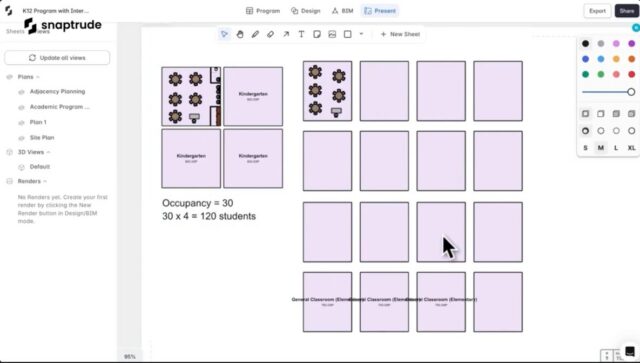
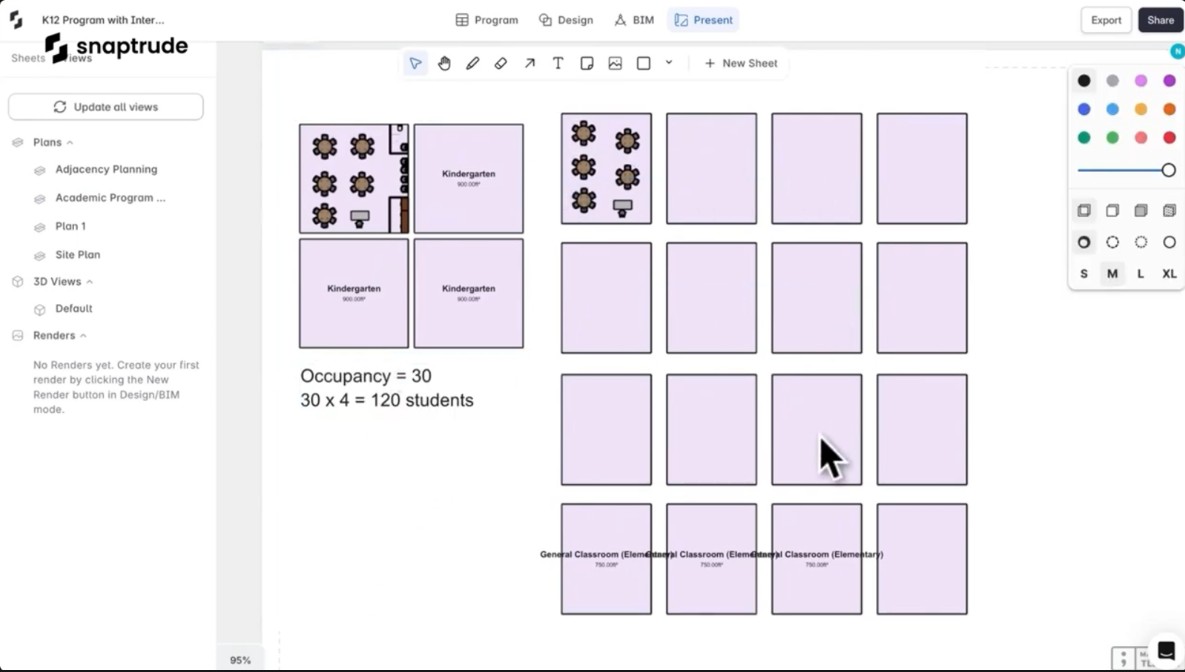
Snaptrude showing classroom program blocks aligned on a planning grid for layout acceptance checks (source: Snaptrude).
Snaptrude showing classroom program blocks aligned on a planning grid for layout acceptance checks (source: Snaptrude).
Architectural grids organize columns, walls, cores, and bays, but editing them safely requires more than moving lines on a drawing. Snaptrude’s checklist explains how teams can evaluate whether grid geometry, labels, visibility, and dependent model elements remain coordinated throughout a design workflow.
The article separates grid behavior into four areas: model location, view extent, annotation, and interaction. Each needs testing, followed by checks of their connections. Moving a datum should produce predictable changes across the model, while shortening its appearance in one view should follow defined display rules.
Initial tests cover grid creation, naming, insertion, and deletion. Teams should establish whether labels remain attached to objects or change with spatial order. Numeric spacing edits must identify which line moves and which stays fixed. Invalid values should trigger clear feedback while preserving the last valid state.
Direct manipulation deserves attention. Lines, endpoints, bubbles, and spacing handles should be distinguishable, with snapping that supports the intended action. Selection should remain predictable at building, bay, and detail scales, even when walls, columns, dimensions, and controls overlap.
Using Revit documentation as an example, the article distinguishes model-wide grid extents from presentation changes limited to individual views. Teams should record coordinates, object identities, visible extents, and affected views before and after edits, rather than relying only on screenshots.
Downstream testing includes checking bay dimensions, constrained elements, plans, elevations, and three-dimensional views. Undo, redo, saving, reopening, and relevant exports must preserve the expected model and documentation states.
Acceptance records should document setup, actions, expected outcomes, actual results, recovery, and evidence. Outcomes are classified as pass, conditional, or fail; destructive errors should block the affected workflow.
The checklist also applies to Snaptrude, but its modeling capabilities do not establish specific grid behavior. Teams must test their intended operations on representative models before approving them for project use.
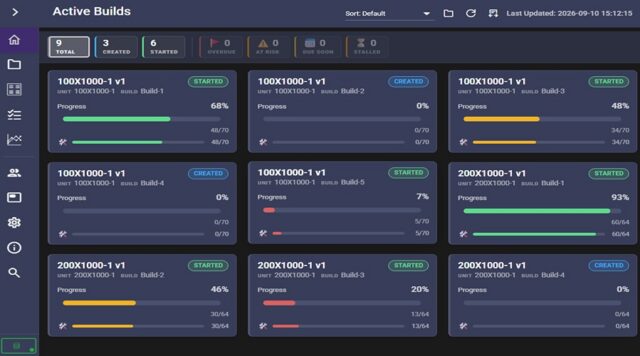
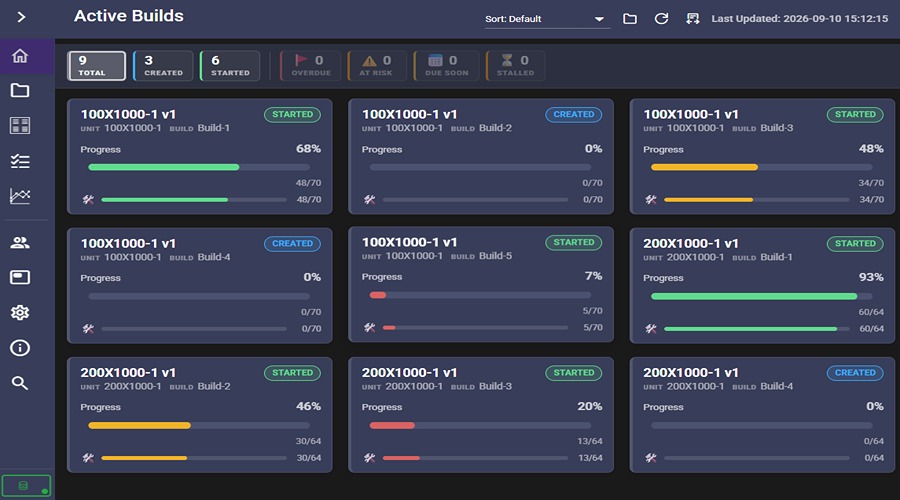
Harness Builder 2027 Active Builds screen showing build status, progress percentages, and completed task counts. (Image: Zuken)
Harness Builder 2027 Active Builds screen showing build status, progress percentages, and completed task counts. (Image: Zuken)
WESTFORD, MA, Sep 30, 2026 – Zuken’s Harness Builder 2027 for E3.series adds Dashboard, which tracks wire harness production as technicians complete tasks in Assembly Task Manager. The release also updates estimating, manufacturing tables and component modeling.
Dashboard Tracks Build Progress
Dashboard displays production data from Assembly Task Manager. Its Active Builds overview shows charts and tracking data. A single-build view includes start and completion dates, technician information, progress charts and timestamps for each task.
Assembly Task Manager creates digital work instructions from engineering designs. Its reusable task library stores text, images, videos and links. The software identifies tasks from a harness design’s parts list and proposes a workflow sequence. Production engineers review and sequence tasks before finalizing the work package.
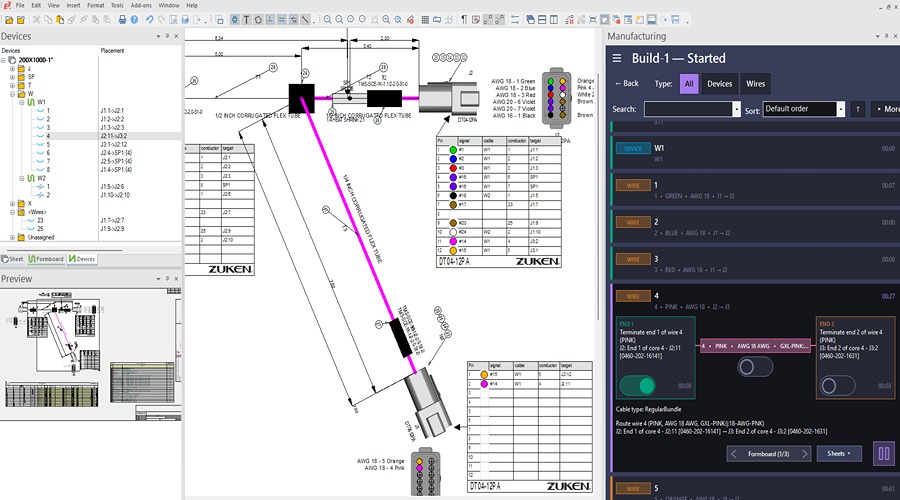
E3.series interface showing a highlighted wiring path and related manufacturing tasks in Harness Builder Assembly Task Manager. (Image: Zuken)
Technicians follow the instructions one task at a time, using supporting media and a digital harness representation. When they mark tasks complete, Assembly Task Manager records progress for Dashboard.
“Harness Builder connects the engineering definition of a harness with the information used to plan and track its production,” said Paul Harvell, vice president of engineering at Zuken USA. “Engineers can prepare tasks and manufacturing outputs within the design workflow, while production teams can follow the work and view build status from the same source data.”
Estimating and Table Controls
The Online Cost Estimator supports quantity-based estimates and subproject estimates for individual harnesses in complex, multi-harness designs. It also uses bulk pricing in its live price data to account for price breaks at larger order quantities.
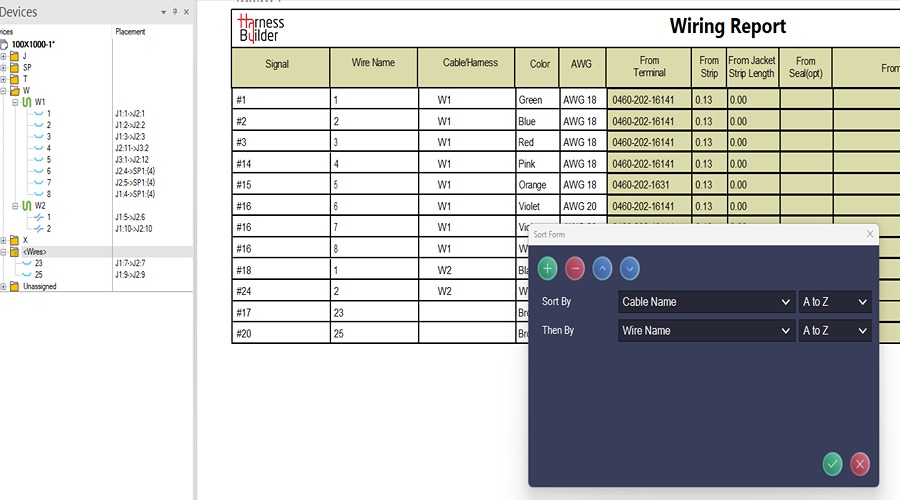
New controls apply to bills of materials (BOMs), wire run lists (WRLs) and splice tables. Multi-tier sorting organizes entries by a hierarchy of attributes. An update command can refresh tables across multiple sheets.
Harness Builder Wiring Report and multi-tier Sort Form showing Cable Name as the primary sort and Wire Name as the secondary sort. (Image: Zuken)
Connector and Cable Protection Models
BOM and WRL tables can show all three levels of a connector-with-inserts hierarchy: the housing, its inserts and the pin terminals connected to each insert.
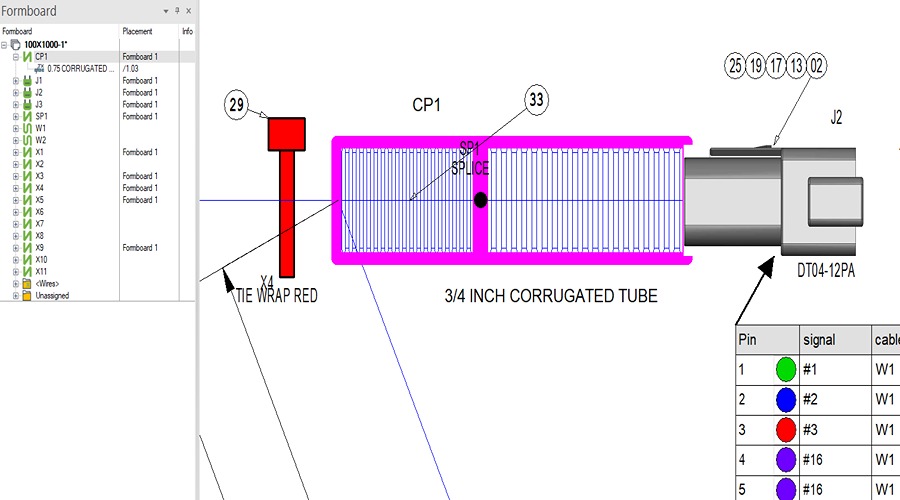
E3.series harness formboard showing three-quarter-inch corrugated tubing covering splice SP1 as one continuous segment. (Image: Zuken)
The Cable Protection utility models tubing, loom, sleeving and overbraid as one segment across a splice, rather than as separate components on either side. This representation reflects the physical assembly, improves calculations and reduces entries in the device list.
Source: Zuken
About Zuken
Zuken Inc. is a software company that develops electronic and electrical design automation tools for engineering teams. Founded in 1976 and headquartered in Yokohama, Japan, the company provides software for printed circuit board design, electrical systems, fluid systems, and 3D cabinet and wire harness layouts. Its core platforms, CR-8000 and E3.series, provide 2D and 3D system-level design environments with integrated design data and configuration management. Zuken’s software supports engineering workflows that connect design, documentation, and manufacturing processes across the product lifecycle. The company also develops tools supporting model-based systems engineering (MBSE) and digital engineering initiatives. Zuken serves industries including electronics manufacturing, automotive, aerospace, telecommunications, and industrial equipment. The company employs about 1,600 people worldwide.
SAN FRANCISCO, CA, Sep 30, 2026 – Dodge AI has raised $2.65 million for AI software that diagnoses failures and resolves incidents and change requests (CRs) across enterprise applications. The software connects information from business processes, configurations, code and support records while documenting the custom rules behind each system.
The round was led by Accel and Google’s venture arm, with participation from New Build Venture Capital, Antler, Schema Ventures and angels from the SAP ecosystem.
Dodge AI estimates that enterprises spend more than $600 billion annually maintaining business software. It describes a model in which system integrators such as Accenture, TCS and IBM assign offshore teams of 20 to 50 people to incidents, CRs and background jobs. Diagnosing failures can require information scattered across support tickets, configurations and consultants’ knowledge.
“For a long time, the only way to maintain enterprise systems was to add more people,” said Rebhav Bharadwaj, co-founder and CEO of Dodge AI. “We believe long-horizon agents can change that. Dodge AI gives enterprises the ability to continuously improve & heal their mission critical systems so incidents can be resolved faster, technical debt can be understood, and the knowledge trapped inside maintenance work can become the foundation for future transformation.”
Diagnosing Problems Across Applications
Dodge AI platform works across SAP, Salesforce, Microsoft Dynamics, Kinaxis, Oracle JDE and other enterprise systems. It analyzes ERP customizations, ITSM records and legacy configurations to identify root causes and recommend fixes.
The platform records rules and exceptions for agents working within those applications. These include warehouse-specific inventory allocation, pricing overrides and background jobs scheduled to run only at night.
“Frontier models are incredibly capable, but enterprise adoption still requires significant hill climbing. Dodge AI captures the necessary rules and exceptions for this – while self-healing your systems instead of an endless transformation project.” said Aditya Thakur, co-founder and CTO, of Dodge AI.
Customer Deployments
Dodge AI customers use the software for incident management and process optimization across applications including SAP, Kinaxis and Microsoft Dynamics. The company reports handling hundreds of queries per hour.
“Enterprises see what AI can do, but legacy IT keeps them stuck in maintenance mode. Within days of working with us, that burden lifts – and they can focus on the bigger picture.” said Aditya Patil, COO of Dodge AI.
Image: DodgeAI
In one deployment, incorrect information on a printed goods receipt note prevented a truck from loading at a warehouse. Dodge AI software traced the fault across SAP, Kinaxis and warehouse software and delivered a fix within minutes. Another customer ran inventory planning overnight because SAP crashed when the process ran in the morning. Dodge AI reports that changes made the process 132 times faster, freed the 10-person team maintaining it and shortened order allocation time by eight hours.
“Application maintenance is one of the largest and least modernized categories in enterprise technology,” said Prayank Swaroop, investor at Accel. “Dodge AI is taking on the work that keeps the world’s most important systems running every day. By starting with maintenance, the team is building the context layer enterprises need before agents can safely operate in production.”
Source: Dodge AI
About Dodge AI
Dodge AI, founded in 2025 and based in San Francisco, develops AI agents for enterprise resource planning (ERP) maintenance and modernization. Its software maps business processes, configurations, code and support records across connected applications. The agents analyze incidents, resolve recurring support tickets, investigate system failures and handle change requests. They can also produce implementation-ready WRICEF or ABAP code for review. Supported systems include SAP ECC, SAP S/4HANA, SAP Ariba, Oracle Fusion, Snowflake and Kinaxis. The company serves organizations that use ERP systems, with applications in finance, procurement, supply chain, human resources, sales and IT operations. Dodge AI reports at least 12 enterprise customers across the United States and India. It also connects with tools including ServiceNow, Jira, Slack, Gmail and Freshdesk.
RCM monitors analyzer health and generates scheduled, and on-demand reports. My Measurement Assistant+ (MMA+) gives operators a single dashboard for fleet status, device information, health reports and historical data. Genix Industrial DataOps supplies contextual data for analysis. Genix Copilot AI interprets analyzer-health data and reports to help operators investigate potential causes and determine appropriate next steps. ABB experts provide remote support when further assistance is needed.
The RCM software serves power generation, waste-to-energy, cement, metals, oil and gas, and chemical industries. These industries require analyzer availability and records to support emissions monitoring and regulatory reporting.
“Keeping emission monitoring systems running reliably is critical, but identifying the cause of an issue can still require specialist knowledge and time,” said David Lincoln, digital lead at ABB’s measurement & analytics division. “With the latest version of RCM, we’re combining continuous monitoring with AI-powered guidance to help operators spot issues earlier, understand what is happening and take action faster. This supports a shift from reactive troubleshooting toward prescriptive maintenance and a more proactive approach to analyzer health and compliance.”
RCM automatically creates an evidence log of device health status. Reports can be securely stored on premises or within MMA+, retaining analyzer performance and event histories for audits.
For ABB’s ACF5000 CEMS, RCM connects measurement and condition monitoring with AI diagnostics and ABB’s global service support. The operators benefit from automatic recording and saves health reports and service history. ABB also identifies its recently launched ACF5000 LCS (Low CEMS specialist) as a certified low-range CEMS designed to meet European IED 2.0 requirements.
Source: ABB
About ABB
ABB is a global technology company specializing in electrification and automation, with headquarters in Zürich, Switzerland, and Västerås, Sweden. Formed in 1988 through the merger of ASEA and Brown, Boveri & Cie, ABB operates in more than 100 countries and serves sectors such as utilities, transportation, infrastructure, and manufacturing. Its portfolio includes robotics, industrial automation systems, electrification products, and motion solutions. The company draws on engineering and digitalization expertise to help industries improve performance and operate efficiently. ABB has a history of more than 140 years and employs about 110,000 people worldwide.
About ABB Automation
ABB Automation is a business area of ABB Ltd. that provides industrial automation products and services. It develops and supplies control systems, programmable logic controllers, measurement devices and analytics tools. The unit supports process, hybrid and maritime industries across energy, water, materials production and transport. It serves customers in oil and gas, chemicals, metals, mining, food and beverage, water and life sciences. ABB Automation also works with marine, ports and power generation operators. The business delivers software, hardware and engineering services, including maintenance, repair, consulting, training and cybersecurity support. Its systems link field equipment with plant and enterprise operations. ABB Automation employs about 26,000 people worldwide. The company is headquartered in Zurich, Switzerland.
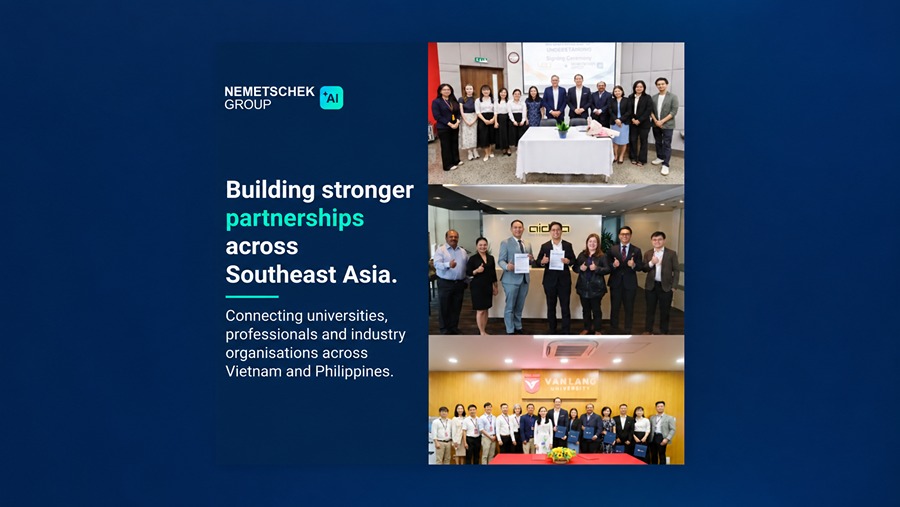
Singapore, Sep 30, 2026 – Nemetschek APAC Pte. Ltd. is expanding BIM workflows and software education through partnerships in the Philippines and Vietnam. The work spans healthcare project delivery, training and university teaching, with a focus on exchanging information across design, construction and building operations.
“Digital transformation in the built environment is ultimately about how information moves between disciplines, between technologies and across the lifecycle of a building,” said Jonathan Ng, managing director, Southeast Asia, Nemetschek Group.
“Firms need interoperable workflows that work on real projects, while professionals entering the industry need to understand how digital information is structured, exchanged and used. What we are building across Southeast Asia reflects those two sides of the transition. In the Philippines, we are working with industry to connect more of the project lifecycle. In Vietnam, we are engaging the education sector around the capabilities future professionals will need. They are different interventions, but they address the same underlying shift towards a more connected built environment.”
Project Delivery in the Philippines
Nemetschek Group will work with AIDEA on a healthcare project involving St. Luke’s Medical Center. The collaboration will connect digital tools and project information across multiple delivery stages.
AIDEA currently uses the following Nemetschek Group products:
Archicad for architectural design.
ALLPLAN for structural detailing.
Solibri for quality checking.
dRofus for project programming.
Bluebeam for communication and documentation.
RISA for engineering workflows.
dTwin for capturing asset information for facilities management applications.
“Over the years, we have seen that digital transformation goes far beyond architects using BIM. We want our design process to be highly collaborative, with different disciplines able to work together more seamlessly, while also extending our involvement beyond design into the wider lifecycle of the building,” said Ar. Abelardo ‘Jojo’ Tolentino Jr., president, AIDEA. “Our relationship with the Nemetschek Group goes back more than 20 years. This collaboration gives us an opportunity to bring different technologies together on a significant project, test new ways of working and continue evolving how we deliver projects for our clients.”
Other Philippine collaborations involve the Philippine Institute of Architects, the United Architects of the Philippines – Makati CBD Chapter, and the University of Mindanao. They cover BIM and openBIM adoption, professional development, knowledge exchange and architectural education.
Software Access and Education in Vietnam
In Vietnam, Nemetschek Group’s engagement with the education sector focuses on how digital delivery is changing the capabilities expected of future built environment professionals.
Nemetschek Group’s education engagements in Vietnam focus on structuring, exchanging and validating project information. The institutions involved are Vietnamese-German University, Van Lang University, Lac Hong University, Ho Chi Minh City College of Architecture and Construction, Hanoi Architectural University and Hanoi University of Civil Engineering.
The three-year collaboration with Hanoi Architectural University (HAU) will provide access to Archicad, ALLPLAN, Solibri, Vectorworks and Bluebeam. The partners will also explore curriculum development, student internships, lecturers, seminars and workshops.
“The next generation of built environment professionals will need more than proficiency in individual software tools,” said Assoc. Prof. Dr. Vu Ngoc Anh, Rector, Hanoi Architectural University. “They will need to understand how digital information is created, exchanged and used across disciplines and throughout a project’s lifecycle. Our collaboration with Nemetschek Group will help us bring more of that industry context into education and give students and faculty greater exposure to the workflows shaping professional practice.”
The engagements follow Nemetschek Group’s partnerships with the Institute of Technical Education (ITE) and Singapore Polytechnic (SP) in Singapore, covering AI, BIM and digital delivery capabilities.
Source: Nemetschek Group
About the Nemetschek Group
Nemetschek Group, founded in 1963 and based in Munich, Germany, is a global provider of software solutions for the architecture, engineering, construction, and operations (AEC/O) industries, as well as the media and entertainment sector. The company operates through four business segments: Planning & Design, Build & Construct, Manage & Operate, and Media & Entertainment. Its portfolio includes brands such as Allplan, Graphisoft, Vectorworks, Bluebeam, and Maxon, offering solutions for building information modeling (BIM), structural design, project collaboration, and 3D visualization. The company employs around 4,000 people and supports over 7 million users globally. Nemetschek Group continues to expand its presence in international markets, including in Saudi Arabia.
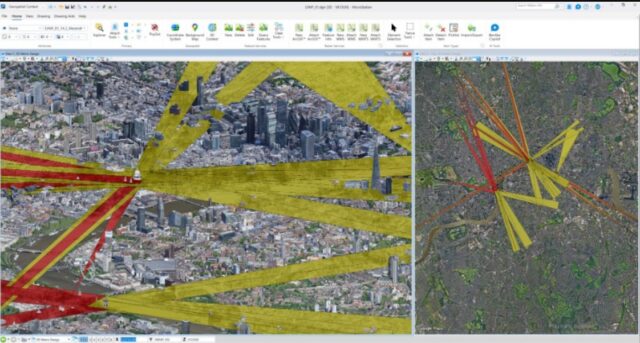
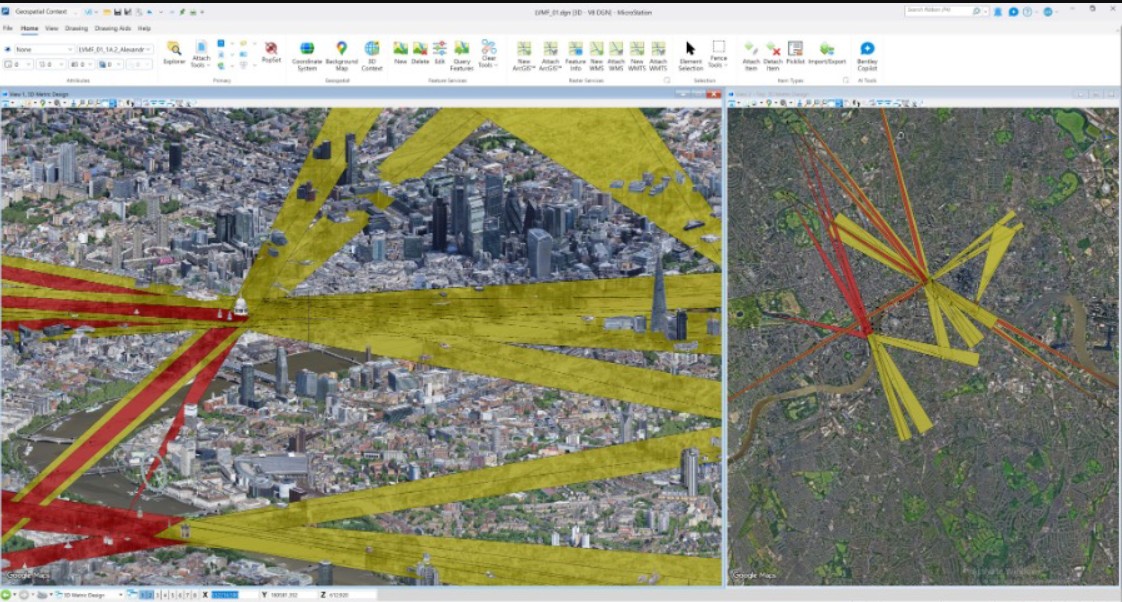
Bentley engineers are using Model Context Protocol servers to connect AI assistants with trusted engineering applications, opening new possibilities in CAD modeling, urban planning, wind farm design, and more (source: Bentley).
Bentley engineers are using Model Context Protocol servers to connect AI assistants with trusted engineering applications, opening new possibilities in CAD modeling, urban planning, wind farm design, and more (source: Bentley).
Bentley engineers are testing how AI models can connect natural language instructions with engineering software. The Bentley article describes four experiments prompted by OpenAI’s GPT-6 Astra release, showing potential applications in CAD modeling, planning, offshore energy, and scientific visualization.
Model Context Protocol servers provide the connection between AI assistants and Bentley applications. Engineers can describe tasks in plain English while software such as MicroStation, STAAD, and Power Line Systems performs the work. Bentley frames this approach around combining probabilistic AI with deterministic engineering tools and experienced practitioners.
In the first experiment, Eduardo Cortés asked AI to recreate a photographed traffic signal assembly in MicroStation. An earlier attempt produced inaccurate dimensions and omitted components. Repeating the same prompt with Astra generated a more complete model, suggesting improvements in image interpretation and the scripts used to construct geometry.
Matthew Felton explored London’s protected landmark views. Using Astra, a coding assistant, and MicroStation’s MCP server, he translated planning documents into three-dimensional volumes and sightlines. This allowed planning requirements to be examined within a design project, turning policy text into spatial information.
Ata Mesgarnejad then used a reference image to generate an offshore turbine in MicroStation and a corresponding structural model in SACS Precede. The experiment expanded into a wind farm without supplied dimensions or engineering specifications. Louis-Martin Losier animated the model and placed it off Scotland’s North Sea coast, illustrating how geographic context can support discussions about scale, site constraints, and community concerns.
Finally, Justin Dehorty used Astra and CesiumJS to visualize equations from OpenAI’s claimed Navier-Stokes breakthrough. The visualization explored a shrinking, accelerating fluid vortex associated with the mathematical result.
Together, these demonstrations suggest that AI could make engineering information easier to create, interpret, and communicate. They show exploratory workflows connecting AI instructions, engineering applications, and visual context to support infrastructure design decisions.
Markerless Accurate Multi-person Motion Acquisition, or MAMMA, takes multi-camera video, estimates virtual markers in all camera views, and then fits a human body model (SMPL-X) to these markers (source: MPI-IS).
Markerless Accurate Multi-person Motion Acquisition, or MAMMA, takes multi-camera video, estimates virtual markers in all camera views, and then fits a human body model (SMPL-X) to these markers (source: MPI-IS).
Researchers at the Max Planck Institute for Intelligent Systems and Carnegie Mellon University have developed MAMMA, a motion-capture system that reconstructs human movement from multicamera video without physical tracking markers. Its advantage is handling close interactions, including hugs, dancing, and martial arts, where people obscure one another from view, tells Tech Xplore.
MAMMA, short for Markerless Accurate Multi-person Motion Acquisition, estimates 512 virtual points on the body from video frames. It matches these points across camera views and fits the SMPL-X digital human model to recover body shape, posture, and hand movement. The underlying neural network also estimates visibility, uncertainty, and contact, helping distinguish interacting people and reconstruct plausible motion.
Traditional motion capture requires specialized studios, marker-covered suits, and manual cleanup. Markers can fall off or become hidden during physical contact, making reconstruction difficult. Commercial markerless alternatives also tend to be expensive and can struggle with complex movements.
The researchers report that MAMMA’s pose accuracy differed from a conventional suit-and-marker system by less than one millimeter in their comparison. This describes the difference between systems, rather than an overall reconstruction error below one millimeter. They also say processing was nearly three times faster than the traditional manual workflow. Demonstrations used consumer equipment, including multiple iPhones.
Potential applications extend beyond film and games. Physical therapists could monitor patients without intrusive markers, while biomechanics researchers could study movement in natural settings. Coaches could analyze several athletes without bulky tracking gear. Virtual reality developers could create expressive avatars with more realistic body and hand interactions.
For smaller studios, capturing wrestling, dancing, and other contact-heavy animation without a dedicated facility could lower production barriers. The team is sharing research data and tools with the academic community to encourage further development. Presented at CVPR 2026, the work shows how computer vision can make detailed motion capture more accessible.