Five Lessons for Integrating AI Into Embedded Software Development

Instead of just learning how to write better AI prompts, learn how to integrate AI into your workflow (source: Natee127/iStock/Getty Images Plus via Getty Images).


Artificial intelligence can accelerate embedded software development, but generating code through isolated prompts rarely delivers consistent results. In a Design News article, embedded systems expert Jacob Beningo shares five lessons from integrating AI into high-reliability firmware development, particularly for aerospace and space applications.

The first lesson emphasizes replacing occasional AI prompting with repeatable engineering workflows. Instead of simply generating code, AI agents should gather requirements, examine hardware documentation, implement software, conduct static analysis, and execute tests. Beningo demonstrates this approach using a lunar simulation involving a propulsion controller, flight computer, and orbital physics engine.

Second, AI requires complete system context. Hardware constraints, peripheral behavior, timing requirements, and software architecture influence engineering decisions. Beningo describes debugging SPI communication timeouts in a Renode microcontroller simulation. The problem originated in an incorrect emulator configuration rather than faulty firmware, demonstrating why AI must examine interacting system components.

Third, engineering decisions should become reusable project instructions. Documenting architectural constraints, coding standards, and verification requirements allows AI agents to maintain consistency across development tasks. Reusable AI skills can also prevent developers from repeatedly explaining established design rules.

Fourth, engineers should establish verification criteria before AI generates solutions. Compiling successfully does not guarantee that software satisfies architectural or safety requirements. Static analysis, automated testing, and engineering reviews remain essential, particularly when following standards such as MISRA C.

Fifth, AI should challenge engineering assumptions before implementation. For example, analyzing battery capacity, transmission frequency, and power consumption can reveal whether a proposed sensor design can achieve its intended operating life.

Beningo recommends beginning with one recurring task, creating reusable instructions, and requiring AI to demonstrate that its work meets defined expectations.

The central message is that AI delivers greater value when integrated into disciplined engineering processes. Reliable embedded software still depends on accurate system knowledge, measurable verification, and human engineering judgment.
Boston Dynamics Unveils Stretch Gen 2 for Trailer Unloading

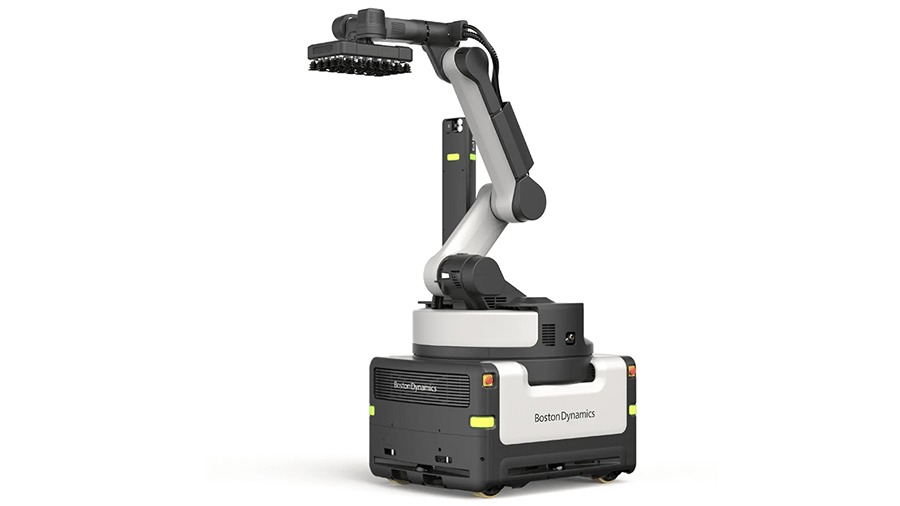
Image: Boston Dynamics

BOSTON, MA, Nov 10, 2026 – Boston Dynamics has unveiled Stretch Gen 2, a mobile robot for trailer unloading that introduces hardware changes to simplify maintenance. The redesign reduces internal cabling by 81% and uses modular components that can be replaced in less time. A full swerve drive replacement can take about one hour, compared with a full day previously.

The redesign follows an analysis of more than 100,000 operating hours and tens of millions of boxes unloaded by first-generation stretch robots. Boston Dynamics used the data to identify causes of unplanned downtime and made changes to the robot’s mechanical and electrical systems.

“Our customers count on Stretch to keep freight moving, and every hour a robot sits idle is an hour of work that piles up on the dock,” said Brian Donnelly, vice president & general manager of Logistics Robotics at Boston Dynamics. “With Gen 2, we focused on the things that actually took robots offline in the real world. We made it tougher, we made it simpler to service, and we made sure it keeps getting better long after it’s deployed.”

Stretch Gen 2 uses automotive-grade connectors to withstand vibration from high-torque box handling and uneven floors. Its upgraded gripper combines new valve systems with precise sensing for box grasping and placement. Continuous rotation joints move beyond 360° without mechanical hard stops, reducing joint stress.

Removing approximately half a mile of internal cabling addresses a major source of intermittent electrical faults and wiring wear. Boston Dynamics also lowered and recessed the emergency stop and introduced new exterior panel materials to reduce accidental stoppages and damage from falling boxes.

The modular design supports faster component replacement. Removing cables and wiring harnesses simplifies servicing, while high-strength fasteners reduce tool changes and repair time. New onboard diagnostics and maintenance tools allow maintenance teams to handle routine servicing with less support.

Computing and Unloading Performance

Stretch Gen 2 incorporates a redesigned onboard computing platform that supports software updates across deployed fleets. Regular releases improve case detection, motion planning, picking strategies and world modeling without requiring hardware changes.

According to Boston Dynamics, the robot can unload up to 1,000 cases per hour, although throughput depends on case weight, and how neatly or irregularly boxes are stacked. The battery supports two shifts of operation, while a fast charger brings it to 90% charge in approx. 75 minutes. Onboard lighting allows Stretch Gen 2 to operate inside dark trailers. Its pre-trained vision system detects most packages from initial use without programming.

Source: Boston Dynamics

About Boston Dynamics

Boston Dynamics, headquartered in Waltham, MA, develops mobile robots used in inspection, logistics and infrastructure work. Founded in 1992, the company offers products that include Spot, a four-legged robot for industrial inspection, and Stretch, a robot designed for warehouse case handling. Its customers span logistics operations, construction sites, industrial facilities and research organizations. The company serves hundreds of customers in more than 35 countries and employs about 800 people. Its systems focus on mobile operation, data collection and integration with existing workflows rather than fixed, repetitive automation.

ENCY 3.2 Adds Reusable Tool Setups, Fixture-Aware Face Milling

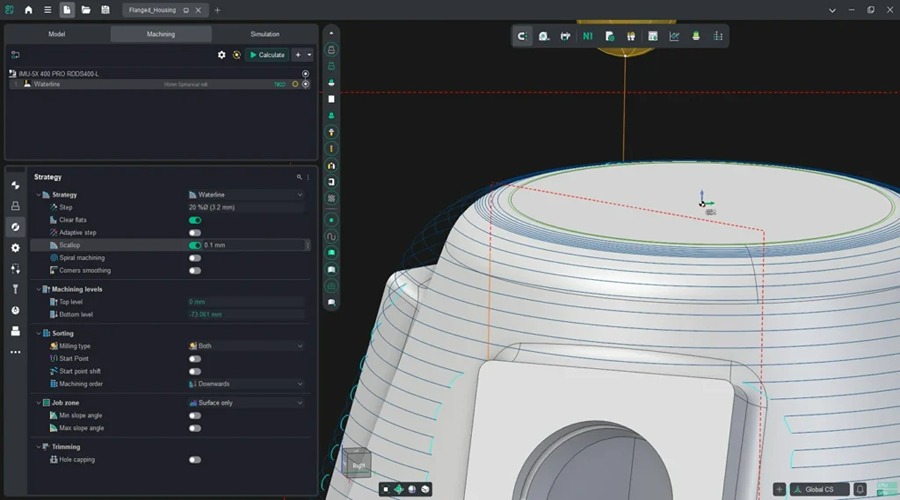
Scallop height setting in a Waterline operation. (Image: ENCY)

LIMASSOL, Cyprus, Nov 10, 2026 – ENCY has released ENCY 3.2, adding reusable tooling configurations to reduce repetitive project setup and new controls for finishing and fixture-aware face milling. The update also includes improvements to robotic machining, sheet cutting and project handling.

Programmers can save a complete tool set in assembly mode and reuse it across machining projects instead of rebuilding the configuration for each job. When multiple operations share a tool, changes to its magazine position or adapter apply across those operations, eliminating separate edits. A component panel displays occupied and available tool magazine pockets.

ENCY 3.2 also introduces drag-and-snap positioning for clamps. As users move a clamp toward the stock, machine table or fixture plate, the software highlights suitable placement levels and snaps it into position, reducing manual entry.

Finishing and Face Milling Improvements

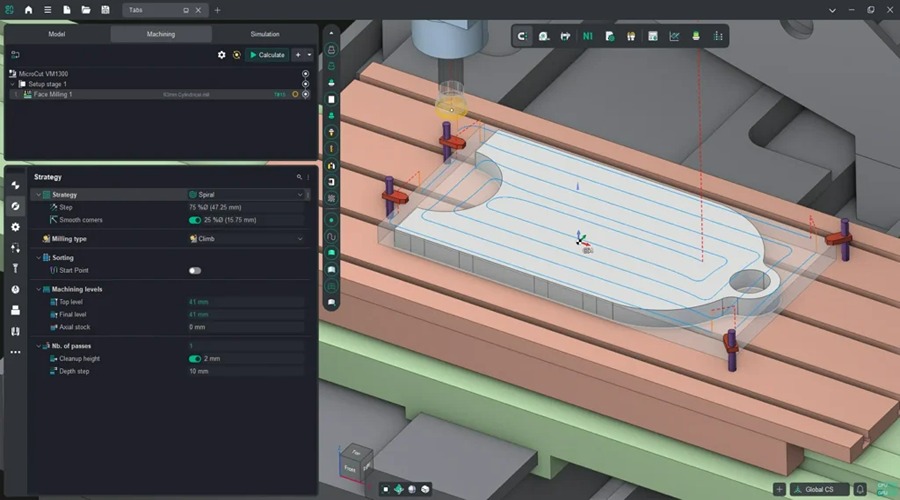
Face Milling toolpath trimmed at the clamps. (Image: ENCY)

In Combo Finish, programmers can specify scallop height to control the spacing between finishing passes. This provides a geometric limit for balancing surface finish requirements against machining time.

Roughing Waterline uses scallop height to distribute intermediate machining levels according to tool geometry. It places levels closer together on shallow slopes while avoiding unnecessary levels on vertical walls, helping control the material left for subsequent finishing.

Programmers can also complete one surface region before moving to the next without duplicating the operation, simplify adjustments to the machining sequence.

Face Milling now accounts for part and fixture geometry when calculating machining passes. Instead of generating a route around fixtures, it trims affected passes and uses a clearance plane above clamps for transfer moves. The operation also reduces unnecessary air passes over previously removed material when using a zigzag pattern.

Robotic Machining and Sheet Cutting

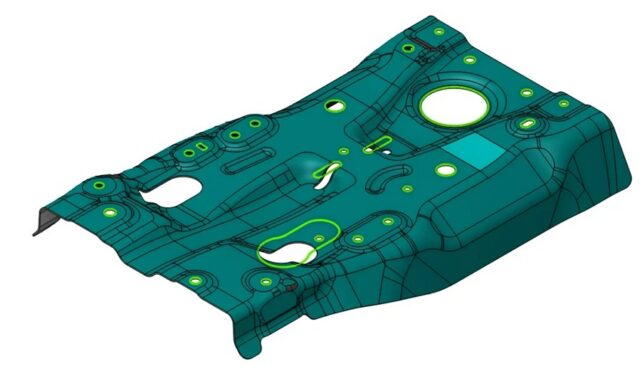
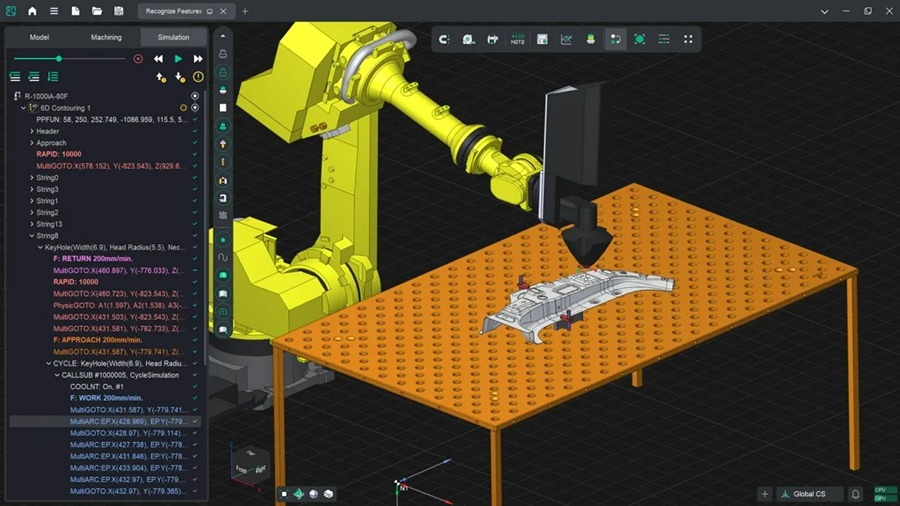
6D Contouring with recognized features on a robot cell. (Image: ENCY)

ENCY 3.2 improves feature recognition in 6D Contouring to help programmers define robotic trimming and spatial contouring operations. Supported cladding operations also gain passes across the processing zone.

For sheet cutting, the Nesting function displays the dimensions of reusable sheet remnants, helping programmers assess material available for subsequent jobs. Undo and Redo functions also cover parameter changes, allowing users to test layout settings and restore results.

Other changes include faster project opening, improvements to the feeds and speeds calculator, and fixes involving toolpath calculation, simulation, project handling and robotic machining.

ENCY 3.2 is available through the built-in updater for customers with an active Software Maintenance Contract.

Source: ENCY

About ENCY

ENCYCAM is a CAD/CAM and offline robot programming software platform from ENCY Software Ltd. The company is based in Limassol, Cyprus, and introduced the ENCY brand in 2024. ENCYCAM provides software for CNC machining, robot programming, NC code verification and manufacturing simulation. Its products include ENCY, ENCY Robot, ENCY Tuner and ENCY Hyper. The software supports milling, turning, mill-turn, Swiss-type machining, wire EDM, additive manufacturing and hybrid manufacturing. It also supports robotic milling, welding, trimming, polishing, deburring and cutting. ENCYCAM serves machine shops, manufacturers, system integrators and automation users in aerospace, automotive, metalworking, woodworking and general manufacturing. The platform includes CAD tools, simulation, post-processing and cloud collaboration through the ENCY X ecosystem.

AI-Powered BIM Tools Improve Fire-Rated Wall Design and Compliance

Source: Pirros.
Source: Pirros.


Fire-rated wall assemblies are essential to building safety, helping contain fire and smoke for specified periods. This Pirros article explains their construction, regulatory requirements, and common design errors while highlighting how AI-powered tools can improve documentation and compliance.

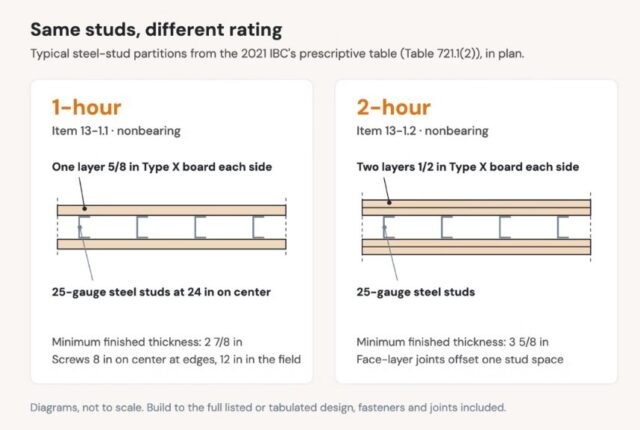
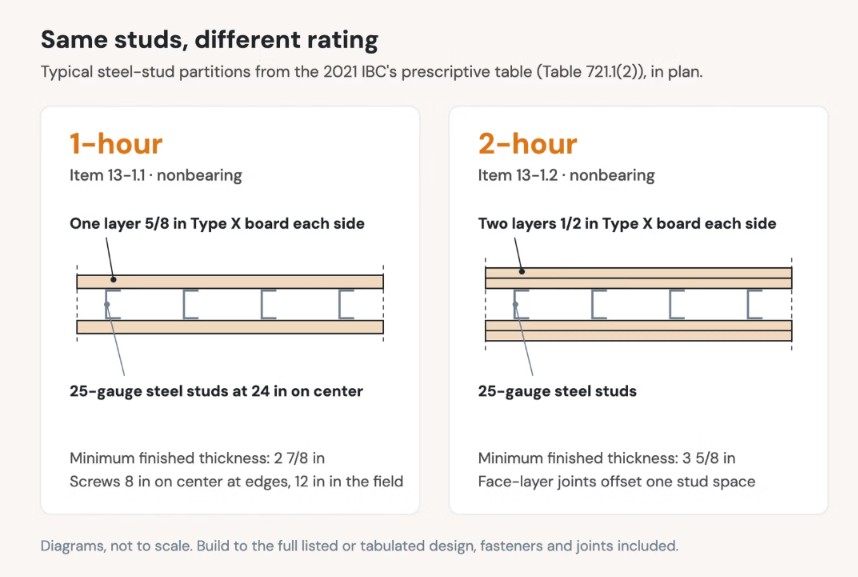
A fire-rated wall consists of framing, gypsum board, fasteners, joints, and insulation tested together to achieve a specific fire-resistance rating. Under the International Building Code (IBC), ratings can be established through standardized testing, approved construction methods, or alternative designs accepted by building officials.

Typical one-hour walls use steel or wood studs covered with a single layer of Type X gypsum board on each side. Two-hour assemblies generally require additional gypsum layers or thicker masonry. Three- and four-hour walls commonly incorporate concrete or masonry construction.

However, achieving the required rating involves more than selecting appropriate materials. Improperly sealed penetrations, inadequate head-of-wall joints, incorrect door ratings, and unauthorized material substitutions can compromise fire resistance.

Accurate architectural documentation is equally important. Designers must maintain consistent wall-type schedules, fire-rating classifications, and construction details across drawing sets. In Autodesk Revit, fire ratings should be assigned to wall-type parameters and reflected accurately in schedules and annotations.

Pirros addresses these challenges through standardized detail management and AI-assisted automation. Its platform helps architectural firms retrieve previously approved construction details, identify duplicates, and maintain consistent design standards across projects.

The company’s Mira AI agent for Revit can automate repetitive modeling tasks. For example, architects can instruct Mira to replace all instances of a particular wall type on a specified floor. The agent identifies affected elements, requests confirmation, and flags potential dimensional changes.

Pirros also offers an AI-powered Quality Management System that checks Revit models and drawing sets against building codes, including the IBC. It identifies potential compliance issues and provides references for human review rather than automatically modifying designs.

Combining standardized construction details with AI-assisted verification can reduce documentation errors, improve efficiency, and support safer building designs.

Synopsys Outlines Three Paths to Agentic AI Adoption in Chip Design

Source: Synopys.
Source: Synopys.


As semiconductor designs become increasingly complex, engineering teams face mounting pressure to accelerate development while managing limited resources. Synopsys proposes three approaches to adopting agentic artificial intelligence, allowing chipmakers to integrate autonomous engineering capabilities according to their existing infrastructure, security requirements, and technical expertise, tells Synopsys.

The company’s strategy centers on its AgentEngineer solutions and Autopilot Platform. AgentEngineer uses specialized AI agents to plan engineering tasks, execute workflows, evaluate results, and refine solutions. The Autopilot Platform provides orchestration, persistent memory, governance, and connections to electronic design automation (EDA) tools.

The first approach offers a fully integrated Synopsys environment. Engineers define objectives and constraints while AgentEngineer, Autopilot, and Synopsys EDA tools coordinate design activities. This reduces the need to develop custom integrations and manage individual automation steps.

The second approach supports hybrid or customer-built environments. Semiconductor companies can retain proprietary AI platforms, models, and workflows while incorporating Synopsys agents and engineering tools. Open protocols, including Model Context Protocol (MCP) and Agent2Agent (A2A), enable interoperability between different systems.

The third approach combines frontier AI models with Synopsys engineering expertise. One example is GPT-Synopsys, developed with OpenAI and specifically trained further for semiconductor design. The system combines advanced reasoning capabilities with proprietary engineering knowledge and verified design tools.

Across all three approaches, Synopsys emphasizes that AI-generated results must undergo rigorous engineering validation. Although autonomous agents can explore design alternatives and optimize workflows, final semiconductor designs still require deterministic, physics-based verification using foundry-certified tools before manufacturing.

The company has introduced AgentEngineer capabilities across verification, implementation, analog and mixed-signal design, manufacturing, simulation, and analysis.

Ultimately, Synopsys aims to give semiconductor companies flexibility in adopting agentic AI without compromising established engineering processes. Its strategy combines autonomous decision-making with trusted EDA tools, potentially accelerating development while preserving the accuracy required for semiconductor manufacturing.

Rillet Expands Into UK With London Office

Image: Rillet
Image: Rillet

LONDON, UK, Nov 10, 2026 – Rillet has expanded into the UK, opening an office in central London and beginning a team to support finance customers across the UK and Europe. The expansion follows Rillet’s $100 million series C funding round less than three months earlier, which valued the company at $1 billion. ICONIQ led the round, with participation from Sequoia and Andreessen Horowitz.

Rillet serves nearly 1,000 customers across 75 countries. Its customers in the UK and Europe include Black Forest Labs, Temporal and Primer. Rillet provides an agentic platform for finance teams, including ERP software. The company has plans of hiring in London to support customers across the region.

“When I joined Black Forest Labs, I really wanted to build a finance function that embodied our companies’ ambition of pushing the frontier of what was possible. We chose Rillet for our ERP because they matched that ambition. Our tech stack needs to have AI at its core and that extends beyond features like MCP connectivity. We need AI that’s built into the architecture, with reliable data that we can both act on and interact with. Rillet provides all of this,” said Dave Arkell, CFO at Black Forest Labs.

Rillet UK Founding Team (Image: Rillet)

Rillet is also bringing its Close Club community to Europe. The initiative currently connects more than 1,500 finance leaders in the United States, providing a forum for chief financial officers to exchange experiences and discuss financial management challenges. LinkedIn included Rillet in its 2026 Top Startups list of 50 U.S. companies.

Nicholas Kopp, CEO, Rillet (Image: Rillet)

“Within a year of launching in the US, we already had finance teams in the UK running on Rillet,” said Nicolas Kopp, CEO and founder of Rillet. “Those teams are building some of Europe’s most ambitious companies, and they deserve a finance partner that keeps up with them. Finance leaders want to know the people behind their systems are close by and committed to them, and a London team lets us be exactly that.”

Rillet’s expansion builds on existing relationships with accounting and professional services firms operating internationally. These include an alliance with EY and RSM and partnerships with more than half of the firms listed in Accounting Today’s top 20 CPA firms.

Nicolas Kopp studied accounting at the London School of Economics and worked in London for several years. Rillet’s existing accounting partnerships provide a foundation for expanding its network across Europe, the Middle East and Africa.

Source: Rillet

About Rillet

Rillet is a U.S. software company founded in 2021 and headquartered in San Francisco, CA. The company develops cloud-based accounting software that uses AI to automate financial processes, including bookkeeping, journal entries, reconciliations and financial reporting. Its platform helps finance teams manage transactions, prepare reports and consolidate accounting data across multiple entities, currencies and countries. Rillet serves startups, private companies and publicly traded enterprises in industries including technology, health care, financial services, retail and biotechnology. Its software integrates with payment, payroll, sales and expense management systems to consolidate financial information. Nicolas Kopp is the company’s founder and CEO. Rillet operates offices in San Francisco, New York and London. The company reports serving nearly 1,000 customers across 75 countries.

CoLab Plans to Expand MCAD Review Platform

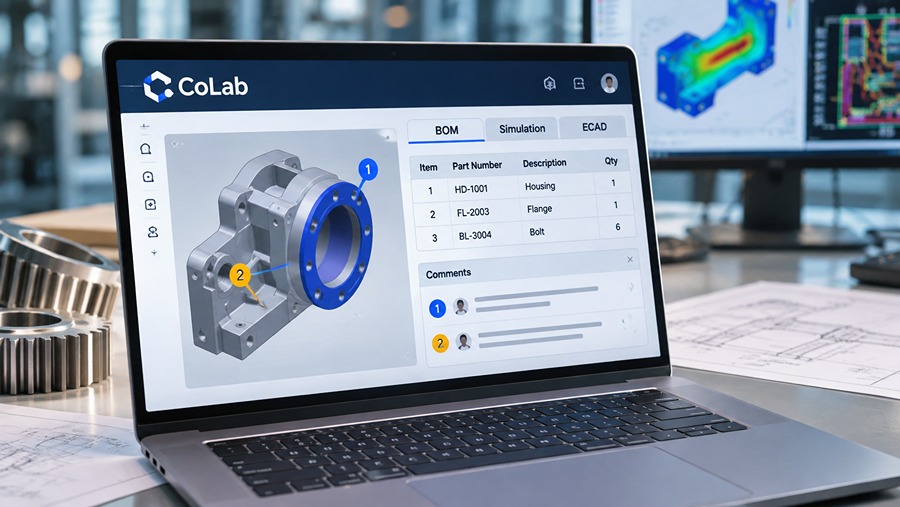
ST. JOHN’S, Newfoundland and Labrador, Nov 10, 2026 – CoLab has announced plans to expand its mechanical CAD (MCAD) review platform to bills of materials (BOMs), simulation results and electronic CAD (ECAD) designs. BOM review is scheduled for Nov’2026, followed by simulation and ECAD review capabilities in 2027.

“Review is where engineering teams weigh trade-offs and make the complex decisions that shape a program,” said Adam Keating, co-founder and CEO of CoLab. “As AI speeds up more of the design process, review will still be a bottleneck, unless teams rethink their approach. We are already seeing this in software development. Engineering teams need one standard review process across new product development, and they need it now more than ever.”

BOM review will allow engineers to examine BOMs alongside corresponding mechanical designs. CoLab cited interest from semiconductor and data center customers, where engineering teams coordinate design decisions with sourcing and manufacturing.

“Engineering teams in fast moving industries like semiconductors and data centers are especially eager to get their hands on BOM review,” commented Keating. “As order volume for these customers grows, managing design complexity without introducing confusion downstream for sourcing and manufacturing is critical. Getting BOMs right is key to that.”

“Giving customers a way to review more datasets is only the beginning,” said Jeremy Andrews, co-founder and CTO of CoLab. “When engineering teams have their product data and decision rationale in one place, that will become the foundation for a generative engineering harness. You’re going to see teams maturing concepts much faster – with an understanding of all the real-world constraints – using AI.”

CoLab previously announced plans to introduce generative design capabilities, including work with nTop on concept design and “AutoFix”, which is meant to implement review feedback in CAD. Its existing AI initiatives include AutoReview, which customers have been deploying as part of engineering AI strategies.

“For nearly 18 months, our biggest customers have been rolling out AutoReview as a central part of their engineering AI strategies,” said Keating. “What we’ve proven throughout that process is that we are the right partner to implement AI across product development. Our advantage is that we’re in the sweet spot: still fast and nimble, but mature enough to handle change management.”

“The last thing customers want, as AI innovation moves faster, is vendor lock,” said Andrews. “We are building a fundamentally open ecosystem.”

Source: CoLab

About CoLab

CoLab is a Canadian engineering software company founded in 2017 and headquartered in St. John’s, Newfoundland and Labrador. The company develops cloud-based software for mechanical design reviews, engineering collaboration and product development. Its platform allows engineers to review CAD models, drawings and technical documents, record feedback, track issues and document design decisions. CoLab also provides AutoReview, which uses AI to identify potential design errors and standards violations. The software integrates with CAD and product lifecycle management systems used by manufacturers. CoLab serves companies in the automotive, aerospace, industrial equipment, medical device and energy sectors. Engineering, supplier and manufacturing teams use the platform to coordinate design reviews across locations. Co-founders Adam Keating and Jeremy Andrews serve as CEO and chief technology officer, respectively.

Choosing the Right AI Tools for AutoCAD in 2026

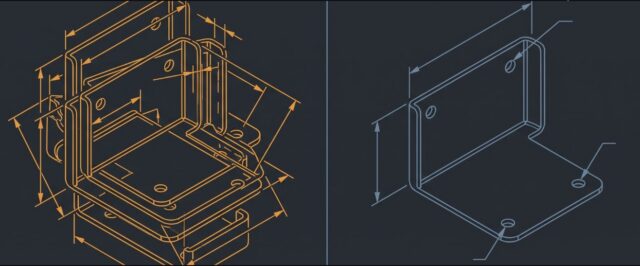
Source: Leo AI.
Source: Leo AI.


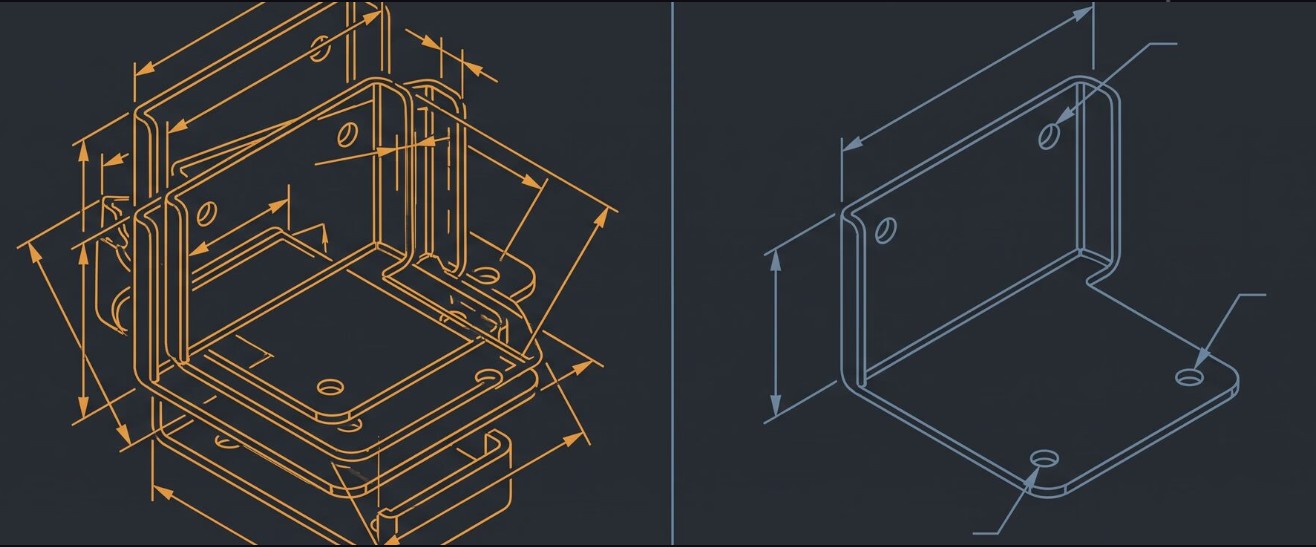
Artificial intelligence is changing AutoCAD workflows, but choosing the right tool requires understanding what AI can realistically accomplish. A Leo AI article identifies three categories of AI solutions and explains where they deliver practical benefits for engineers and CAD managers.

The first category includes AutoCAD’s built-in machine learning capabilities. Features such as Smart Blocks identify repetitive geometry, while Markup Import and Markup Assist help interpret drawing revisions. Activity Insights tracks changes between saves. These tools simplify drafting tasks but primarily operate within individual drawings.

The second category comprises general-purpose AI chatbots. Although useful for answering technical questions, these assistants often lack direct access to DWG files, company standards, and engineering documentation. Their responses may also lack verifiable sources, limiting their reliability in design workflows.

The third category involves engineering knowledge platforms that connect CAD drawings with product data management (PDM), product lifecycle management (PLM), and enterprise systems. These tools help engineers locate existing designs, retrieve technical information, and reuse components across projects.

The article identifies five criteria for evaluating AI tools: direct file access, traceable citations, geometry-aware search, permission management, and performance with inconsistent engineering archives.

AI can also accelerate drawing reviews, identify annotation errors, support standards compliance, and simplify employee onboarding.

Leo AI positions its engineering assistant as a complementary knowledge layer rather than an AutoCAD replacement. The company says its platform integrates with Autodesk Vault, SolidWorks PDM, Siemens Teamcenter, PTC Windchill, and other engineering repositories. Its geometry-aware search capabilities help users retrieve components even when filenames are inconsistent.

The article recommends testing AI tools against actual engineering files rather than polished demonstrations. Engineers should verify whether retrieved answers link to correct drawings, revisions, and standards.

Ultimately, combining native AutoCAD automation with engineering knowledge retrieval offers a practical approach to reducing repetitive tasks while preserving human responsibility for design decisions.

Agentic Robotics Could Redefine Industrial Robot Intelligence

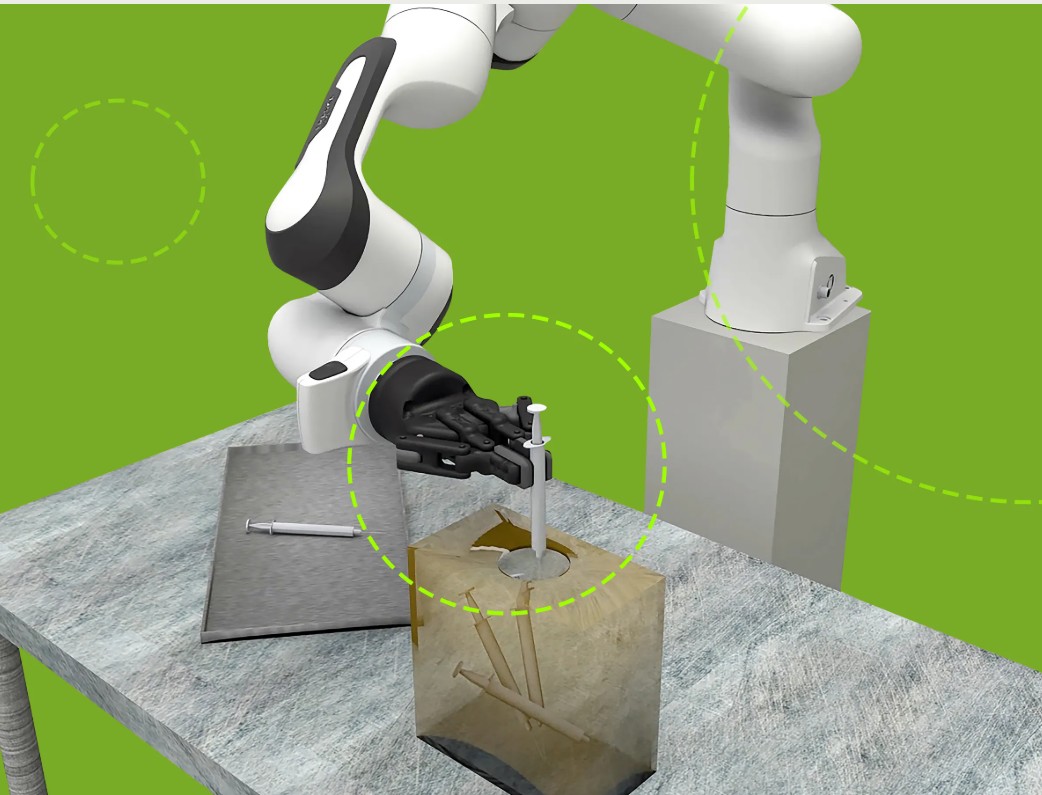
A 3D rendering shows an agentic robotic arm depositing used hypodermic needles into a disposal box. The simulated task required that agents successfully navigate variable subchallenges, such as differently shaped disposal boxes. (Source image: Kaiyuan Chen, Shuangyu Xie, et al.).


Industrial robots traditionally rely on carefully programmed instructions or machine learning models trained on extensive human demonstrations. Researchers at the University of California, Berkeley, and Nvidia are exploring a different approach called agentic robotics, which uses AI agents to generate, test, and refine robot control code, tells IEEE Spectrum.

Presented at the 2026 Conference on Robot Learning, the approach addresses a fundamental challenge in robotics: collecting sufficient training data to achieve reliable performance. Unlike large language models trained on internet-scale datasets, robots lack comparable amounts of real-world interaction data.

Agentic robotics replaces much of this data dependence with automated programming. Engineers describe tasks using natural language, and multiple AI coding agents divide them into smaller operations involving perception, object manipulation, motion planning, and execution.

For example, when instructed to pack groceries, separate agents can identify objects, control robotic grippers, and coordinate movements. The generated code is tested in simulation, where agents identify failures, modify instructions, and repeat the process until performance improves.

Researchers also use AI agents to adjust simulation parameters, including lighting, environmental conditions, and physical interactions, to better reproduce real-world scenarios.

In UC Berkeley tests, agentic robotics achieved success rates of up to 99%, matching human-engineered solutions. Comparable imitation-learning approaches achieved success rates as low as 20% on certain tasks.

The technology could significantly improve industrial automation. Nvidia reports that retasking a robot at Taiwanese manufacturer Wistron currently requires at least eight hours, whereas agentic robotics could reduce that process to one or two minutes.

However, challenges remain. Simulations cannot perfectly reproduce physical contact, and AI-generated code requires careful validation.

Researchers believe agentic robotics could initially benefit precision manufacturing, including semiconductor production, where accuracy and repeatability are essential. Its broader potential lies in combining established robotics technologies with autonomous AI coordination, making industrial robots more adaptable without relying exclusively on massive training datasets.

Community Colleges Tackle America’s Growing Semiconductor Workforce Shortage

A professor holds a silicon wafer as students from Rio Salado College participate in a chipmaking lab at the Arizona State University NanoFab, Tuesday, Oct. 20, 2026, in Tempe, Arizona. (Source: AP Photo/Ross D. Franklin).
A professor holds a silicon wafer as students from Rio Salado College participate in a chipmaking lab at the Arizona State University NanoFab, Tuesday, October 20, 2026, in Tempe, Arizona (source: AP Photo/Ross D. Franklin).


The United States is expanding domestic semiconductor manufacturing, but a shortage of skilled workers threatens to slow progress. Community colleges are responding with accelerated training programs designed to prepare technicians for jobs in chip fabrication plants without requiring traditional four-year degrees, tells Tech Xplore.

Supported by the 2022 CHIPS Act, semiconductor manufacturers have committed more than $800 billion to new U.S. fabrication facilities. However, industry organization SEMI estimates that the country could face a shortage of 157,000 full-time semiconductor workers by 2030. Arizona, Texas, Ohio, California, and New York are expected to experience particularly severe shortages.

Community colleges are introducing specialized programs with support from federal agencies and manufacturers, including Taiwan Semiconductor Manufacturing Company (TSMC), Intel, Samsung, and SK Hynix.

Rio Salado College in Arizona offers a free, 12-week semiconductor manufacturing course developed with industry input. Students learn fabrication procedures through virtual reality before completing approximately 20 hours of practical training in Arizona State University’s clean-room laboratories.

The program attracts students from diverse professional backgrounds, including career changers and individuals without engineering degrees. According to college officials, approximately 75% of previous participants secured semiconductor-related employment.

Similar initiatives are emerging at Austin Community College in Texas and West Valley College in California. More than 200 colleges and universities nationwide are collaborating with SEMI to develop semiconductor workforce skills.

Despite these efforts, manufacturers continue recruiting experienced engineers and technicians from Taiwan and South Korea to support new American facilities and train local employees.

TSMC’s $265 billion investment in northern Phoenix alone is expected to generate approximately 25,000 jobs over the next decade, with about half designated for locally recruited technicians.

The challenge extends beyond recruitment. Semiconductor fabrication demands precision, safety, and reliability. Industry experts emphasize that practical training and close collaboration between educational institutions and manufacturers will be essential to sustaining American chip production and supporting AI development.

0FansLike
0FollowersFollow
0SubscribersSubscribe
Google search engine

Recent Articles

Trending Now