Design Better with Service Data


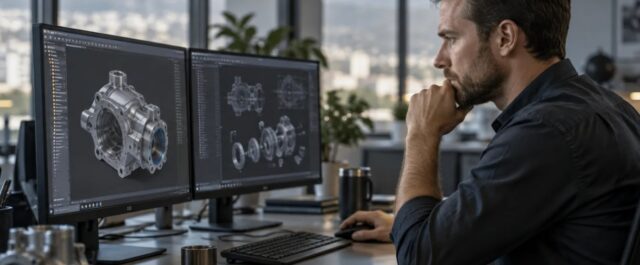
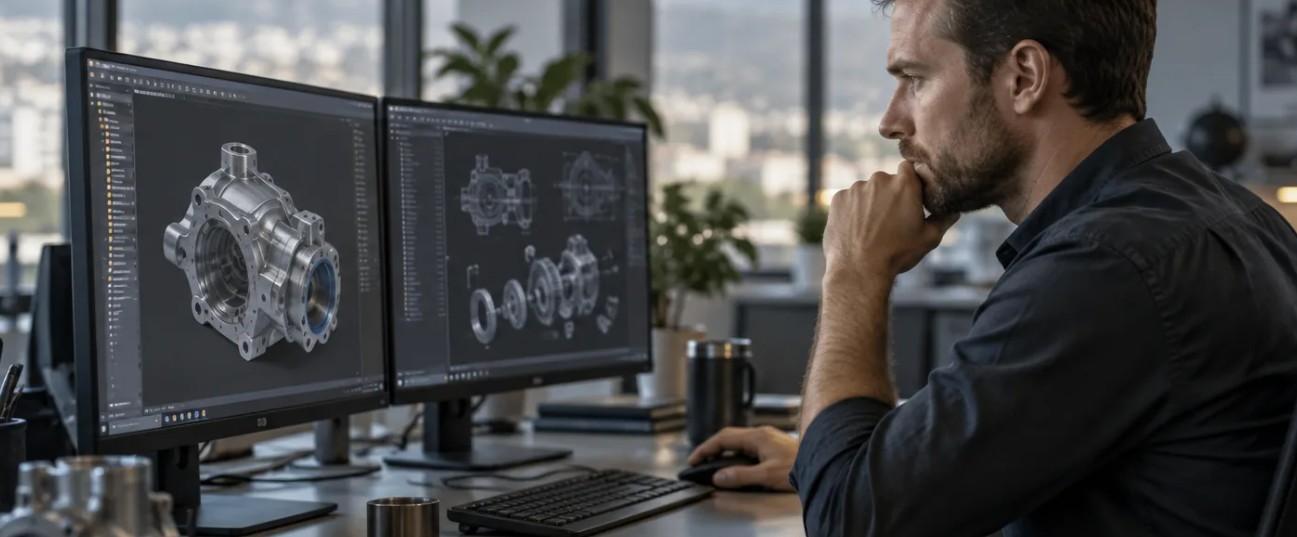
An engineer, sitting down to design a product, rarely starts with a clean screen. Instead, the screen shows the product’s last version. The job now is to make it better, cheaper… or both. The engineer could pick up where they left off, continuing to refine a design interrupted by last year’s design freeze for the sake of production. Designs, as engineers know, are not perfected; they are abandoned. Picking up the abandoned design a year later, a thought occurs. It would be nice to get a report card on how the product had performed out there.

Let’s say the initial design was close to perfect. The product will not stay that way. No product stays as shiny and pristine as the rendered image. It gets dirty, wears, breaks and gets repaired.

If your product is a million-dollar excavator, for example, a failed part could delay a multimillion-dollar project. Knowing that it happened, perhaps more than once, the engineer who signed off on the part’s design could strengthen it. On the other hand, aircraft parts that show no wear or replacement after extensive use may be overdesigned and become candidates for lightweighting. And if every snowmobile customer in Minnesota is buying the same aftermarket accessory, the snowmobile manufacturer may want to offer its own version — thereby adding a surprise revenue stream.

Information inaccessible

Clearly, knowing how your product handles the hard knocks during its life would help design the next generation of the product. But getting service and maintenance data into the hands of the design engineer has been hard for several reasons:

  • The records may not exist.
  • They may be inaccessible.
  • You don’t know where to look.
  • Records are scattered.
  • The data may sit in a system you are denied entry to. Like automobile warranty claims that are kept under lock and key by the dealer.

Even if all the above is false and maintenance and service records are accessible, would a design engineer want to wade through thousands of scattered notes, spreadsheets, work orders, invoices and receipts? I certainly would not. Not in my job description. Definitely not something I would enjoy.

Just ask
So what if the design engineer could ask, in plain English — or whatever language they speak — for (a) the most commonly replaced parts and (b) suggested design improvements? And what if AI could respond?

As usual, I am asking AI for the sky and the moon.

“Orbit can already answer what’s failing and where,” says Sumair Dutta, marketing lead of PTC Orbit. “With the 6.0 release, it can also reason about why and come back with an explanation and the evidence behind it.”

We meet Sumair Dutta and Micki Collart, also from PTC, on a Zoom call.

Those with a history with PTC know it as a design and engineering software company. But starting February 14, 2024, when Neil Barua took over as CEO, the writing may have already been on the wall. The company was expanding its role to an “intelligent product lifecycle approach,” connecting design and manufacturing to service.

Working in the dark

PTC announced Orbit at PTC NEXT in Chicago in June, 2026 as a cloud-native, AI-first as-maintained system of intelligence. Orbit is:

  1. a next-generation business intelligence capability for as-maintained assets.
  2. an AI-based product, so you query that knowledge in natural language.
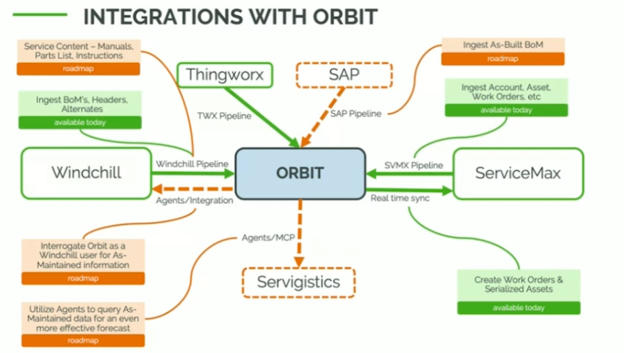
  3. a connector across product information silos. Orbit pulls from Windchill and ServiceMax today, and on the roadmap are connectors to Servigistics, the SAS pipeline and Arbortext content.

Perhaps new to engineers is the term as-maintained, a term for all that has happened to an asset since it shipped from the manufacturer. It is not simply a snapshot of the asset at present but a connection all the way to when it was designed. That connection to the design is what makes the history useful to engineering. Engineering owns the as-designed product in CAD and the design bill of materials in the PLM system. Manufacturing owns the as-built, usually in an MES or ERP system. Sales owns the as-sold configuration, usually in SAP or Oracle.

Then the product ships and nothing happens. It’s not from lack of activity. Parts may be failing. Work orders may be piling up. Parts are swapped. Some of it lands in the field service system, some of it doesn’t. An engineer may get notified (maybe with a pink slip) of a part that results in a massive recall. Or they may not. Information about part failure must survive a trip more harrowing than a passenger pigeon in a war zone, going from field crews, warranty claims, landing at the manufacturer’s quality control window only to nest in a spreadsheet with a reliability engineer. Rarely does the message reach the design engineer.

The design engineer then makes the next generation of products from where they left off — in other words, in the dark.

Dissimilarity guaranteed

A 1953 Smithsonian study found that 98% of the molecules in a human body are replaced every year. Change is a fact of life.

Philosophers may ponder the idea of a universal flux, as did the ancient Greek Heraclitus, who said “No man ever steps in the same river twice, for it’s not the same river and he’s not the same man.”

It’s similar with machines. Any machine with a sufficiently long service life is in for having many of its parts replaced. I am reminded of buying a road bike with a titanium frame 20 years ago and justifying the expense as “the last bike I would ever buy.” Since then, every part of that bicycle has been replaced — except for the frame.

In a perfect world, a design is mass-produced and should lead to perfectly replicated products. In the real world, differences start appearing as soon as manufacturing starts.

  • The second part coming off a CNC machine is different from the first, even if the difference is imperceptible. Tool wear does that.
  • One production machine differs in age, use and operator.
  • Each production machine itself is unique due to its unique. assembly and its own mass-produced yet imperceptibly unique parts.

Where the products are distributed from matters. Did they sit in a hot warehouse? Did the warehouse have rats? Rats are notorious for chewing off wiring insulation.

Let’s say the product is a delivery vehicle. Even in the same fleet:

  • One operator runs a machine differently than the next.
  • One operator may be more accident-prone.
  • Each vehicle may have different routes, stop at different job sites and operate in different conditions.

If a consumer product company is lucky, its products end up all over the world. Now, they will live vastly different lives.

Orbit at your service

Applications like Salesforce, SAP and ServiceMax are built to record the lives of each product after manufacturing. But these are not apps that engineers are granted access to or trained to use.

All the apps have their own databases — and not always the same data. A motor may have three records: one in Salesforce, one in SAP, one in ServiceMax. The account name differs slightly. The install dates don’t match. Which one to trust?

Here’s where Orbit comes in. Orbit assembles the asset’s as-maintained history, connects that history back to design, and allows engineers to question the resulting context. Where there is a conflict in the data, Orbit will recommend which application’s data will become the data of record. For example, it would trust Salesforce for the account data, ServiceMax for the asset’s location, and ERP for the serial number. Roles get different permissions, preventing too much information and access to privileged information.

Orbit is smart enough to flag anomalies. An excavator might have an effective date in ERP from a month ago while CRM shows its cost a year ago. The AI can detect that discrepancy so the asset can be identified correctly.

English, please
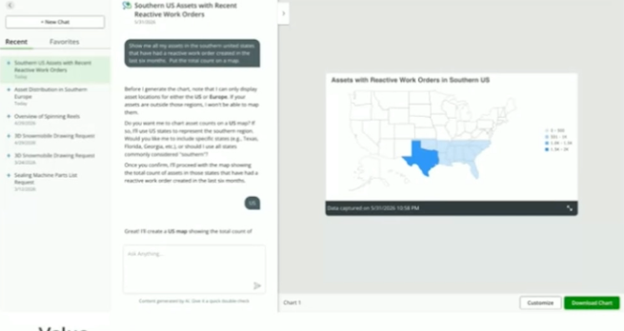
A product engineer may know the language of CAD and PLM, but they wouldn’t know the language of ERP, FSM and CRM. With Orbit, they don’t have to. Orbit reduces that data-search burden and provides a more direct path to answers. They can simply interact with Orbit in their native language.

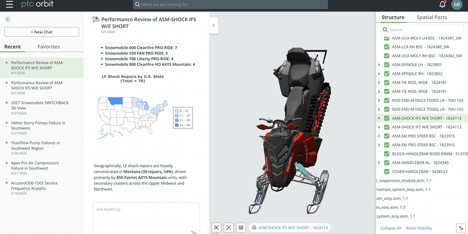
One demo showed a query for “reactive work orders of the Southern United States.” The AI on its own decided what states were in the South and returned results. In a later query for North America, it came back as the U.S., Mexico and Canada.

How Orbit works
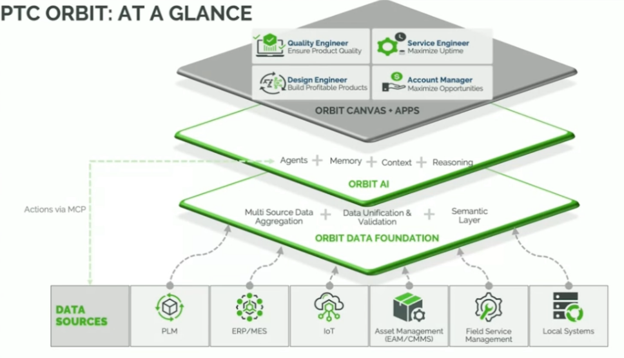
PTC describes four layers:

  1. Data foundation. Aggregation from PLM, ERP, IoT, field service and proprietary homegrown systems, AKA spreadsheets. Then validation and unification. Tying data together is the ontology that supports data inquiry in your own business terms.
  2. AI layer. Agents supported by memory, context and reasoning.
  3. Connections. MCP, so Orbit’s agents can work with agents in other systems.
  4. Interaction. AI for natural-language queries and purpose-built applications.

Where engineers would use Orbit

Orbit can provide the opportunity to improve the next generation of a product by feeding the reality of what happens to it in the field into the design of the next version so it can be made more reliably and be more serviceable. That can be divided into multiple tasks, each one a chore today.

Field issue investigation. A quality or reliability engineer chasing a problem, trying to understand a potential design issue, may start gathering clues from the quality system, work orders, warranty claims, IoT signals and conversations with service engineers. Meanwhile, the issue keeps recurring. Orbit’s job is to get all the digital clues from the systems in place and cut the time required to understand the issue. By working faster and digging deeper, it can identify trends and help prevent product recalls and liability faster than a manual approach.

Orbit uses Creo’s viewer to present the product changes necessary.

Sample questions — asked in plain English — that Orbit can answer — in plain English.

  • How many machines are affected?
  • How many still run revision A of a pump?
  • How many have already been replaced?

Orbit provides the evidence and impact analysis, such as how many assets are affected and which revisions are involved. The engineering change then runs in Windchill from problem report through change request and change notice. After approval, Orbit can turn the change into a field-service campaign.

Build it yourself?

Users with IT staff and access to advance data platforms such as Snowflake or Databricks may think they can do what Orbit does.

But general purpose database platforms cannot immediately know how the objects they store as records behave and how they relate to each other. Without an ontology connecting design, configuration, and service data, every new question could become a project. Orbit, on the other hand, already understands the physical assets, their configurations, service events, work orders and claims, and the relationships among them. A general-purpose database with AI has to be trained on your assets and the care they need, something ServiceMax has understood.

PTC applications—including Codebeamer, Creo models managed in Windchill, and ServiceMax work orders—create and manage source data and connect to Orbit. Orbit also connects to external applications, including Snowflake and Databricks, through integrations, open APIs and MCP.

When?

Although the usefulness of service/maintenance data in improving the next generation of products is undeniable, it remains to be seen how exactly it will be implemented for product designers and engineers and how much it will cost.

Imagine a world in which a design engineer need only to ask questions in their natural language and could just check in with Orbit when a product needs to be updated. Like this:

“Hey, Orbit. How can I make this product more reliable and serviceable?”
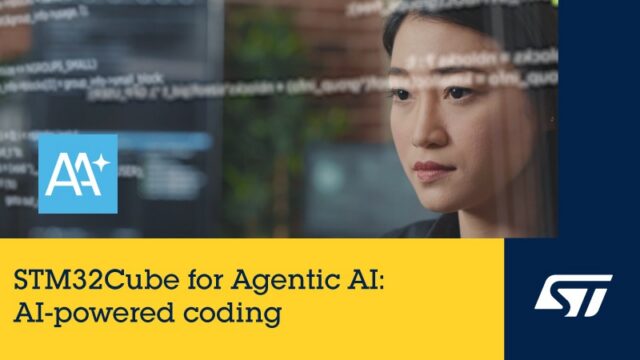
 

STMicroelectronics Introduces AI Development Framework for STM32 MCUs

Image: STMicroelectronics

GENEVA, Switzerland, Nov 9, 2026 – STMicroelectronics (ST) has introduced STM32Cube for Agentic AI, a framework that gives AI agents access to manufacturer-supplied technical information, reference code and development tools for STM32 microcontrollers (MCUs). It supports embedded software development, code generation and review.

“Agentic AI is transforming embedded software development, redefining commercial expectations and changing the developer’s role into orchestrator, director, and supervisor,” said Patrick Aidoune, group vice president and general purpose and automotive microcontrollers division general manager, STMicroelectronics. “STM32Cube for Agentic AI is built to support the “team” of developer and AI agent, providing the truthful information about STM32 the agent needs to do its work and giving the developer the tools for expressing intent and checking the output. Our tests confirmed the dramatic improvement in accuracy now available for STM32 developers.”

“By combining the intelligence of OpenAI models with STM32Cube’s accurate data and skills, our solutions help embedded developers work more efficiently and benefit from enhanced optimization,” said Benjamin Schwartz, managing director for partnerships, OpenAI.

“STM32Cube for Agentic AI gives us more confidence in adopting AI agents in our development,” said Serge Robin, lead architect at Somfy. “It provides validated configurations, reference examples, and code review capabilities, along with deployment flexibility and the ability to regain control within a familiar development workflow.”

The STM32Cube for Agentic AI gives AI agents access to verified reference code examples developed by ST. Agents can select existing code or use STM32CubeMX, depending on development requirements.

The framework supports STM32CubeIDE and other integrated development environments (IDEs). Developers can return to their existing coding environment to modify generated code, debug applications and control subsequent development steps.

After code generation, the framework performs an initial review of application programming interface (API) calls, checks interactions with MCU hardware and suggests workarounds. It also supports validation, debugging and optimization for developers at original equipment manufacturers (OEMs) and mass-market companies.

ST also offers STM32Sidekick, a digital assistant that provides 24/7 responses to technical support questions and directs developers to relevant documentation and resources.

AI-Assisted Code Development Tests

ST tested the framework by assigning AI agents software development tasks for STM32 MCUs. Some agents received STM32-specific context and guidelines through STM32Cube for Agentic AI, while others attempted code generation without any assistance.

According to ST, agents using the framework successfully generated functional code, while those working without the additional guidance failed. The assisted agents also consumed 15 times fewer tokens during the tests.

Source: STMicroelectronics

About STMicroelectronics

STMicroelectronics (ST) is a semiconductor company founded in 1987. It designs and manufactures microcontrollers, sensors, power devices and other analog and mixed-signal components. The company operates as an integrated device manufacturer with in-house production that supports large-volume supply for global markets. Its customers include automotive, industrial, consumer electronics and communications equipment manufacturers. ST also works with technology partners to develop components used in mobility systems, energy and power management equipment and connected devices. The company reports ongoing efforts to reduce emissions across its operations and increase the share of renewable electricity in its manufacturing sites, with a goal to reach full renewable sourcing by 2027. ST is headquartered in Geneva, Switzerland. It serves more than 200,000 customers worldwide and employs about 50,000 people. Its technologies support applications that require efficient power conversion, sensing, processing and connectivity. The company expands its portfolio to support automotive, industrial, consumer and connected system applications through integrated design and manufacturing.

Slingshot Aerospace Names Vince Monteparte CEO

Image: Slingshot Aerospace

WINDSOR, CO, Nov 9, 2026 – Slingshot Aerospace has announced a new leadership structure, with Vince Monteparte as CEO, co-founder David Godwin as president and co-founder Melanie Stricklan as chairperson of the board. The announcement follows a $69.2 million U.S. Space Force contract award and the company’s expansion with allied governments.

Slingshot provides AI-enabled capabilities for national security missions, including SOIA services covering sensor-backed operations, data fusion across multiple sources and domains, predictive models and AI-enabled mission rehearsal. Its capabilities also cover testing, training and operating in contested environments.

“In national security, the advantage goes to the side that sees first, decides fastest and has already rehearsed the outcome,” said Stricklan, who founded the company with Godwin and Thomas Ashman in 2017. “Closing that gap is more urgent today than ever. I’m proud to be part of this team and this mission as chairperson of the board. Vince was an early believer and investor in Slingshot. He understands our customers’ missions and what it takes to deliver for them at scale. He’s the right leader and CEO for Slingshot’s next chapter.”

Monteparte, a venture partner with Sway Capital, was an early investor in Slingshot and previously served on its board. He has more than 25 years of experience across aerospace, defense, technology, logistics and enterprise software. His background includes founding and expanding a global software and technology company that was subsequently acquired, advising on venture investments and leading strategic transactions and growth initiatives for middle-market and high-growth companies.

“Having served on Slingshot’s board, I’ve seen firsthand what this team has built: the leading AI engine for space operations, trusted by the U.S. Space Force and hundreds of organizations around the world. The need for real-time awareness and decision-making has never been greater, and Slingshot is uniquely positioned to meet it,” said Monteparte. “My focus is on positioning the business as the operating standard for defense, civil and commercial space operators, delivering on our commitments to the Space Force and U.S. government, and expanding our reach with allies and partners worldwide.”

Stricklan also serves as senior vice president of special programs at Vast, where she leads the national security division. Under her leadership at Slingshot, the company raised more than $100 million in venture capital, recorded triple-digit annual growth and completed multiple acquisitions.

Slingshot also developed AI-native orbital intelligence and high-fidelity modeling and simulation capabilities. Its operational platforms serve commercial space operators, civil agencies, U.S. defense and intelligence organizations, and allied nations.

Godwin, a technology executive and entrepreneur, has contributed to Slingshot’s strategic direction, product development and long-term growth plans since the company’s founding in 2017.

Source: Slingshot Aerospace

About Slingshot Aerospace

Slingshot Aerospace is a U.S. space software and data company founded in 2017. The company develops software, data products, analytics, AI tools, training tools and sensor network services for space operations. Its products include Slingshot Portal, Data, Analytics, AI, Learn & Build, Beacon, Laboratory, PNT-SA and hardware sensors. Slingshot combines sensing, data fusion, simulation and mission workflows to support space activity monitoring. Its software supports maneuver planning, anomaly response, mission execution, scenario evaluation and operator coordination. The company serves government and defense users, commercial satellite operators, enterprises, international partners and research organizations. Its markets include space, defense, satellite operations, space domain awareness and space traffic coordination. Slingshot operates or maintains offices in Colorado, TX, Canada, Taiwan and the United Kingdom.

Trimble Introduces WorksManager Drone for Construction Site Monitoring

Image: Trimble
Image: Trimble

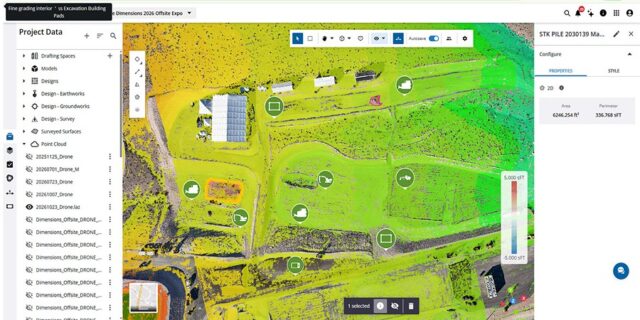
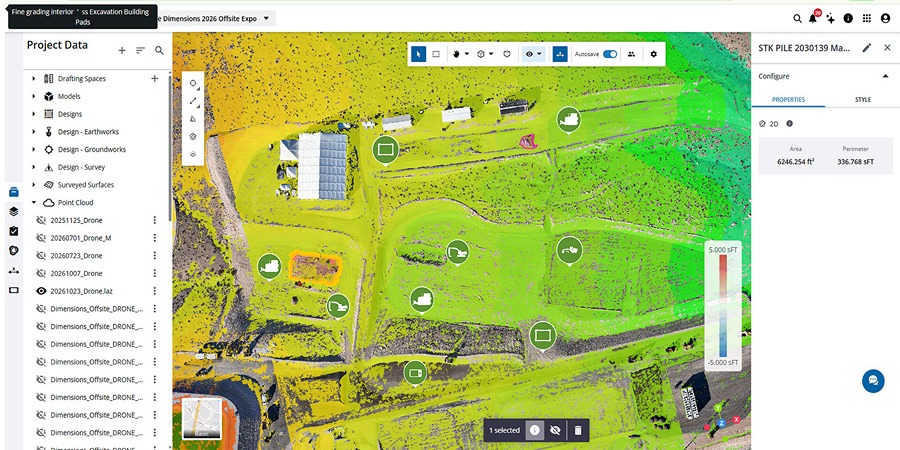
WESTMINSTER, CO, Nov 9, 2026 – Trimble has announced Trimble WorksManager Drone, a cloud-based photogrammetry solution that will allow civil contractors to process drone data within the Trimble ecosystem. The software will combine accurately scaled drone data with project designs, machine data, records of work completed on-site and other site information to calculate volumes, take measurements, verify materials and monitor construction.

This extends the functionality of Trimble WorksManager, a cloud-based software and data management tool that connects construction jobsites for sharing project files and design updates. Project supervisors will be able to access drone data showing current jobsite conditions and view it alongside the latest design files and machine data. The software solution will also provide 3D visuals and excavation and fill measurements to help construction teams assess site conditions and make decisions based on updated information.

“Civil contractors shouldn’t have to juggle fragmented tools in order to see what’s happening on-site,” said Elwyn McLachlan, vice president, civil construction product and strategy, Trimble. “WorksManager Drone closes the loop between photogrammetry insights and ground action giving teams a complete and accurate picture of their jobsite. This connectivity further enhances the depth and breadth of the Trimble ecosystem to power each part of the design, build and operate lifecycle of a construction project.”

“In the past, verifying on-site material volumes required a lot of manual coordination,” said Joe Zapien, field technology manager at Markham Contracting. “Trimble WorksManager Drone allows us to quickly process flight data, putting 3D visuals and cut-fill site metrics right in the hands of our foremen and project managers. Bringing that real-time visibility to the field gives us the clarity to make immediate, informed design changes and site decisions.”

Trimble WorksManager Drone is expected to be available in Jan’2027 through Trimble’s global dealer channel for use with DJI and Wingtra drones.

Source: Trimble

About Trimble

Trimble Inc., established in 1978, is a technology company focused on creating tools that connect the physical and digital worlds. Based in Westminster, CO, the company serves industries such as agriculture, construction, geospatial technology, and transportation. Its products include GNSS receivers, optical devices, machine control systems, and widely used software and services. Trimble’s construction technology improves project efficiency by using data throughout each build stage. The company employs around 12,000 people worldwide. The company prioritizes innovation and sustainability, working to make industries productive, safer, and environmentally friendly.

SpaceX Selects Qualcomm for Starlink Mobile 5G Network

Image: Qualcomm
Image: Qualcomm

SAN DIEGO, CA, Nov 9, 2026 – Qualcomm has announced that SpaceX has selected Qualcomm Dragonwing cellular infrastructure platforms for Starlink Mobile‘s terrestrial 5G network in the United States. The network will use QRU100 and QDU100 platforms, along with commercial-grade Layer 1 software, to support Massive MIMO radio and baseband processing for cellular base stations.

Starlink Mobile will use Massive MIMO radio units with 64 transmit and 64 receive paths (64T64R). According to Qualcomm, this architecture is designed to improve network coverage, capacity and spectral efficiency while handling higher traffic volumes.

The QRU100 platform provides integrated processing for Massive MIMO radio units, supporting the radio functions required for the 64T64R architecture. The QDU100 platform provides high-performance, energy-efficient and latency-sensitive Layer 1 processing for distributed units. The two platforms are designed to improve performance per watt across radio and distributed-unit processing, which could improve network deployment economics at scale.

“Building a nationwide network demands high performance and power efficiency at every site. Dragonwing Cellular Infrastructure platforms bring together advanced Massive MIMO, purpose-built processing and commercial-grade Layer 1 software to help Starlink deliver an exceptional nationwide network,” said Durga Malladi, EVP & GM, technology planning, edge solutions, and data center, Qualcomm Technologies. “Together with SpaceX, we are building world-leading cellular infrastructure in the United States, advancing 5G today, with an opportunity to lay the foundation for AI-native 6G in the years ahead.”

“We shouldn’t live in a time where phone calls are still dropping whether you’re at home or on-the-go. Starlink is building the first fully-integrated nationwide satellite and terrestrial network that will keep people connected no matter where they are. We’re excited to collaborate with Qualcomm Technologies and leverage their industry expertise and platform to accelerate our timeline to develop our base station end-to-end architecture,” said Michael Nicolls, senior vice president of Starlink.

Network Deployment and Future Development

Starlink Mobile plans to use Qualcomm Dragonwing-powered radio units as building blocks for a multi-band network deployed across multiple phases. Although the deployment focuses on terrestrial 5G, the platforms’ energy-efficient processing and open architecture provide a foundation for future connectivity and intelligence. The collaboration also represents a commercial step toward SpaceX and Qualcomm’s vision for AI-native 6G infrastructure.

Source: Qualcomm

About Qualcomm Technologies

Qualcomm Technologies, Inc., a subsidiary of Qualcomm Inc., is an American semiconductor and wireless technology company headquartered in San Diego, CA. Established in 1985, the company specializes in designing and supplying integrated circuits and system software for wireless telecommunications. Its product portfolio includes Snapdragon processors, modems, and platforms utilized in smartphones, automotive systems, Internet of Things (IoT) devices, and industrial equipment. Qualcomm operates primarily through two segments: Qualcomm CDMA Technologies (QCT), which focuses on semiconductor products, and Qualcomm Technology Licensing (QTL), which manages its patent portfolio. The company serves a global clientele across various industries, including mobile, automotive, computing, and industrial sectors, leveraging its expertise in 5G, AI and low-power computing to drive innovation and connectivity worldwide.

About SpaceX

SpaceX, formally Space Exploration Technologies Corp., designs, manufactures and launches rockets and spacecraft. Its fleet includes Falcon 9 and Falcon Heavy rockets and the Dragon spacecraft; it is developing Starship, a reusable heavy-lift system. The company also operates Starlink, a global satellite internet network serving residential, enterprise, mobility, maritime and aviation users. Founded in 2002, SpaceX provides launch services, human spaceflight, cargo transport and satellite connectivity for U.S. government and national-security customers, commercial satellite operators and consumers worldwide. The company is headquartered in Hawthorne, CA, with operations in TX and FL. Production in Hawthorne covers engines, stages and spacecraft assembly; testing is centered in McGregor, TX, and mission operations span multiple launch ranges.

MIT Develops a Unified AI Model to Simulate Different Physical Materials

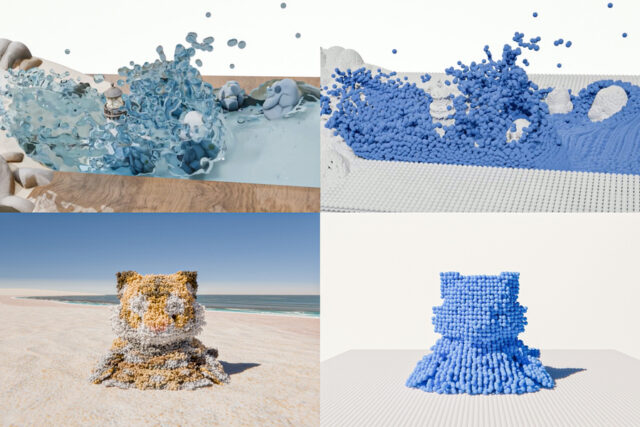
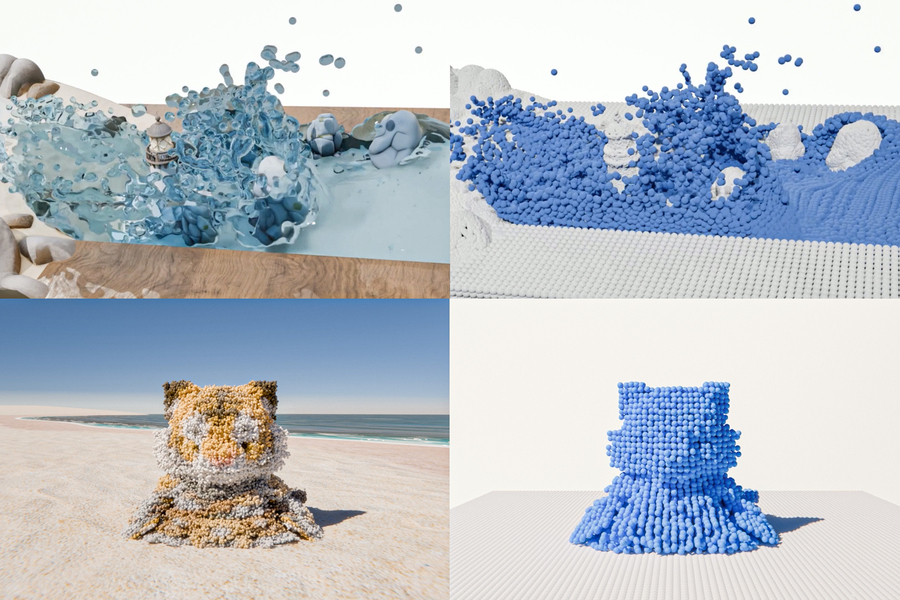
“It is a similar architecture to ChatGPT. But instead of predicting one word at a time to write a piece of text, we are predicting how these particles will move, one step at a time,” says Peter Yichen Chen (source: courtesy of the researchers).


Researchers at MIT, the University of British Columbia, and collaborating institutions have developed WorldParticle, an artificial intelligence system capable of simulating multiple physical phenomena using a single deep-learning architecture. The technology could reduce reliance on specialized simulation software traditionally required for different materials and physical processes.

Conventional simulations depend on mathematical equations and numerical solvers tailored to specific phenomena, such as fluid movement, deformable solids, or protein folding. WorldParticle replaces this fragmented approach with a neural network that learns physical dynamics and predicts material behavior across different environments.

The system uses a Lagrangian representation, dividing objects into thousands or millions of three-dimensional particles. It analyzes their positions, velocities, and physical properties to predict movement over successive simulation steps. External forces are incorporated to improve predictions under changing conditions.

To manage computational complexity, researchers developed a particle-merging technique that compresses information while preserving important physical details. This allows the model to handle large simulations without excessive processing demands.

WorldParticle was tested across six physical phenomena, including granular materials, deformable objects, and proteins. Researchers reported higher accuracy than conventional numerical simulation methods in their evaluations. For example, the system reproduced collapsing sand more realistically than some baseline approaches, while protein motion simulations ran approximately 100 times faster.

Potential engineering applications include modeling interactions between fluids and flexible structures, studying soil behavior during robotic manipulation, and developing soft robots. The technology could also support drug development, materials research, and astrophysical simulations.

The researchers envision extending WorldParticle into a general-purpose simulation framework capable of handling previously unseen materials and physical conditions. Their long-term objective is to create an AI foundation model for scientific simulation.

Although further development is needed, WorldParticle demonstrates the potential of unified AI models to simplify complex simulations, accelerate engineering research, and enable investigations that conventional tools struggle to perform.

Siemens Signs Rail Agreements in Singapore and Taiwan

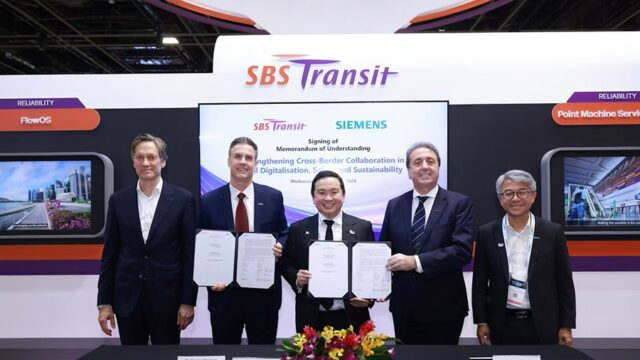
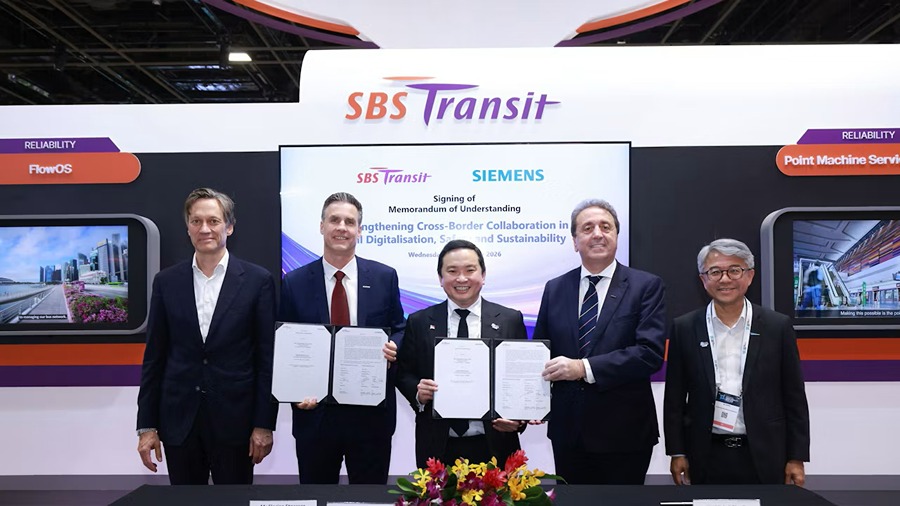
From L-R: Siemens Mobility’s President, Mr. Michael Peter, Siemens Mobility Asia-Pacific Finance Director, Mr. Florian Stoesser, SBS Transit Ltd Group CEO, Mr. Jeffrey Sim, Siemens Mobility Asia-Pacific Managing Director, Mr. Michel Obadia and Managing Director and Group Chief Executive Officer of ComfortDelGro Corporation, Mr. Cheng Siak Kian officially inked their commitment to long-term mobility partnership at SUMW 2026, Singapore. (Image: Siemens)

Singapore, Nov 9, 2026 – Siemens has signed two memorandums of understanding (MoUs) with SBS Transit companies in Singapore and secured signaling contracts from ST Engineering for two Taoyuan Metro projects in Taiwan. Announced at Singapore Urban Mobility Week 2026, the agreements cover rail engineering capabilities, digitalization and signaling infrastructure. The event was organized by the Land Transport Authority of Singapore, MSI Global Pte Ltd and MP Singapore.

Under the first MoU, Siemens and SBS Transit Ltd. (SBST) will explore collaboration on local engineering capabilities and rail asset lifecycle management. The proposed work covers technology transfer, diagnostics and repair solutions to support the reliability and sustainability of Singapore’s rail operations.

A separate MoU with SBS Transit Mobility Ltd. (SBST-M) establishes a framework in identifying industry challenges, developing solutions and exploring opportunities in rail digitalization, safety, sustainability and cross-border rail initiatives. The collaboration also covers knowledge sharing and the exchange of best practices.

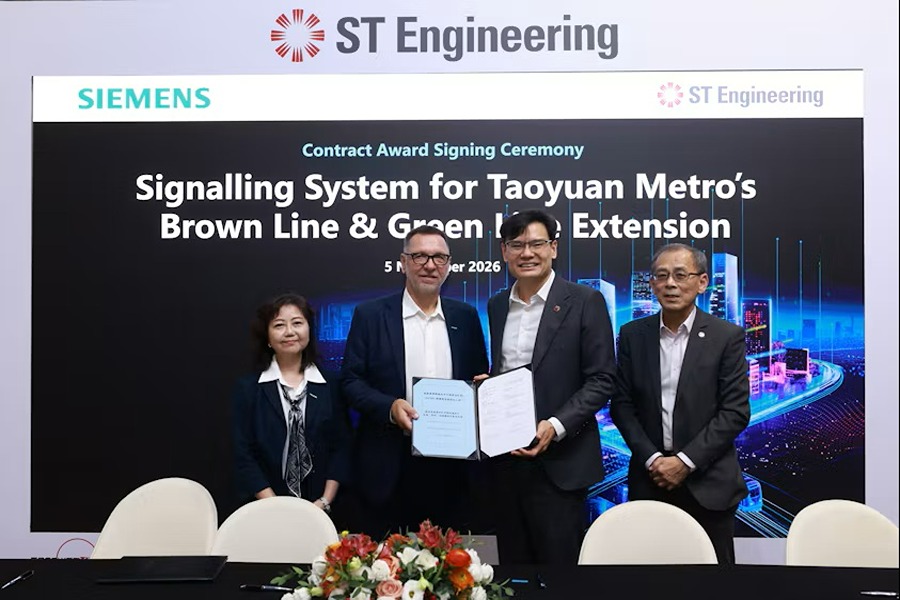
The contracts will combine Siemens’ signaling technologies, including Signaling X, with ST Engineering‘s rail capabilities and local expertise. The companies also intend to explore future rail modernization opportunities. The contracts follow a MoU signed by Siemens and ST Engineering in Berlin during InnoTrans 2026.

“As we deliver these important rail projects for Taoyuan, our collaboration with Siemens will draw on our complementary strengths to advance Taoyuan’s rail infrastructure and support its evolving mobility needs,” said Mr. Yong Kim Shen, general manager, urban solutions (Taiwan), ST Engineering.

“Strong partnerships enable us to deliver greater value for our customers. Building on our existing collaboration with ST Engineering, these contracts combine global signalling expertise with deep local market knowledge to support the next generation of rail infrastructure in Taiwan. Together, we aim to enhance operational performance while contributing to sustainable and future-ready mobility,” said Mr. Thomas Leu, managing director of Siemens Mobility, Taiwan branch.

Siemens Mobility GmbH Taiwan Branch’s Finance Director, Ms. Georgia Shih, with former Managing Director, Mr. Thomas Stein and Mr. Gareth Tang, President, Urban Solutions, ST Engineering and Mr. Koh Chan Tia, Head, Global Sales, Urban Solutions, ST Engineering signed new contracts to deliver Signaling X solutions for Taoyuan’s Brown Line and Green Line Extension. (Image: Siemens)

“Building a thriving rail ecosystem with our partners is essential to delivering the next generation of rail solutions,” said Mr. Michel Obadia, managing director of Siemens Mobility Asia-Pacific. “These agreements reflect our shared commitment to strengthening rail capabilities, accelerating innovation, and delivering reliable, sustainable mobility solutions that create lasting value for passengers and communities across Asia-Pacific”.

Rail Projects Across Asia-Pacific

Siemens also cited many rail projects and contract awards across the region:

  • Hanoi, Vietnam: A contract awarded in 2026 for high-speed rail development, including rolling stock, electrification, communications and signaling solutions.
  • Sydney, Australia: Delivery of Siemens’ first metro train to Australia since 2006 as part of the Sydney Metro – Western Sydney Airport project, alongside the first deployment of Railigent X in 2026.
  • Kuala Lumpur, Malaysia: Delivery of Trainguard MT in 2026 to support Grade of Automation 4 (GoA4) driverless operations on Kuala Lumpur’s LRT3 Shah Alam Line.
  • Singapore: Contracts awarded in 2023 for Trainguard communications-based train control (CBTC) signaling and electrification on the Cross Island Line, followed by a Downtown Line service support contract awarded in 2025 and extending through 2047.
  • Bangkok, Thailand: Contracts awarded in 2024 covering 32 new metro trains, signaling, systems integration and long-term maintenance for Bangkok’s MRT Orange Line, along with signaling for Northern Thailand’s double-track railway.
  • Jakarta, Indonesia: A signaling system supporting automated operations on Jakarta’s Jabodebek light rail transit (LRT) network, which began revenue service in 2023.

Source: Siemens

About Siemens Mobility

Siemens Mobility is the rail and transportation division of Siemens AG, headquartered in Munich, Germany, with roots dating back to 1989 and formal setup in 2018. The company provides rolling stock, rail electrification, signaling and automation solutions, and digital services for passenger and freight transport. Its products support urban transit, regional rail, intercity, and high-speed rail networks. Siemens Mobility also delivers full-turnkey rail infrastructure solutions and long-term maintenance services. In fiscal year 2023, the division reported revenue of approximately €10.5B and employed around 40,000 people globally. Its portfolio includes electric multiple units, locomotives, trams, automation platforms, and rail asset management tools. The company supports public and private clients in improving transit and logistics reliability, safety, and efficiency through integrated, data-driven systems.

About ST Engineering

ST Engineering is a global technology, defense and engineering group founded in 1997 and headquartered in Singapore. The company designs, manufactures and services products for aerospace, smart city infrastructure, defense and public security markets. Its portfolio includes aerospace maintenance, repair and overhaul services; land systems and marine equipment; smart mobility and infrastructure technology; satellite communications systems; and cybersecurity solutions. ST Engineering serves government, military, aerospace and urban infrastructure customers in more than 100 countries. It operates facilities and offices across Asia, Europe, the Middle East and the United States. The company also provides system integration, training and lifecycle support services. ST Engineering employs about 27,000 people worldwide.

Pirros Explores AI-Assisted Occupancy Classification and Building Code Compliance

Source: Pirros.
Source: Pirros.


Occupancy classification is a fundamental step in building design, influencing fire safety, occupant loads, exits, and construction requirements. Pirros explains the International Building Code (IBC) classification system and explores how artificial intelligence can help architects maintain accurate, compliant construction documentation.

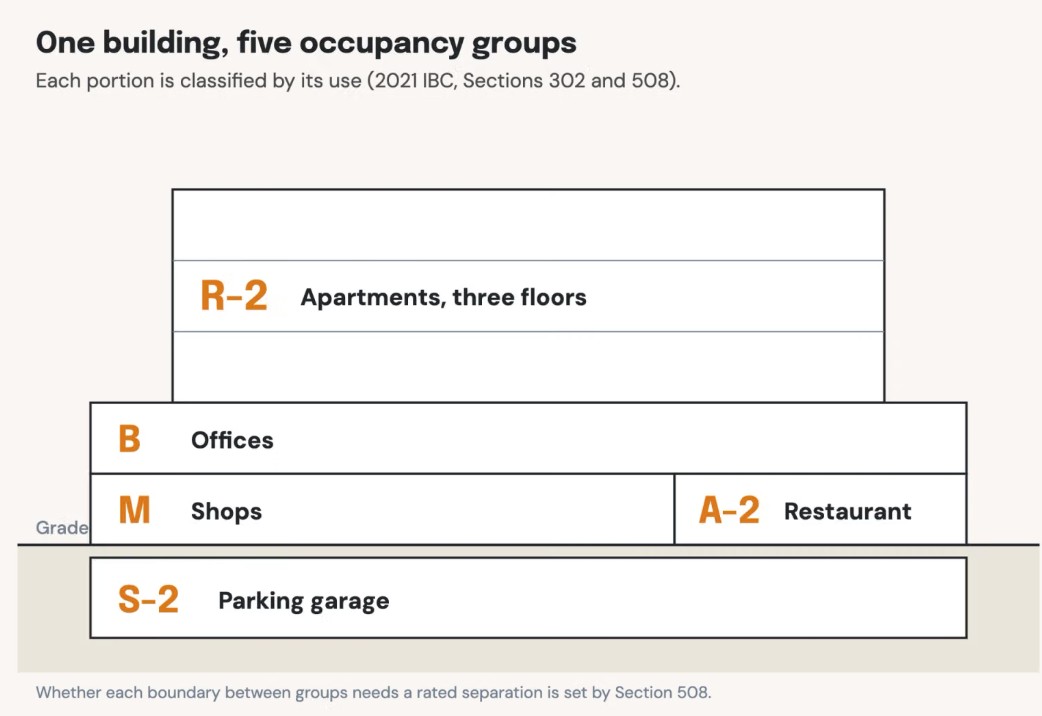
The IBC divides buildings into 10 occupancy groups: Assembly, Business, Educational, Factory, High-hazard, Institutional, Mercantile, Residential, Storage, and Utility. Each classification establishes requirements for building height, floor area, fire protection, plumbing fixtures, and emergency exits.

Classifying mixed-use buildings presents additional challenges. Architects must determine whether spaces qualify as accessory, nonseparated, or separated occupancies. These decisions affect fire barriers, construction costs, and allowable building dimensions.

Common errors arise when building functions change during design. For example, converting a conference room into a larger training facility may increase occupant loads and require additional exits. Similarly, accessory spaces exceeding 10% of a floor’s area may trigger different occupancy requirements.

Pirros addresses these challenges through its AI-powered Quality Management System, which reviews Revit models and drawing sets against applicable building codes, including the IBC. The system identifies potential violations, references relevant code sections, and highlights affected drawing locations. Architects retain responsibility for reviewing and approving findings.

The company’s AI agent, Mira for Revit, also automates repetitive documentation updates. For example, it can locate references to outdated building code editions across drawing notes and propose replacements. Before making changes, Mira identifies affected text, requests clarification, and requires user approval.

However, updating code references does not establish compliance with revised regulations. Architects must independently verify whether the applicable requirements have changed.

The article illustrates how AI-assisted quality management can reduce documentation inconsistencies and repetitive work while supporting more reliable building code reviews. By combining automated checks with professional oversight, architects can improve coordination and maintain greater control over evolving design requirements.

Mobile versus Drone LiDAR: Choosing the Right Data for AI-Assisted Extraction

Source: Mach9.
Source: Mach9.


Artificial intelligence is transforming LiDAR data processing by automating the extraction of survey features from point clouds. However, the effectiveness of AI-assisted extraction depends heavily on data quality, sensor positioning, and the scanning method used. Mach9 examines the differences between mobile mapping and drone LiDAR to help surveyors select the appropriate technology.

Mobile LiDAR systems capture detailed information from road level, making them particularly effective for surveying curbs, pavement markings, signs, utility poles, and building facades. Their proximity to roadside features produces dense point clouds, while integrated panoramic imagery improves feature identification. However, data quality decreases farther from the vehicle, and obstacles such as fences and buildings restrict visibility.

Drone LiDAR provides broader coverage by scanning terrain and infrastructure from above. It is particularly useful for large sites, parking lots, subdivisions, and inaccessible areas. Flight altitude, speed, and overlap determine point cloud density. However, its overhead perspective makes capturing vertical surfaces, including curb faces and roadside signs, more difficult.

Mach9 identifies four factors affecting AI extraction quality: point density, viewing angle, physical obstructions, and supporting imagery. Insufficient data can produce incomplete linework, requiring additional manual drafting.

For aerial surveys, Mach9 recommends a minimum density of 400 points per square meter. Its project experience indicates that approximately 650 points per square meter, collected using cross-grid flights, can reveal distinct curb lines.

The company also recommends combining mobile and drone datasets when projects require detailed road features and comprehensive terrain coverage. Processing both datasets within one environment allows technicians to compare point clouds, extract features, and export consistent CAD linework.

Importantly, neither scanning method inherently guarantees superior accuracy. Ground control and positioning workflows remain essential for survey-grade results.

The article emphasizes that successful AI-assisted extraction begins with capture planning. Selecting the appropriate LiDAR method can improve automated drafting quality, reduce manual corrections, and produce more reliable engineering deliverables.

Claude and SolidWorks versus Leo AI: Beyond CAD Automation

Source: Leo AI.
Source: Leo AI.


Connecting AI chatbots such as Claude or ChatGPT to SolidWorks can automate CAD commands, but does this translate into meaningful engineering productivity? Leo AI argues that executing modeling operations represents only a fraction of the product development process.

Leo AI cofounder and CEO Maor Farid compares general-purpose chatbots connected to CAD software with specialized AI platforms designed for mechanical engineering.

Using Model Context Protocol (MCP) plugins, chatbots can perform operations such as sketching, extruding, and applying fillets. However, Farid argues that these integrations lack sufficient understanding of geometry, engineering standards, company-specific requirements, and manufacturing constraints.

Leo AI takes a broader approach through its Large Mechanical Model, reportedly trained on more than one billion CAD assemblies. The platform incorporates engineering guidelines, previous projects, component libraries, and industry standards to support workflows extending from initial requirements to manufacturing-ready assemblies.

Its capabilities include engineering calculations, component selection, CAD modeling, design reviews, and manufacturing preparation. Manufacturing drawing generation and finite element analysis are undergoing testing, with broader availability planned.

The company cites deployments involving Scania, Nvidia, BMW, Bosch, and U.S. military engineering teams. According to customer testimonials, Leo identified a design error in one minute that five engineers had overlooked. Another engineering team reportedly reduced three weeks of analysis to 30 minutes.

Data security is another differentiator. Leo AI reports SOC 2 Type II certification, isolated customer environments, and policies preventing customer information from being used for model training.

Farid maintains that AI adoption should prioritize measurable engineering outcomes rather than faster CAD interactions. However, the comparison reflects Leo AI’s commercial perspective, and its performance claims require independent validation.

The article highlights an emerging distinction in engineering AI: automating software commands versus supporting the broader technical decisions required to develop reliable, manufacturable products.

0FansLike
0FollowersFollow
0SubscribersSubscribe
Google search engine

Recent Articles

Trending Now