Siemens, Bosch Introduce Automated NVH Testing Solution
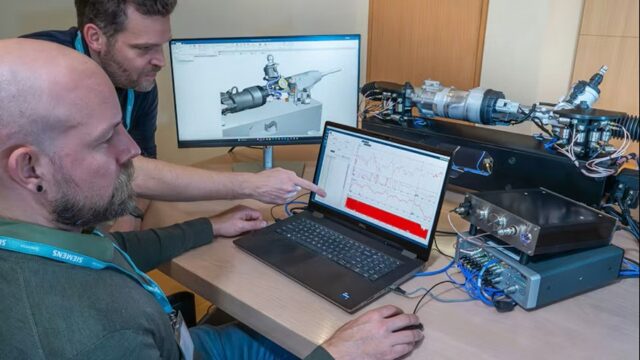
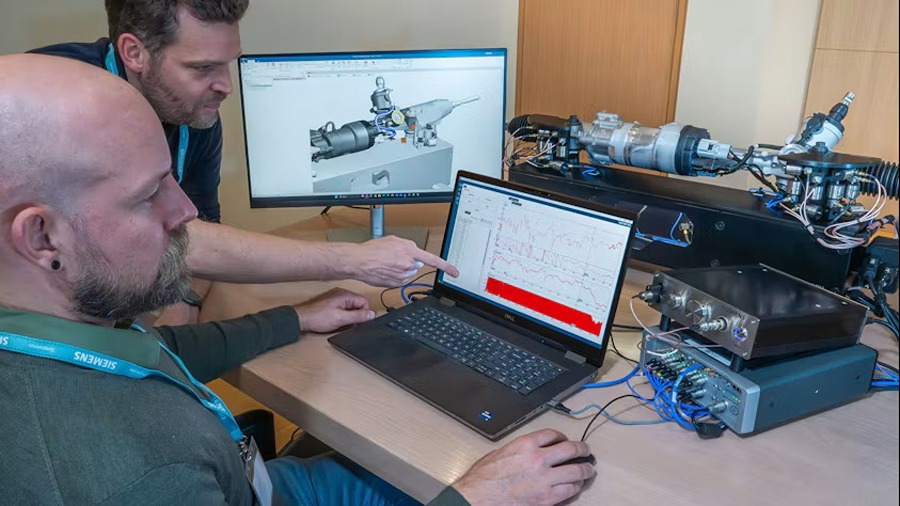
Automated component model extraction is an integrated hardware-and-software solution that automatically extracts ISO 20270-compliant component models for virtual NVH development. (Image: Siemens)

PLANO, TX, Nov 9, 2026 – Siemens has introduced an automated component model extraction solution that reduces noise, vibration and harshness (NVH) characterization of mechanical components. Developed with Bosch, the system combines automated testing hardware and software to perform blocked force extraction in accordance with ISO 20270 and generate component models for virtual prototyping.

The solution automates measurement and data processing, replacing manual procedures. The controlled, operator-independent workflow improves measurement consistency and produces simulation-ready models that engineers can reuse across multiple system variants.

The solution builds on Bosch’s predictiveVIA technology, with Siemens providing what it describes as the only industrialized implementation. It integrates automated test benches with dedicated software to characterize components and generate models for NVH prediction through virtual prototyping.
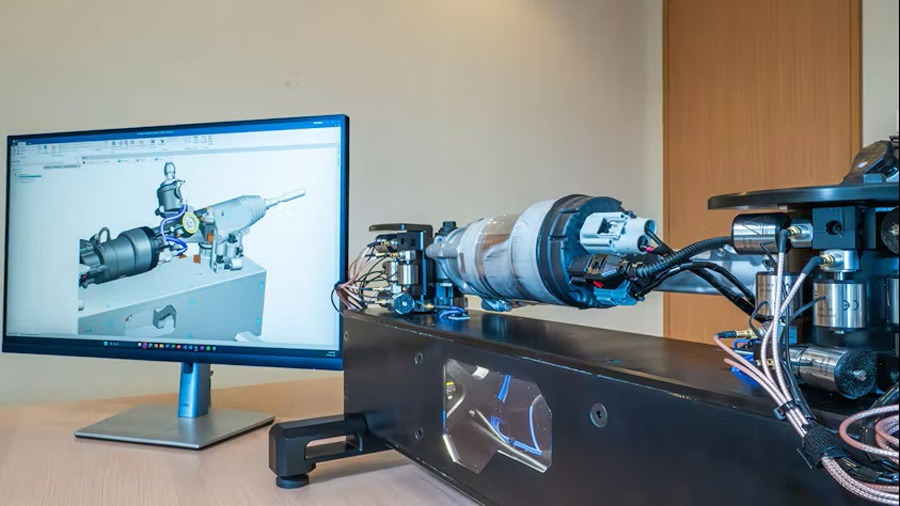
Automated component model extraction uses a self-measuring fixture where rigid virtual-point adapters carry a permanently mounted set of shakers and accelerometers, an automation control unit wired through an amplifier and a Simcenter SCADAS frontend to a laptop running Simcenter Testlab. (Image: Siemens)

“Automated component model extraction helps customers turn a complex, expert-driven process into a scalable engineering capability,” said Sam Mahalingam, executive vice president and head of simulation software, Siemens. “By combining automated testing with simulation-ready workflows and high-quality noise and vibration data, engineers can shift their focus from collecting data to gaining insights from it, enabling greater confidence in NVH performance earlier in development.”

“Automated component model extraction brings the speed, precision, and consistency needed to industrialize blocked force testing,” said Christian Sperrle, director – product management; “Vehicle Motion” division, Bosch USA. “By enabling automated, repeatable measurements across global test facilities, it provides suppliers and OEMs with a common data foundation for digital NVH engineering. The result is faster decision making, more reliable virtual development, and a cost-effective path to large-scale blocked force testing that is independent of individual user expertise.”
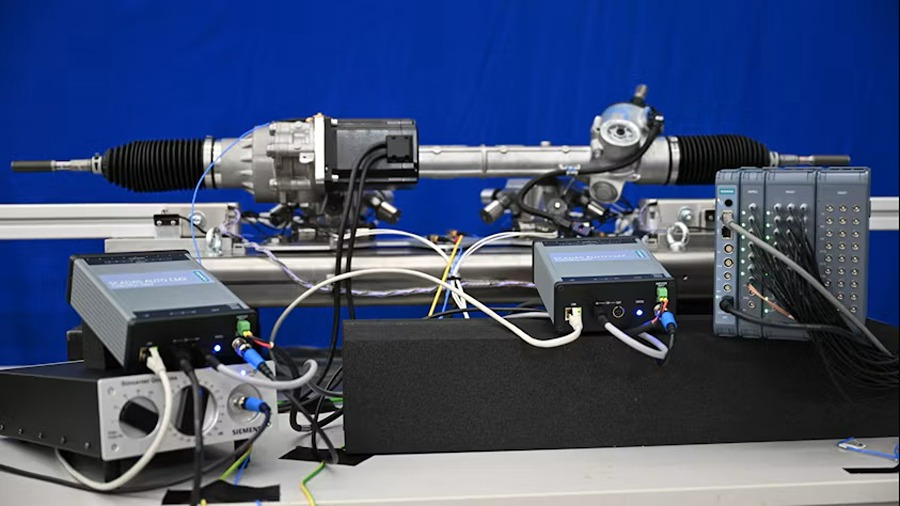
As all instrumentation lives on the fixture, nothing is attached to the component under test. Swapping a part means unbolting the previous unit and bolting on the next, enabling genuine batch throughput. (Image: Siemens)

Siemens reports that the automated process reduces frequency response function (FRF) measurement time by 93% compared with conventional methods. It also claims 100% accuracy and repeatability across component variants. The measurement data supports earlier system validation using digital twins. This approach can reduce dependence on physical prototypes and shorten product development cycles.

The automated component model extraction solution is part of Siemens’ Simcenter physical testing portfolio. It combines Simcenter Testlab software, Simcenter SCADAS hardware and Simcenter for Qsources hardware.

The system supports both test-based and computer-aided engineering (CAE)-based representations of mechanical components, including electric motors, pumps, compressors, steering systems and actuators. Engineers can use these models to predict NVH behavior during virtual system integration.

Source: Siemens

About Siemens Digital Industries Software

Siemens Digital Industries Software, a business unit of Siemens AG, provides industrial software, hardware and related services through the Siemens Xcelerator platform. The company’s portfolio includes product lifecycle management, electronic design automation, simulation and digital twin tools, manufacturing operations management and low-code application development. These products support design, engineering and production workflows across sectors such as aerospace and defense, automotive, electronics and semiconductors, machinery, medical devices and process manufacturing. Siemens Digital Industries Software traces its origins to 1963 as United Computing, later becoming Siemens PLM Software in 2007 before adopting its current name. It supplies technologies that help organizations manage product, process data, and improve development and manufacturing efficiency across a range of industrial applications.
Nvidia-Backed MetAI Uses Digital Twins to Accelerate Chip Factory Construction

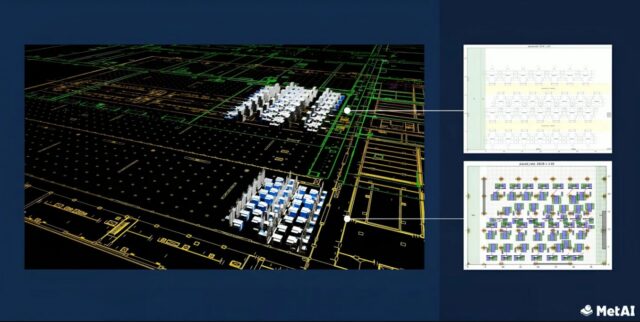
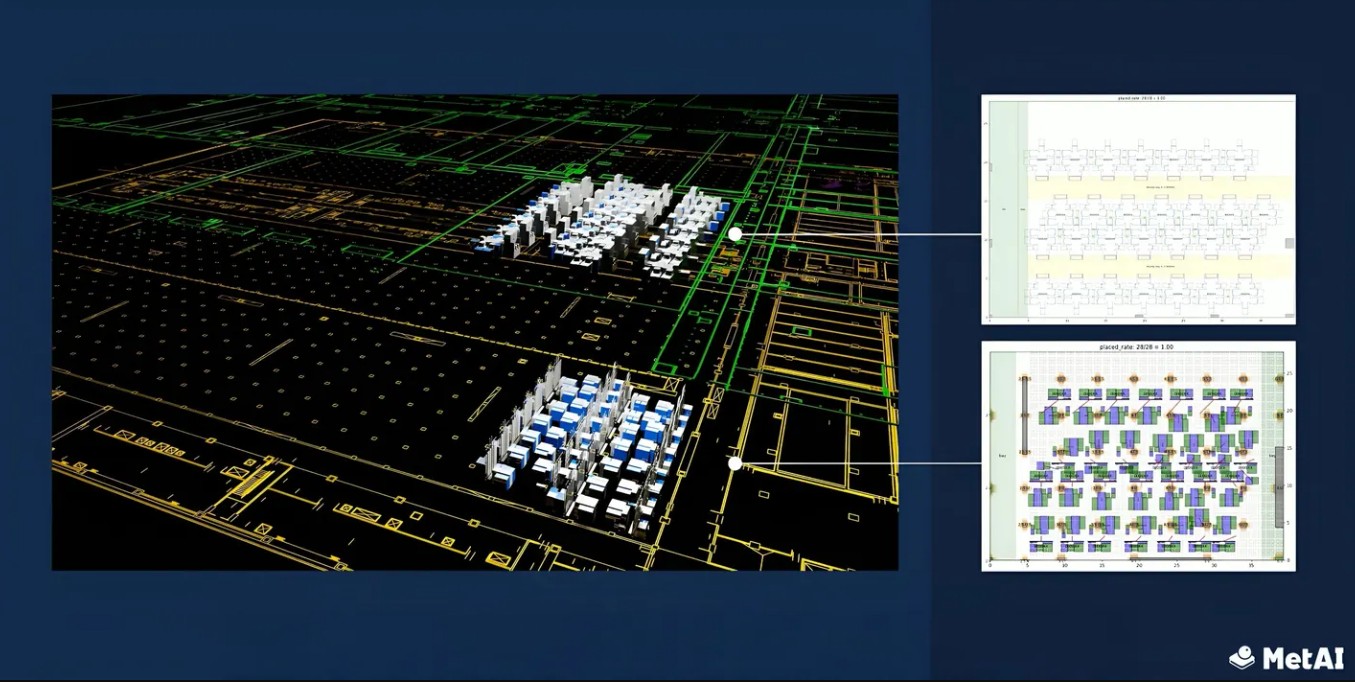
MetAI’s MetGen digital twin platform (source: MetAI).


Taiwanese startup MetAI Technology is helping semiconductor manufacturers accelerate factory construction and reduce engineering costs through AI-powered digital twin technology. Backed by Nvidia, the company develops software that generates detailed virtual replicas of semiconductor fabrication plants, enabling engineers to identify design problems before construction begins, tells this Forbes article  .

Founded in 2023 by Daniel Yu and Renton Hsu, MetAI has attracted major customers, including Taiwan Semiconductor Manufacturing Company (TSMC) and Micron Technology. Its MetGen software converts engineering blueprints and equipment specifications into three-dimensional digital twins, reportedly completing simulations in under five minutes. Comparable work traditionally requires thousands of engineering hours.

The software integrates with Nvidia Omniverse, allowing engineers to simulate factory layouts, equipment configurations, and operating conditions. It automatically identifies objects and assigns physical properties, reducing the manual effort involved in preparing simulations. These virtual environments can also train AI-powered robots before deployment in physical facilities.

TSMC uses MetAI technology to model utility and piping systems for semiconductor factories in Taiwan and the United States. Micron employs the software to generate three-dimensional layouts for its expanding manufacturing operations.

MetAI is also targeting AI data centers, where complex cooling infrastructure demands precise engineering. Cooler Master uses its technology to generate digital twins of liquid cooling systems, allowing engineers to revise piping arrangements and equipment placements quickly when project requirements change.

The financial implications are substantial. Semiconductor factories can cost more than $20 billion, making construction delays and design errors extremely expensive.

Following a $4 million seed funding round in January 2025, MetAI is raising $25 million to support expansion. The company plans to establish a U.S. sales office in 2027.

MetAI ultimately aims to develop standardized digital twin platforms for semiconductor factories and AI data centers. Its approach demonstrates how industry-specific AI can accelerate engineering workflows, improve design accuracy, and reduce risks in increasingly complex industrial construction projects.

Mastercam 2027 Wins Gold Globee Award

Image: Mastercam
Image: Mastercam

TOLLAND, CT, Nov 9, 2026 – Mastercam 2027 has been named a Gold Globee winner and awarded Best of Category in the Manufacturing, Industrial or Industry 4.0 Product or service category at the Globee Awards.

The award recognizes Mastercam’s work in computer-aided manufacturing (CAM) software, including AI-assisted programming, intelligent automation, connected workflows and advanced simulation capabilities.

Recent developments include Mastercam Copilot, Mastercam EverPath Technology and enhancements introduced in Mastercam 2027. These technologies help manufacturers improve productivity, streamline workflows and reduce programming complexity.

“Receiving this recognition from the Globee Awards is a testament to our commitment to helping manufacturers work smarter and more efficiently,” said Russ Bukowski, president of Mastercam. “By integrating AI-assisted programming, intelligent automation, and advanced simulation directly into the manufacturing workflow, we are empowering manufacturers to navigate increasing complexity while maximizing productivity and process reliability.”

Mastercam has supported manufacturers for more than 40 years. Its software serves the aerospace, automotive, medical device and heavy industries, helping manufacturers accelerate programming, and support engineering changes.

Source: Mastercam

About Mastercam

Mastercam is a computer-aided design and manufacturing (CAD/CAM) software solution headquartered in Tolland, CT. Founded in 1983, the company has over 40 years of experience in providing advanced software tools for designers and NC programmers across various industries, including aerospace, automotive, and consumer products. Mastercam offers a comprehensive suite of applications such as 2- through 5-axis milling, turning, wire EDM, router programming, plasma cutting, laser cutting, and 3D design and drafting. The company employs approximately 500 individuals. Mastercam is recognized as one of the widely used CAM software packages worldwide, with over 250,000 installations.


World Models Bring AI Closer to Understanding the Physical World

Source: Jacqui VanLiew; Getty Images


Artificial intelligence is moving beyond text-based interactions toward understanding and simulating the physical world. World models, an emerging category of AI technology, create realistic three-dimensional environments that allow machines to predict movement, understand physical relationships, and practice tasks before operating in real-world conditions, tells Wired.com (full article available to subscribers).

Unlike large language models, which predict sequences of words, world models use visual information to anticipate changes in their surroundings. These systems incorporate physics, cause and effect, and interactions between objects, people, and environments, making them valuable for robotics and autonomous transportation.

Niantic Spatial, which emerged from the company behind Pokémon Go, is developing world models using extensive geospatial data collected through augmented reality applications. Its technology could enable robots to train within digital replicas of actual environments, potentially completing millions of simulated exercises without physical movement.
Autonomous vehicle developer Wayve is applying similar technology to driving. Using dashcam footage, its generative world models recreate hazardous road conditions and unpredictable traffic situations that would be difficult or dangerous to reproduce during physical testing. This approach helps autonomous systems improve their responses to unfamiliar scenarios.

World models also have applications in video game development, where realistic physics and interactive environments are essential. Companies including Tencent and Google are investing in the technology, while researchers such as Yann LeCun and Fei-Fei Li have attracted substantial attention to the field.

Developing these systems requires enormous quantities of visual training data. Companies increasingly employ individuals to record everyday activities, including household chores, providing examples of human movement and object manipulation.

As world models advance, they could become fundamental to domestic robotics, autonomous transportation, and interactive digital environments. Their broader significance lies in enabling AI systems to understand physical consequences rather than simply recognize patterns, bringing machines closer to operating independently in complex environments.

Rapid Fusion Installs Zeus Robotic Cell at Kingston University

Image: Rapid Fusion
Image: Rapid Fusion

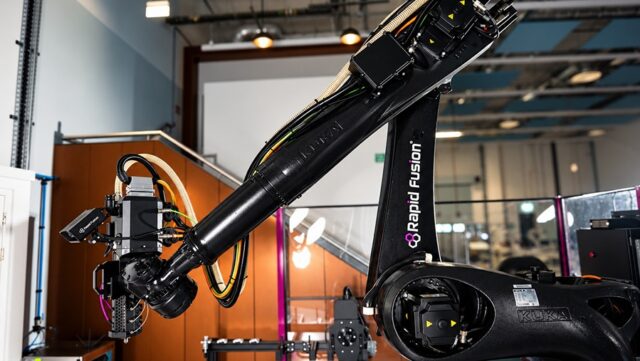
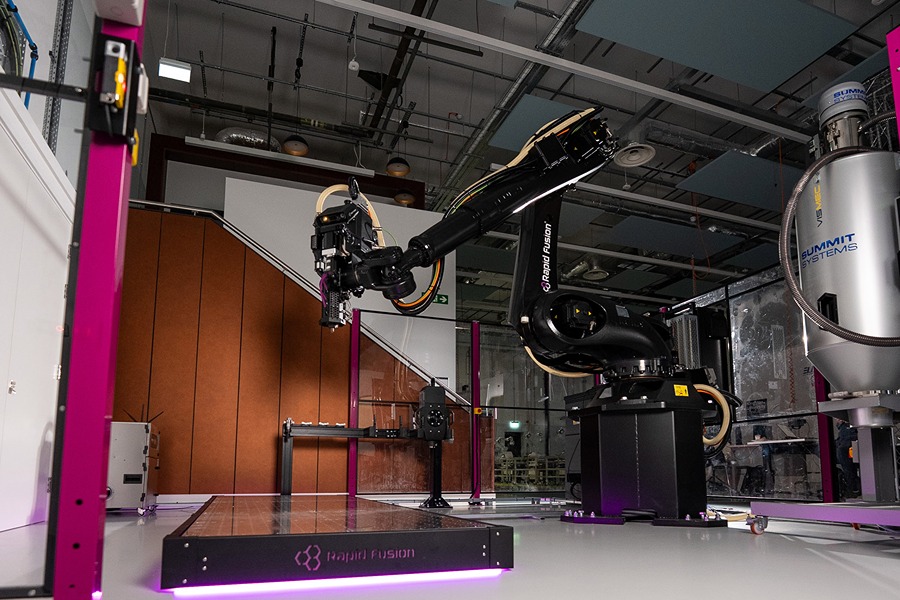
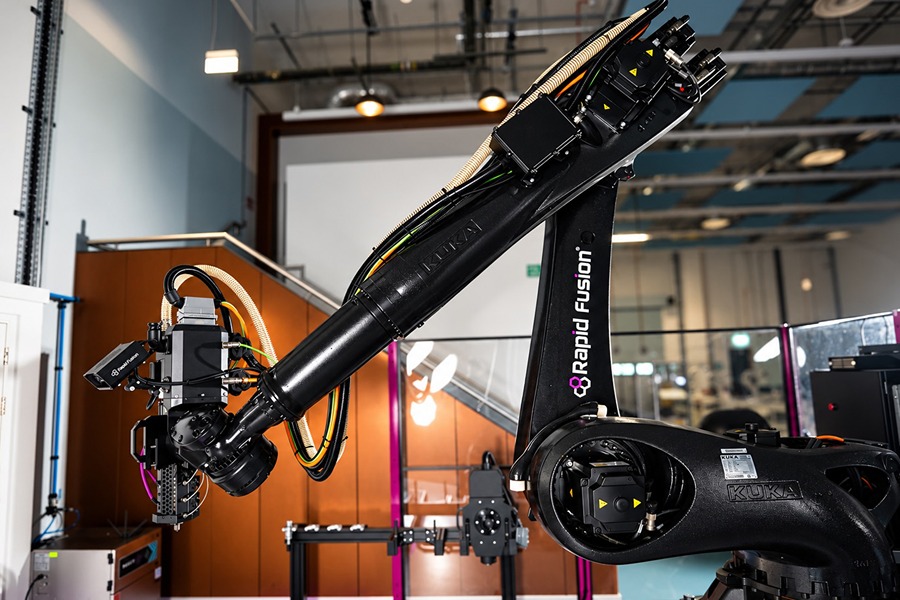
Rapid Fusion has installed a £450,000 Zeus Robotic Cell at Kingston University’s Faculty of Engineering, Computing and the Environment. Located at the university’s Roehampton Vale campus, the modular system combines large-format additive manufacturing (LFAM), industrial scanning and computer numerical control (CNC) milling, allowing researchers and industrial partners to print, scan and machine components within a single manufacturing platform.

The system supports prototyping and low-volume production of complex components. Rapid Fusion says integrating additive and subtractive processes can reduce outsourcing, streamline production workflows and improve quality.

Zeus incorporates an industrial scanning camera from Zivid and AI-driven CAD/CAM robot programming software from Ency. The system scans custom parts or molds and uses the resulting data to generate machining toolpaths with less manual input.

“This is a real show of intent from our partners at the university and gives them access to one of the most advanced LFAM robots in the world,” explained Jake Hand, CEO of Rapid Fusion.

“Zeus will provide staff, partners and grads with the opportunity to ‘print, scan and mill’ in one solution, removing a whole host of secondary ‘ops’ and, importantly, guaranteeing exacting tolerances as you are removing manually inputting the CNC toolpath.”

He continued: “This is the first time we’ve put this system into a university, but this is just the start. There’s a real skills gap in the UK for robotics and 3D printing experts, so need to do our bit to train budding engineers on equipment and tech that is going to be used in the world real now and during the next ten years.”

“This is what we’re doing with Kingston. As well as installing and training staff on the cell, we are also looking at how our technical experts can work with education professionals to shape the curriculum and maximize what learners can do with the solution.”

“It’s not just about developing people we can employ at Rapid Fusion. We’re doing this for advanced manufacturing as a whole – there’s lot of opportunity, but we need the right skills to go alongside the pioneering tech.”

Kingston University will also use Zeus to train undergraduate and postgraduate engineering students in additive manufacturing and robotic machining. Rapid Fusion has committed to offering work placements, exploring Knowledge Transfer Partnership (KTP) opportunities and contributing technical expertise to future curriculum development.

Image: Rapid Fusion

Rapid Fusion has developed LFAM robotic systems for about five years. Its existing products include Apollo, Medusa and Cerberus, a containerized manufacturing system to produce components in remote locations.

Lesley Stigling, operations manager at Kingston University said: “We are always exploring the latest technology and how it can add value to our industrial, research and educational offer.”

“One of our graduates, Raghav, went to work with Rapid Fusion and insisted we meet. That quickly led to us acquiring the Zeus system, which gives us a competitive edge in large-format additive manufacturing and machining.”

“I fully expect it will help us attract new research projects and cement existing relationships with industrial partners who are keen to push the boundaries of innovation and performance.”

Stigling concluded: “This equipment will also help drive our efforts to future-proof the faculty. Our undergraduates and postgraduates will learn on this state-of-the-art robot, giving them the hands-on experience and skills that employers want, and a head start in the graduate job market.”

Source: Rapid Fusion

About Rapid Fusion

Rapid Fusion, established in 2023 and based in Exeter, UK, develops large-format additive manufacturing (LFAM) systems for polymer-based applications. Its product portfolio includes pellet extrusion hardware and robotic 3D printing systems such as Apollo, Medusa, and Zeus, which are designed for high-speed, high-temperature printing. These solutions are used in aerospace, automotive, construction, marine, energy, and design sectors. The company manufactures its equipment in the UK and operates a 5,000-square-foot demonstration facility at Skypark for product trials and customer engagement. The company has received support from Innovate UK to expand its product capabilities and market reach. Its technology focuses on scalable, efficient production of large polymer parts using pellet-based 3D printing integrated with industrial robotics.
Supermicro Introduce KV Cache Storage for AI Inference

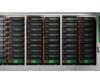
Image: Super Micro Computer

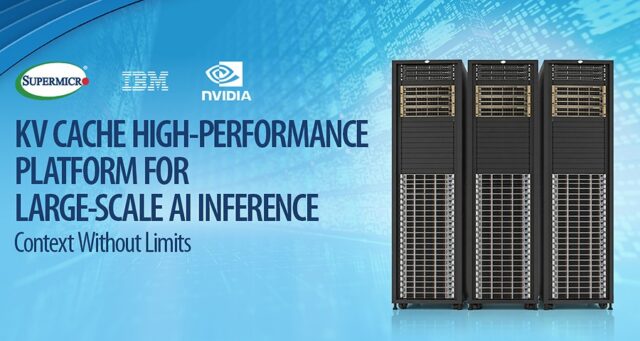
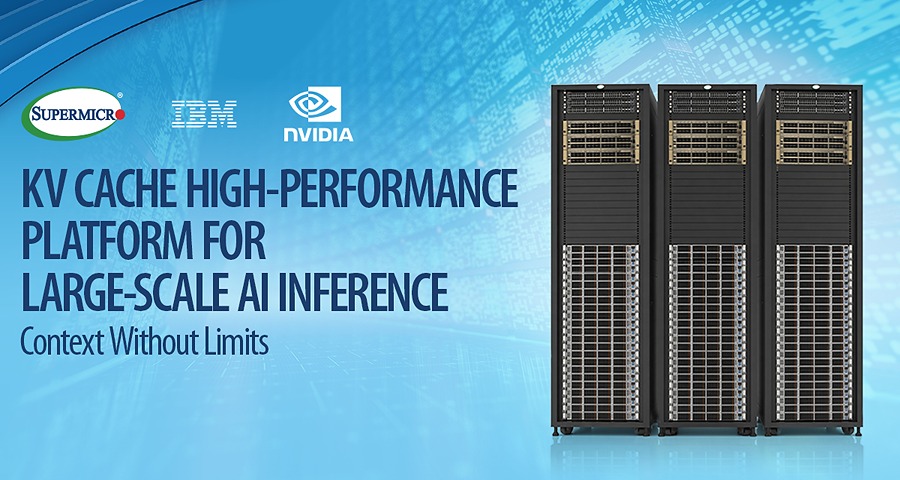
SAN JOSE, CA, Nov 9, 2026 – Supermicro has announced a new key-value (KV) cache storage solution developed with IBM and NVIDIA to reduce redundant computation during AI inference. The architecture combines Supermicro Petascale all-flash storage servers using AMD EPYC 9005 series (“Turin”) processors, IBM storage scale software, NVIDIA Dynamo and NVIDIA Spectrum-X ethernet networking.

“As AI workloads expand from training to inference, enterprises and neoclouds deploying high-throughput inference workloads characteristic of agentic AI and long-context, multi-turn generative AI need to remove bottlenecks to improve GPU efficiency,” said Charles Liang, president and CEO of Supermicro. “Our solution with IBM and NVIDIA clearly demonstrates these performance benefits.”

Persistent KV Cache for AI Inference

During AI inference, LLMs generate key-value states that can be reused across subsequent requests. The solution stores these states in shared network storage, allowing GPU nodes and clusters to access previously processed context without repeating computations. According to Supermicro, this approach can improve GPU utilization and inference throughput while supporting availability and nondisruptive cache expansion.

Performance Testing and Deployment

In joint testing by Supermicro and NVIDIA using a 120-billion-parameter LLM, persistent KV caching delivered up to 56 times faster time to first token (TTFT) with 130,000-token prompts. As input length increased from 30,000 to 130,000 tokens, TTFT increased by 0.377 seconds with persistent KV caching, compared with 29.55 seconds without it.

“Enterprises need a fundamentally better way to scale AI inference. Together, IBM, Supermicro, and NVIDIA are delivering a high-performance, resilient KV cache solution that helps customers maximize their GPU investments, scale independently of compute, and significantly improve infrastructure efficiency,” said Sam Werner, GM, IBM Storage. “This collaboration represents an important step toward making enterprise AI inference more scalable, reliable, and cost-effective.”

“Agentic AI and long-context applications depend on reusing context efficiently across many steps, and NVIDIA Dynamo helps orchestrate distributed inference so enterprises can get more usable throughput from every GPU,” said Shruti Koparkar, NVIDIA AI Inference product lead. “By pairing NVIDIA Dynamo and Spectrum-X Ethernet with Supermicro Petascale storage servers and IBM Storage Scale, this KV cache solution creates a high-performance shared storage tier that can reduce redundant computation, improve time-to-first-token and help customers scale resilient AI inference services.”

Source: Super Micro

About Super Micro Computer

Super Micro Computer is a U.S. technology company founded in 1993 and headquartered in San Jose, CA. It designs and manufactures server and storage systems, networking devices and server management software. The company also develops components such as motherboards, power systems and chassis used in its hardware platforms. Supermicro provides products for enterprise data centers, cloud computing, AI, telecommunications and edge computing environments. Its portfolio includes servers, AI systems, storage platforms, IoT systems, switches and related support services. The company designs and manufactures products in facilities in the United States, Taiwan and the Netherlands. Its systems support a range of processors, memory configurations, GPUs, storage and networking options, along with air and liquid cooling methods. Supermicro serves global customers across enterprise and service provider markets. The company employs about 5,000 people worldwide.

AI and Robotics Are Reshaping American Manufacturing

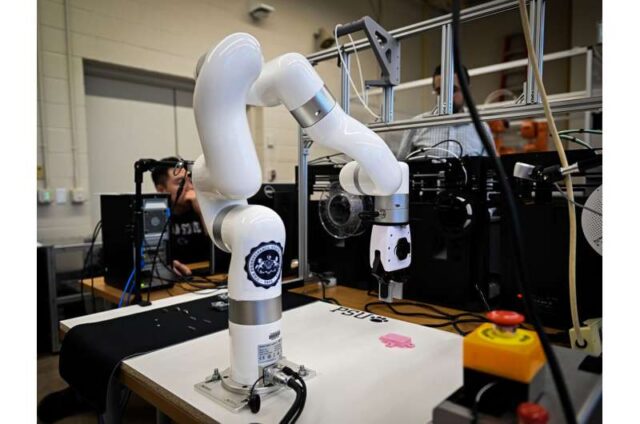
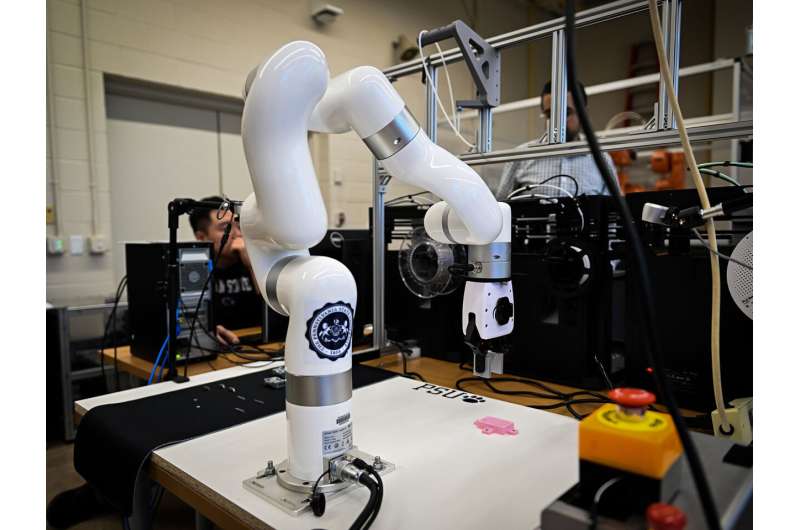
Technological innovations, like advanced robotics and AI, are fundamentally changing the way factories are managed and operated (source: Poornima Tomy/Penn State).


Artificial intelligence and robotics are transforming American manufacturing by improving production efficiency, workplace safety, and operational flexibility. Growing investments in advanced manufacturing are accelerating research into intelligent robots, simulation technologies, and automated production systems.

In an interview published by Tech Xplore, Ilya Kovalenko, assistant professor of mechanical engineering and industrial and manufacturing engineering at Pennsylvania State University, discusses the technological developments shaping the industry.

One major driver is the push to bring manufacturing operations back to the United States. Supply chain disruptions during the COVID-19 pandemic exposed the risks of relying heavily on overseas production. Consequently, manufacturers are investing in automation to strengthen domestic capabilities, particularly among smaller businesses struggling with labor shortages and increasing demand.

AI-powered robots can handle repetitive, hazardous, and physically demanding tasks, reducing workplace risks while improving productivity. More importantly, intelligent automation enables manufacturing systems to adjust dynamically to changing production requirements.

Kovalenko emphasizes the importance of flexible and reconfigurable production environments. AI and smart robotics can help factories respond to changing customer specifications, optimize operations, and improve resource utilization.

Emerging applications include humanoid robots, large-scale additive manufacturing, advanced semiconductor fabrication, and modernized foundry operations. These technologies could support more efficient production across multiple industrial sectors.

Workforce development remains equally important. Universities such as Penn State are preparing future engineers through hands-on training, interdisciplinary research, and practical experience with advanced manufacturing equipment.

Looking ahead, Kovalenko envisions manufacturing systems capable of adapting automatically to external conditions, including weather changes, energy availability, and evolving customer requirements. Such capabilities could reduce material waste and electricity consumption.

He also anticipates manufacturing extending beyond traditional factory environments, potentially enabling production activities during transportation.

The article highlights a shift toward intelligent, adaptable manufacturing systems where AI, robotics, and skilled workers collectively improve industrial resilience, sustainability, and competitiveness.

Bentley Emphasizes Human Accountability in AI-Driven Engineering

Source: Bentley.
Source: Bentley.


Artificial intelligence is moving beyond answering questions to performing tasks independently, raising important questions about trust, governance, and accountability. Bentley Systems believes that human engineers must remain responsible for critical decisions, particularly when public safety and infrastructure integrity are involved.

In an article reflecting on the Financial Times Future of AI Summit in London, Nathan Marsh, Bentley’s senior vice president for EMEA, discusses the changing relationship between AI autonomy and human judgment. The panel included representatives from NiCE Cogni, Mastercard, and Adaption, highlighting AI applications across customer service, financial transactions, and infrastructure engineering.

While AI agents increasingly resolve customer issues and execute authorized transactions, engineering presents different challenges. Bentley uses AI to automate routine activities, improve software interactions, and explore design alternatives. However, Marsh emphasizes that decisions affecting structural integrity and public safety must remain under professional supervision.

A central theme is the importance of industry-specific context. Reliable AI recommendations require access to engineering standards, site conditions, historical design decisions, construction modifications, and maintenance records. Without this information, AI may produce technically plausible recommendations that overlook critical project constraints.

Bentley advocates connecting fragmented engineering information through shared data schemas that preserve institutional knowledge. This approach helps AI systems understand infrastructure assets throughout their lifecycles.

Another priority is AI literacy. Engineers must learn to evaluate AI-generated recommendations, recognize limitations, and apply systems thinking and critical judgment rather than accepting automated outputs unquestioningly.

AI adoption is already accelerating across infrastructure projects. Bentley reports that nearly 70% of finalists and more than one-quarter of submissions to its recent Year in Infrastructure Awards incorporated AI.

The article reinforces Bentley’s position that successful engineering automation depends on combining machine capabilities with professional expertise. AI can improve efficiency and expand design possibilities, but engineers must retain authority over consequential decisions and remain accountable for their outcomes.

Autom8Labs Introduces 22 Free AI Agent Skills for AEC Software

Source: AEC Magazine.


Autom8Labs has introduced 22 free Model Context Protocol (MCP) Skills designed to help AI agents perform specialized tasks across architecture, engineering, and construction (AEC) software. The release aims to bridge the gap between giving AI agents access to design applications and teaching them to execute professional workflows correctly, tells AEC Magazine.

The new skills work alongside Autom8Labs’ MCP Connectors, which provide AI agents with access to Revit, AutoCAD, Navisworks, Grasshopper, MicroStation, 3ds Max, Rhino, Civil 3D, and Advance Steel. While connectors enable interaction with these applications, MCP Skills provide structured instructions for completing tasks and verifying results.

According to Autom8Labs, access to design software alone does not guarantee that an AI agent understands established engineering practices. The skills address this limitation by guiding agents through procedures similar to those followed by experienced AEC professionals.

Most of the 22 skills focus on Autodesk Revit, covering family creation, scan-to-BIM workflows, model health assessments, structural engineering, mechanical, electrical, and plumbing (MEP) systems, coordination, site management, and document control. These capabilities are intended to help AI agents approach complex BIM tasks systematically.

For computational design, a Grasshopper skill guides AI agents in developing parametric definitions using methods familiar to experienced computational designers. Meanwhile, 3ds Max skills support visualization workflows by helping agents configure Corona and V-Ray rendering environments according to professional practices.

Autom8Labs also offers custom skill development for AEC firms. These tailored solutions can incorporate company-specific templates, design standards, and approval procedures, allowing organizations to align AI-assisted workflows with their established requirements.

The release highlights an important development in AEC automation: AI agents need more than software connectivity to become useful engineering assistants. By combining application access with procedural knowledge and verification steps, Autom8Labs aims to make AI-driven design workflows more consistent, accountable, and aligned with professional expectations.

Kenyan Startup Brings AI to Small Businesses Through Mobile Money

Salon owner Peter Chege says Fastagger’s AI tool has helped him identify customer trends (source: Afrikanna Production/Microsoft).


Kenyan startup Fastagger is making artificial intelligence accessible to small businesses by developing AI systems that work on inexpensive smartphones and unreliable internet connections. Its approach addresses technological limitations that often prevent businesses in developing economies from adopting advanced digital tools, tells IEEE Spectrum.

Founded by Mutembei Kariuki, Jude Mwenda, and Stephanie Njerenga, Fastagger focuses on practical AI applications tailored to African markets. Its flagship product, Auni, launched in 2024 and was integrated into M-Pesa, Kenya’s leading mobile money platform. Approximately 6,000 businesses have signed up to use the AI-powered business intelligence assistant.

Auni analyzes mobile payment transactions to identify customer behavior, sales patterns, and marketing opportunities. For example, Nairobi salon owner Peter Chege uses the application to identify peak business hours, recognize loyal customers, and improve staffing decisions. Restaurants can similarly identify frequent customers and offer personalized discounts without manually reviewing transaction records.

A key technical innovation involves adapting optical character recognition (OCR) technology to extract information from poorly formatted financial statements. Fastagger combines OCR with small neural networks to organize transaction data into structured formats. Several functions, including document processing, data analysis, and visualization, operate offline on low-cost devices. More advanced analysis and conversational features still require internet connectivity.

The startup is also expanding beyond retail businesses. Its workforce management solution uses SMS-based AI agents to monitor security guards working in remote locations, detect unusual activity, and generate operational alerts.

Despite receiving support from Google, Microsoft, and Nvidia accelerator programs, Fastagger operates with just three employees. The company is developing additional AI agents capable of automatically executing marketing activities.

Fastagger demonstrates the potential of designing AI around local infrastructure and business requirements rather than adapting technologies developed for wealthier markets. However, experts caution against creating a technological divide where developing economies receive only smaller, less capable AI systems while advanced models remain concentrated in richer regions.

0FansLike
0FollowersFollow
0SubscribersSubscribe
Google search engine

Recent Articles

Trending Now